AWID es un organización feminista internacional de membresía, que brinda apoyo a los movimientos que trabajan para lograr la justicia de género y los derechos de las mujeres en todo el mundo.
Confrontando al extractivismo y al poder corporativo
Defensoras de derechos humanos de todo el planeta defienden sus tierras, medios de subsistencia y sus comunidades ante las industrias extractivas y el poder corporativo. Ellas hacen frente a fuertes intereses económicos y políticos que promueven el robo de tierras, el desplazamiento de comunidades, la pérdida de los medios de subsistencia y la degradación del medioambiente.
¿Por qué resistir a las industrias extractivas?
El extractivismo es un modelo económico y político de desarrollo que mercantiliza la naturaleza y prioriza la ganancia por sobre los derechos humanos y el medioambiente. Arraigado en la historia colonial, refuerza las desigualdades sociales y económicas tanto a nivel local como global. Muchas veces, las mujeres negras, rurales e indígenas son las más afectadas por el extractivismo, y además son notablemente excluidas de la toma de decisiones. Desafiando estas fuerzas patriarcales y neocoloniales, las mujeres se alzan en defensa de los derechos, las tierras, las personas y la naturaleza.
Riegos críticos y violencia específica de género
Las defensoras que enfrentan a las industrias extractivas, experimentan una diversidad de riesgos, amenazas y violaciones, incluidas la criminalización, la estigmatización, la violencia y laintimidación. Sus historias dan cuenta de marcados aspectos de violencia sexual y de género. Entre los perpetradores se incluyen autoridades estatales y locales, las corporaciones, la policía, el ejército, las fuerzas paramilitares y de seguridad privada, y en algunos casos, sus propias comunidades.
Actuar juntxs
AWID y la Coalición Internacional de Mujeres Defensoras de Derechos Humanos (WHRDIC por su sigla en inglés) tienen el placer de anunciar «Defensoras de derechos humanos confrontado al extractivismo y al poder corporativo»; un proyecto interregional de investigación que documenta las experiencias vividas por las defensoras de Asia, África y América Latina.
Alentamos a activistas, integrantes de movimientos sociales, la sociedad civil organizada, donantes y responsables de políticas públicas, a leer y utilizar estas producciones para el trabajo de incidencia, con fines educativos y como fuente de inspiración:
AWID reconoce con gratitud las invaluables contribuciones de cada Defensora de Derechos Humanos que ha sido parte de este proyecto. Esta guía ha sido posible gracias su generosidad y apertura al compartir sobre sus experiencias y lecciones. Su coraje, creatividad y resiliencia son una inspiración para todxs nosotrxs. ¡Muchas gracias!
Contenido relacionado
Desejam recolher quantas respostas ao questionário?
O nosso objetivo é alcançar um total de 2000 respostas, quase o dobro do último questionário WITM em 2011.
Nicole Barakat
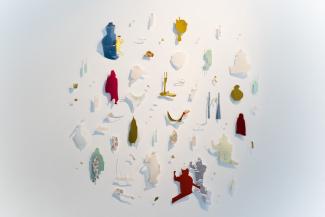
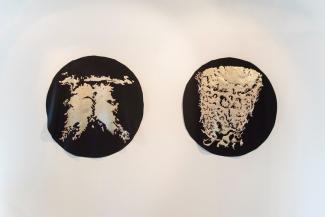
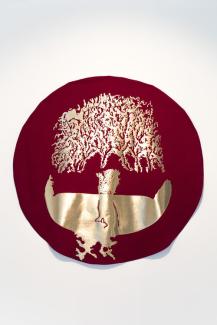
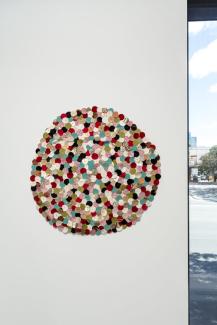
“We transcend time and place” [«Trascendemos el tiempo y el lugar»], papel recuperado cortado a mano (2017)“We will remember who we are and we will persist” [«Recordaremos quiénes somos y persistiremos»], lamé cortado a mano bordado en algodón sobre seda de lana (2018)“We will return home” [«Regresaremos a casa»], lamé cortado a mano bordado en seda sobre terciopelo de algodón (2018)“We will heal in the now” [«Sanaremos en el ahora»], seda cortada a mano, lana, lamé, algodón, impresión digital directa de satén sobre tela de lino (2018)
somos infinitxs
Una exposición de Nicole Barakat que encarna su reconexión con los objetos de la diáspora de sus tierras ancestrales en la región del Sudoeste Asiático y África del Norte (SWANA, por sus siglas en inglés).
Barakat presenta una colección de obras textiles como manifestaciones de su práctica de conectarse con los objetos desplazados, y a menudo robados, que son exhibidos en colecciones de museos occidentales que incluyen el Museo del Louvre de París, el Museo Británico de Londres y el Nicholson Museum de Sydney.
Para burlar a los guardianes y fisurar las vitrinas que retienen estos objetos ancestrales, Barakat recupera formas de conocimiento precoloniales, no lineales y receptivas que son, a menudo, devaluadas y desestimadas por las instituciones coloniales y patriarcales, utilizando la adivinación con la borra del café, el trabajo con los sueños, la escucha intuitiva y las conversaciones con los objetos mismos (fuente).
Sobre Nicole Barakat
Nicole Barakat es una artista femme queer de SWANA, que nació y vive en las tierras de Gadigal (llamadas Sydney) en Australia. Trabaja con procesos intuitivos y de escucha profunda, con la intención de transformar las condiciones de la vida cotidiana. Su obra se desarrolla a través de métodos artísticos no convencionales, creando objetos intrincados que plasman el amor y la paciencia característicos de las prácticas textiles tradicionales.
Sus trabajos incluyen dibujos en papel y en tela cortados y cosidos a mano, esculturas realizadas con su propio cabello, tela y materiales vegetales, así como obras en vivo en las que utiliza su voz como material.
La práctica creativa de Nicole está arraigada en el re-cuerdo y la re-colección de sus conocimientos ancestrales, incluyendo la adivinación con la borra del café y, más recientemente, el trabajo con esencias de plantas y flores para el cuidado y la sanación comunitaria.
Nicole’s creative practice is rooted in re-membering and re-gathering her ancestral knowing, including coffee divination and more recently working with plants and flower essences for community care and healing.
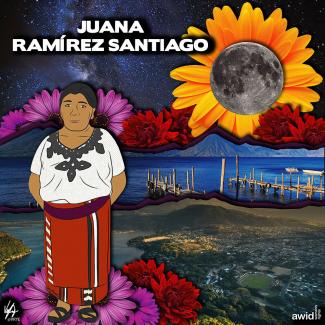
Juana was one of the founders and current Board Member of Red de Mujeres Ixiles de Nebaj, an Indigenous women’s rights organization that is a member of the Mesoamerican Initiative of WHRDs (IM-Defensoras).
She was also a midwife and a mother of 7 children. Juana had received death threats that were reported to the Prosecutor’s office. Juana is the third Indigenous WHRD murdered in the area during 2018. The Guatemala Ombudsman reports that a total of 20 HRDs were killed in the country this year.
Juana Ramírez Santiago was shot dead by unidentified attackers while crossing a bridge in Nebak, Quiché, Guatemala. Investigations to identify the perpetrators are ongoing.
Les tendances antidroits au sein des systèmes régionaux des droits humains
Chapter 6
À la Commission africaine et au Système interaméricain, les antidroits promeuvent les notions essentialistes de culture et de genre pour miner les avancées en matière de droits et décrédibiliser la redevabilité. Les antidroits gagnent en influence dans les systèmes de protection des droits humains régionaux et internationaux.
La Commission africaine des droits de l’Homme et des peuples commence à présenter les droits des femmes et droits sexuels comme mettant en danger sa capacité à adresser les « droits réels » et contraires aux « valeurs africaines », un précédent inquiétant à l’égard des droits. Le retrait de son statut d’observatrice à la Coalition des lesbiennes africaines est un exemple de cette tendance, et traduit la répression de l’engagement féministe panafricaniste.
Au sein de l’Organisation des États américains (OEA) et du Système interaméricain de protection des droits humains, les stratégies antidroits incluent l’ONGisation de groupes religieux, l’adoption d’un langage séculier et la prise de contrôle de cadres discriminatoires. L’influence antidroits a pris plusieurs formes, et notamment l’intimidation d’activistes trans et l’entrave à l’introduction d’un langage progressif dans les résolutions.
Sommaire
Réduire les féministes au silence au sein du Système africain de protection des droits humains
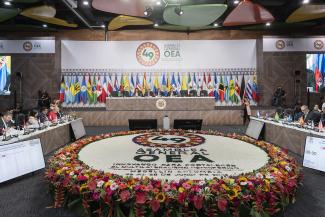
Les groupes antidroits en Amérique latine : l’Assemblée générale de l’Organisation des États américains (OEA) et le Système interaméricain de protection des droits humains
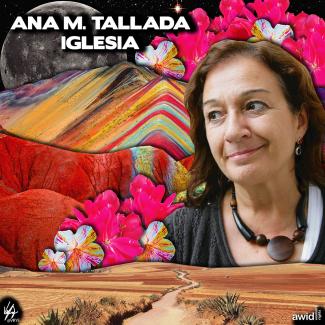
Ana fue una firme defensora de los derechos de las mujeres y trabajó con una amplia diversidad de mujeres, desde aquellas que están redes de base hasta las que son parte del sector privado.
Creía que había que tender puentes entre sectores. Ana fue integrante de la Red Nacional de Promoción de la Mujer (RNPM), y tuvo participación activa en el desarrollo de muchos programas sociales que abordan temas como la salud y los derechos sexuales y reproductivos.
Las Realidades Feministas son una invitación cálida y afectuosa, una suerte de acto de cuidado y preservación colectivo (en oposición al autocuidado), una invitación a atesorar, a hacer inventario de toda la labor realizada para que no desaparezca. (...)
When we are desperate for change, as we are both in illness and insurrection, our language drains of complexity, becomes honed to its barest essentials... As illness and revolution persist, though, the language made in them and about them deepens, lets in more nuance, absorbed in the acutely human experience of encountering one’s limits at the site of the world’s end. Johanna Hedva
When we began scheming for such an issue with Nana Darkoa, ahead of AWID’s Crear | Résister | Transform: a festival for feminist movements!, we departed from a question that is more of an observation of the state of the world – a desire to shift ground: why do our sexualities and pleasures continue to be tamed and criminalized even as we are told, over and over again, that they bring neither value nor progress? We came to the conclusion that when they are embodied, something about our sexualities works against a world order that continues to manifest itself in border controls, vaccine apartheids, settler colonialism, ethnic cleansing, and rampant capitalism. Could we speak, then, of the disruptive potential of our sexualities? Could we still do that when, in order to be resourced, our movements are co-opted and institutionalized.
When our embodied labor becomes profit in the hands of the systems we seek to dismantle, it is no wonder that our sexualities and pleasures are once again relegated to the sidelines – especially when they are not profitable enough. In many instances during the production of this issue, we asked ourselves what would happen if we refused to accommodate the essential services of capitalism. But can we dare ask that question when we are exhausted by the world? Perhaps our sexualities are so easily dismissed because they are not seen as forms of care. Perhaps what we need is to reimagine pleasure as a form of radical care – one that is also anti-capitalist and anti-institutional.
As we enter our second full year of a global pandemic, our approach to transnational embodiments has had to focus on a single political realization: that taking care is a form of embodiment. And because right now so much of our work is being done without consideration for the borders between and within ourselves, we are all Transnationally Embodied – and we are all failing. We are failing to take care of ourselves and more critically, to take care of each other.
This failure is not of our own making.
Many of our parents thought of labor as transactional, something to be given in exchange for compensation and a guarantee of care. And while that exchange was not always honored, our parents did not expect that their work would provide them fulfillment. They had their leisure, their hobbies, and their communities for that. Today, we their children, who have been conditioned to think of our labor as intertwined with our passion, have no such expectations. We think of work and leisure as one and the same. For too many of us, work has come to embody our whole selves.
However, heteropatriarchal capitalism doesn’t value us, let alone our labor or our sexualities. This is a system that will only demand more and more until you die. And when you die, it will replace you with somebody else. Expectations to be online round the clock mean we simply can’t get away from work, even when we want to. This commercialization of labor, divorcing it from the person, has infiltrated every aspect of our lives and is being perpetuated even in the most feminist, the most radical and revolutionary circles.
Capitalist expectations have always been particularly pernicious to bodies who don’t fit its ideal. And those seeking to consolidate their powers have used the pandemic as an opportunity to target women, sexual minorities, and any others that they see as less than.
This special issue exists because of, and certainly in spite of this.
Almost every contributor and staff member was pushing themselves past their capacity. Every single piece was produced from a place of passion, but also incredible burnout. In a very real way, this issue is an embodiment of transnational labor – and in the digital world we live in, all labor has become transnational labor. As we have to contend with new borders that do not break an old order but reify it, we experienced firsthand, alongside our contributors, how capitalism drains our limits – how it becomes difficult to construct cohesive arguments, especially when these come with a deadline. We collectively became lost for words – because we are lost for worlds.
Feeling lost and alone in the world of heteropatriarchal capitalism is exactly why we need to re-evaluate and rethink our systems of care. In many ways, we turned this issue into a mission of finding pleasure in care. Because it has become more difficult to construct cohesive arguments, visual and creative mediums have come to the forefront. Many who used to write have turned to these mediums as ways to produce knowledge and cut through the mental fog that’s enveloped us all. We brought into the issue other voices, in addition to many whom you heard at the festival, as a way of opening up new conversations, and extending our horizons.
As we are robbed of our words, it is our political duty to continue to find ways to maintain and care for ourselves and each other. So much of our current realities are trying to erase and displace us, while still exploiting our labor. Our embodiment, therefore, becomes a form of resistance; it is the beginning of us finding our way out and into ourselves.
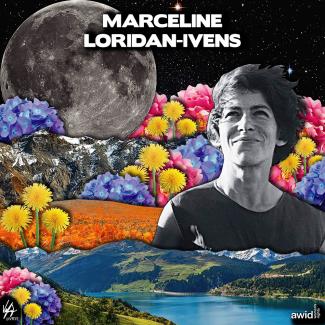
Née en 1928, Marceline était actrice, scénariste et réalisatrice.
En 2003, elle avait réalisé « La petite prairie aux bouleaux », mettant en vedette Anouk Aimée, ainsi que plusieurs autres documentaires. Survivante de l'holocauste, elle n'avait que quinze ans lorsque son père et elle furent arrêtés et envoyés dans des camps de concentration nazis. Les trois kilomètres qui la séparaient de son père à Auschwitz alors qu’elle-même était à Birkenau furent une distance insurmontable, décrite dans l’un de ses romans majeurs « Et tu n’es pas revenu ».
En parlant de son travail, elle a un jour déclaré: « Tout ce que je peux dire c’est que tout ce que je peux écrire, tout ce que je peux dévoiler, c’est à moi de le faire. »