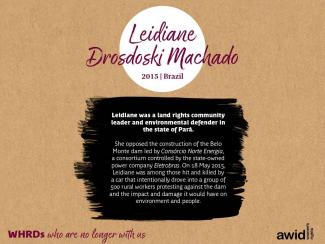
Leidiane Drosdoski Machado
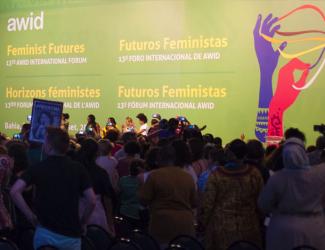
En septiembre de 2016, 1800 feministas y activistas por los derechos de las mujeres de todos los rincones de nuestros movimientos se congregaron en las costas de Bahia, en el 13º Foro Internacional de AWID.
En esta sección se destacan los logros, los aprendizajes y los recursos que surgieron de las ricas conversaciones mantenidas. Te invitamos a analizar, compartir y comentar.
Uno de los aportes más importantes del Foro fue la necesidad de ampliar y profundizar nuestro trabajo entre movimientos, frente a la confluencia de los fascismos en auge, fundamentalismos, codicia corporativa y cambio climático.
Nuestras Iniciativas Semilla han ayudado a 20 ideas que surgieron en el Foro para crecer en forma de acciones concretas
El vídeo «Defendiendo a las Personas y al Planeta» y la guía «Tejiendo la resistencia a través de la acción» estan protagonizados por defensoras de derechos humanos y presentan estrategias concretas para confrontar al poder corporativo
Con nuestras animaciones El estado de nuestros movimientos feministas y Justicia climática y ambiental, los movimientos ahora tienen herramientas creativas para apoyar su trabajo.
La compilación de las expresiones artísticas «Los Movimientos Importan», sigue inspirando una organización más fuerte y creativa en todo el mundo.
Los movimientos también pueden beneficiarse de nuevas metodologías para imaginar nuestros futuros feministas (¡pronto!)
AWID se ha comprometido, mediante su próximo plan estratégico y su proceso del Foro, a continuar y profundizar las relaciones, las lecciones y los procesos iniciados en el Foro 2016 y basándonos en el momento actual.
Los Foros de AWID comenzaron en 1983 en Washington DC. Desde entonces, el evento ha crecido hasta convertirse en muchas cosas para muchas personas: un proceso iterativo para darle forma a nuestros análisis, objetivos y acciones; un hito crucial que fortalece los feminismos de lxs participantes e infunde energías a sus procesos de organización; un hogar político donde lxs defensoras de derechos humanos encuentran un santuario y solidaridad.
If you wish to save your responses and come back to the survey later, you are able to do this whenever needed. KOBO will save your draft responses on the top left corner of the survey page and reload your record when you return to the survey. Just make sure to continue from the same computer and browser.
Anglais, français, espagnol et chinois mandarin.
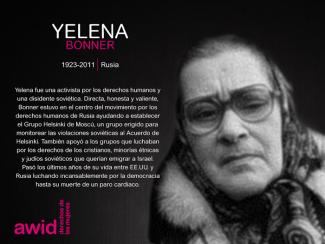
In our 2015 Online Tribute to Women Human Rights Defenders No Longer With Us we are commemorating four women from Sub-Saharan Africa, three of whom were murdered due to their work and/or who they were in their gender identity and sexual orientation. Their deaths highlight the violence LGBT persons often face in the region and across the globe. Please join AWID in honoring these women, their activism and legacy by sharing the memes below with your colleagues, networks and friends and by using the hashtags #WHRDTribute and #16Days.
Please click on each image below to see a larger version and download as a file


Nous Sommes la Solution uplifts and grows the leadership of rural women working towards African solutions for food sovereignty.
Si por algún motivo deseas que retiremos y borremos tus respuestas, tienes todo el derecho a hacerlo. Puedes contactarnos a través del formulario disponible aquí indicando «Encuesta WITM (¿Dónde está el dinero?) » en el título del mensaje, y procederemos a retirar y borrar tu respuesta.
Nous mettrons le site à jour avec les informations pertinantes le moment venu.
In 2013, we published three global reports. These reports confirm that women’s rights organizations are doing the heavy lifting to advance women’s rights and gender equality by using diverse, creative and long-term strategies, all while being underfunded.
Our 2010 global survey showed that the collective income of 740 women’s organizations around the world totaled only USD 104 million. Compare this with Greenpeace International, one organization with a 2010 budget of USD 310 million1. Imagine the impact these groups could have if they were able to access all the financial resources they need and more?
AWID’s WITM research has catalyzed increased funding for women’s rights organizing. WITM research was a driving force behind the Catapult crowdfunding platform, which has raised USD 6.5 million for women’s rights. The Dutch Government cited WITM research as a reason for its unprecedented MDG 3 Fund of EU 82 million. WITM research has also led to the creation of several new funds: FRIDA – The Young Feminist Fund, the Indigenous Women’s Fund, Fundo Elas, the Mediterranean Women’s Fund and the Rita Fund.
While the WITM research has shed important light on the global funding landscape, AWID and partners have identified the need to dig deeper, to analyze funding trends by region, population and issue. In response, organizations are now using AWID’s WITM research methodology to do their own funding trends analyses. For example, in November 2013, Kosova Women’s Network and Alter Habitus – Institute for Studies in Society and Culture published Where is the Money for Women’s Rights? A Kosovo Case Study.
At the same time, AWID continues to collaborate with partners in Where is the Money for Indigenous Women’s Rights (with International Indigenous Women’s Forum and International Funders for Indigenous Peoples) and our upcoming Where is the Money for Women’s Rights in Brazil? (with Fundo Elas).
Several organizations have also conducted their own independent funding trends research, deepening their understanding of the funding landscape and politics behind it. For example, the South Asian Women’s Fund was inspired by AWID’s WITM research to conduct funding trends reports for each country in South Asia, as well as a regional overview. Other examples of research outside of AWID include the collaboration between Open Society Foundations, Mama Cash, and the Red Umbrella Fund to produce the report Funding for Sex Workers Rights, and the first-ever survey on trans* and intersex funding by Global Action for Trans* Equality and American Jewish World Service.
Cooperativa Textil Nadia Echazú
Oui, n’hésitez pas à le faire! Nous vous encourageons à communiquer le lien vers l’enquête à vos réseaux. Plus les points de vue exprimés et collectés seront divers, plus notre compréhension du paysage du financement de l’organisation des mouvements féministes sera exhaustive.
Contenu lié
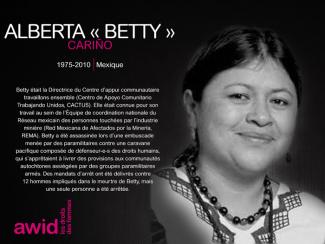
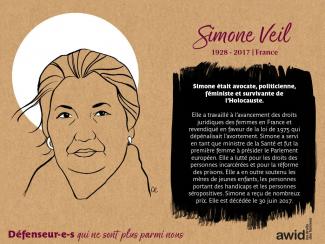
Huffington Post: Mort de Simone Veil: l'ancienne ministre de la Santé est décédée ce vendredi
Le Monde: Mort de Simone Veil, icône de la lutte pour les droits des femmes
Vous N’AVEZ PAS besoin d’un visa pour assister au Forum à Taipei si vous détenez un passeport émis par l’un des pays suivants (la durée de séjour autorisée varie d’un pays à l’autre) :
Allemagne, Andorre, Australie, Autriche, Belgique, Belize, Bulgarie, Brunei, Canada, Chili, Chypre, Croatie, Danemark, Espagne, Estonie, Eswatini, État de la Cité du Vatican, États-Unis, Finlande, France, Grèce, Guatemala, Haïti, Honduras, Hongrie, Îles Marshall, Islande, Irlande, Israël, Italie, Japon*, Lettonie, Liechtenstein, Lituanie, Luxembourg, Malaisie, Malte, Monaco, Nauru, Nicaragua, Norvège, Nouvelle-Zélande, Palaos, Paraguay, Pays-Bas, Philippines, Pologne, Portugal, République de Corée, République dominicaine, République tchèque, Roumanie, Royaume-Uni, Russie, Saint-Christophe-et-Niévès, Sainte-Lucie, Saint-Marin, Saint-Vincent-et-les-Grenadines, Singapour, Slovaquie, Slovénie, Suède, Suisse, Tuvalu.
Les personnes détentrices de tout autre passeport AURONT BESOIN D’UN VISA pour se rendre à Taipei.
Remarque :
Une fois inscrit·e au Forum, il est probable que vous receviez un code relatif à l’événement vous permettant de demander un visa en ligne, quelle que soit votre nationalité.
Nous vous donnerons plus d’informations à ce sujet après l’ouverture du processus d’inscription.
Now that you have analyzed all your data – from your survey, interviews, desk research and potentially other sources – you can create your final product.
In this section:
- Create your final product
1. Write clearly
2. Make it pretty- Gather review and inputs
1. Polish your results
2. Facilitate the feedback
Your final product will be the document that will summarize, analyze and criticize your data. That will be the piece that you will share with your community to present and explain your research to your audience.
At AWID, we often write a comprehensive written report that analyzes each set of data and synthesizes all of our findings, then later create smaller products, such as infographics and summaries (explained in the subsequent section “Finalize and format”).
Importance of the editor
An editor will proofread, ensure concise writing, conduct fact-checking, point out inconsistencies that need to be resolved, arrange the flow of the document and possibly suggest titles.
Your editor should preferably be someone who understands and knows your WITM work but who was not directly involved in the research. This will bring in a fresh perspective.
Use the data collected to create graphs and tables. These type of visuals are a compelling way to highlight the main findings of your research and validate your analysis.
Source relevant images that can illustrate your report.
Highlight key-numbers and/or powerful testimonials.
Remember: The more accessible your product is, the more people will want to read (and share!) it.
At this point, you have collected all your data, analyzed it and transformed it into your final product, likely in a long report.
Before moving on to the next steps – you should share your final research product with your advisor organizations, activists, and donors.
This is a great moment to check the following points:
Once you have inputted all feedback from your advisors, be sure to run it by your editor once more.
This will now be the final, completed version of your report. If you intend to publish the final report in other languages, now is the time to send it for translation.
This is a significant contribution from your advisors. Consider offering them some form of recognition.

• 2 - 5 months
• 1 or more research person(s)
• 1 Editor (or web-editor if you create an online product)
• Translator(s), if done in more than one language
• List of advisor organizations, activists, and donors.
• Concept note (from “Frame your research” section)
• Survey topline results
• Prepared interview questions
• Interview results
• Desk research data
• All other data used in report

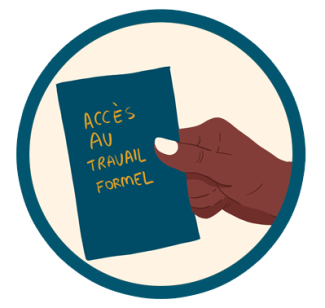
Seul·es 18 % des trans et travestis en Argentine ont accès à un emploi formel.
لمشاركة تجاربكم/ن المعاشة بما يتعلق بتمويل منظمتكم/ن
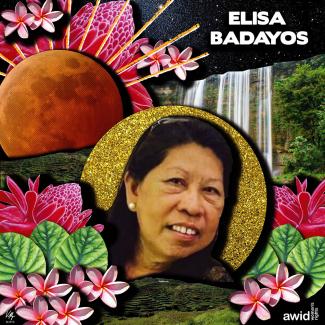
She also served as an organiser of urban poor communities in Cebu Province, and worked with Desaparecidos, an organization of families of the disappeared.
Elisa and two of her colleagues were killed on November 28, 2017 by two unidentified men at Barangay San Ramon, Bayawan city in the Negros Oriental province during a mission to investigate alleged land rights abuses in the area.
She is survived by four children.