La memoria como resistencia: Un Tributo
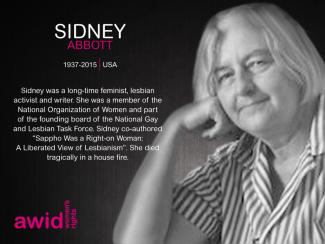
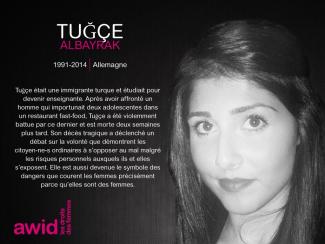
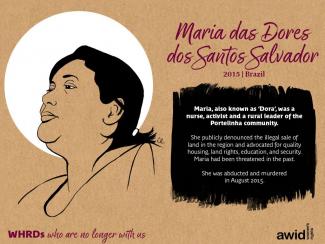
El Tributo de AWID es una exhibición de arte que honra a feministas, a activistas por los derechos de las mujeres y de la justicia social de todo el mundo que ya no están con nosotrxs.
En 2020, hacemos un cambio
El Tributo de este año cuenta y comparte las historias y narraciones de quienes crearon conjuntamente realidades feministas, ofrecieron visiones de alternativas a los sistemas y actores que nos oprimen, y propusieron nuevas formas de organizarnos, de movilizarnos, de luchar, de trabajar, de vivir y de aprender.
Se agregan a la galería 49 retratos nuevos de feministas y defensorxs de derechos humanos. Aunque muchxs feministas y defensorxs han fallecido debido a edad avanzada o enfermedad, muchísimxs han sido asesinadxs debido a su trabajo y por ser quienes eran.
Esta violencia creciente (de parte de Estados, empresas transnacionales, crimen organizado, sicarios no identificados, etc.) no se dirige solo a activistas individuales sino a nuestro trabajo común y a las realidades feministas.
Al compartir las historias de lxs activistas en este Tributo, mantenemos vivo su legado y nos inspiran para el trabajo futuro de nuestros movimientos.
Visita nuestra exhibición en línea
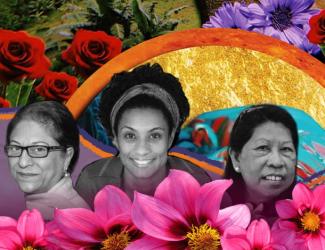
Lors retratos de 2020 fueron diseñados por la ilustradora y animadora galardonada, Louisa Bertman.
En AWID nos gustaría agradecer a las familias y organizaciones que nos compartieron sus historias personales, y así haber contribuido a este memorial. Nos unimos a ellxs para continuar el extraordinario trabajo de estxs activistas y defensorxs, y en el esfuerzo para asegurarnos de que se logre justicia en los casos que permanecen en la impunidad
"Ellos trataron de enterrarnos pero no sabían que éramos semillas."‐ Proverbio Mexicano
Presentamos el Tributo por primera vez en 2012
Primero tomó forma como una exposición física de retratos y biografías de feministas y activistas que habían fallecido, en el 12º Foro Internacional de AWID, en Turquía. Ahora vive como una galería en línea, que actualizamos cada año.
Desde 2012 hemos presentado más de 467 feministas y defensorxs.
Contenido relacionado
Snippet FEA We are living in a world left (FR)
Nous vivons dans un monde où la destruction de la Nature alimente notre économie mondiale actuelle.
Могу ли я связаться с кем-либо, если у меня возникнут вопросы?
Если у вас есть какие-либо вопросы или сомнения, пожалуйста, свяжитесь с нами через форму здесь, указав «Опрос «Где деньги?» (WITM Survey) в качестве заголовка вашего сообщения. или напишите нам по адресу witm@awid.org
FRMag - Roots of Love and Resilience
Kunyit Asam : Les racines de l’amour et de la résilience
par Prinka Saraswati
Les cycles menstruels sont généralement d’une durée de 27 à 30 jours. Pendant cette période, les règles elles-mêmes ne durent que 5 à 7 jours. L’épuisement, les sautes d’humeur et les crampes sont le résultat de l’inflammation qui se produit alors. (...)
< illustration : « Mouvement féministe », Karina Tungari
Who are AWID's members?
A dynamic network of people around the world, AWID members are researchers, academics, students, educators, activists, business people, policy-makers, development practitioners, funders, and more. Our members - of every age - are those who make AWID a unique global feminist association.
Membership with AWID is open to anyone who shares our values
We offer different types of memberships geared to income level and whether you are an individual or an organization. Currently we have over 5000 members, individual and institutional, from 164 countries.
Our members are an important part of our work
We collaborate for advocacy on specific issues, members vote in elections for our Board, and can also participate in and contribute to our Priority Areas through webinars, surveys, or urgent actions, for example.
Our institutional membership draws from a broad range of organizations interested in advancing gender justice and women’s human rights, including women’s rights organizations, from the local to the global levels, grassroots networks, major international institutions, government departments, university programs and more. 63% of our members are from the global South and 38% are under the age of 30.
Key impacts on the international human rights system
Anti-rights actors have had a substantive impact on our human rights framework and the progressive interpretation of human rights standards, especially rights related to gender and sexuality.
When it comes to the impact of conservative actors in international policy spaces, the overall picture today is of stasis and regressions.
We have witnessed the watering down of existing agreements and commitment; deadlock in negotiations; sustained undermining of UN agencies, treaty review bodies and Special Procedures; and success in pushing through regressive language in international human rights documents.
Commission on the Status of Women (CSW)
The CSW, held annually in March, has long been one of the most contested sites in the UN system. In March 2015, conservative efforts set the tone before events or negotiations even began; the outcome document of the Commission was a weak Declaration negotiated before any women’s rights activists even arrived on the ground.
At 2016’s CSW, the new Youth Caucus was infiltrated by large numbers of vocal anti-abortion and anti-SRHR actors, who shouted down progressive youth organizations. Again, intensive negotiations resulted in a lacklustre text, which included regressive language on ‘the family.’
Precisely when addressing women’s human rights is of urgent importance, the CSW has been rendered a depoliticized and weakened space. Using it to advance rights has become harder and harder since progressives’ energy is taken up trying to hold the ground against conservative backlash.
Human Rights Council (HRC)
As the intergovernmental body responsible for the promotion and protection of human rights around the globe, the HRC is a key entry point for conservative actors. In recent years, this mechanism has been the scene for a number of damaging anti-human rights moves.
In conversation with other anti-rights actors, one strategy of conservative states, and blocs of states, is to aggressively negotiate out positive language and to introduce hostile amendments to resolutions, most often resolutions focusing on rights related to gender and sexuality.
To take one example, during the June 2016 session of the HRC, opposition was mounted towards a resolution on discrimination against women by the member states of the Organization of Islamic Cooperation (OIC) and allies. During contentious negotiations, multiple provisions were removed, including women’s and girls’ right to have control over their sexuality, sexual and reproductive health, and reproductive rights; and the need to repeal laws which perpetuate the patriarchal oppression of women and girls in families, and those criminalizing adultery or pardoning marital rape.
The HRC has also been the site of pernicious conservative initiatives to co-opt human rights norms and enact conservative “human rights” language, such as that of the Russia-led “traditional values” resolutions, and more recently the “Protection of the Family” agenda.
Human Rights Committee
In 2015, moving their sights to another front, a number of religious right organizations began to target the Human Rights Committee, the treaty monitoring body for the International Covenant on Civil and Political Rights (ICCPR), a pivotal human rights instrument.
Anti-human rights groups mobilized in hopes of cementing their anti-abortion rhetoric into the treaty.
When the Committee announced it was drafting a new authoritative interpretation of the right to life, over 30 conservative non-state actors sent in written submissions, advocating their misleading discourse on ‘right to life’ - that life begins at conception and that abortion is a violation of the right - be incorporated in the Committee’s interpretation of article 6.
Conservative groups targeting the Human Rights Committee was a shift considering that historically anti-human rights actors have repeatedly attempted to undermine and invalidate the essential work of the treaty monitoring bodies, including the Human Rights Committee.

SDG negotiations and Agenda 2030
Anti-human rights actors were involved in lobbying towards the development of the new Sustainable Development Goals (SDGs) in 2015, focusing again on rights relating to gender and sexuality. These efforts had limited traction in their attempts to embed regressive language in Agenda 2030.
However, after successfully pushing back against progressive language in the final text, conservative actors then pivoted to another strategy. In an attempt to evade state accountability and undermine the universality of rights, several states have repeatedly made reservations to the Goals.
On behalf of the African Group, Senegal claimed that African states would only “implement the goals in line with the cultural and religious values of its countries.”
The Holy See also made a number of reservations, stating it was “confident that the related pledge ‘no one will be left behind’ would be read” as meaning “the right to life of the person, from conception until natural death.”
Saudi Arabia went one step further, declaring that the country would not follow any international rules relating to the SDGs that reference sexual orientation or gender identity, describing them as running “counter to Islamic law.”
General Assembly (GA)
Anti-rights actors have made increasing headway at the UN General Assembly (GA). Most recently, during the 71st session in 2016, the GA was the scene of feverish anti-rights organizing in opposition to the new mandate created by the Human Rights Council resolution on sexual orientation and gender identity in June 2016: the Independent Expert on SOGI. Four separate attempts were made to undercut the mandate in GA spaces.
One approach was to introduce a hostile resolution at the Third Committee[1], led by the African Group, which in essence aimed to indefinitely defer the new mandate. While this approach was not successful, such an attempt in the GA to retroactively block the creation of a mandate brought forward by the Human Rights Council represented a new and troubling tactic - anti-right actors are now working to directly undermine the HRC’s authority respective to the General Assembly.
Another approach targeted the Fifth Committee (responsible for administration and budgetary matters) as an entry point to attack the mandate. In an unprecedented move a number of States attempted (again, unsuccessfully) to block the funding of UN human rights experts, including the new IE on SOGI[2],.
While these multiple efforts were unsuccessful in blocking the creation and continuation of the new mandate, the significant support they received, the novel strategizing employed, and the strong alliances built along regional lines through negotiations point to difficulties ahead.
[1] The Third Committee of the GA deals with agenda items relating to a range of social, humanitarian affairs, and human rights issues. Each year it discusses and issues resolutions on issues including the advancement of women, the protection of children, family, and youth.
[2] While UN Special Procedures experts (i.e. Special Rapporteurs, Working Group members and Independent Experts) work pro bono, some funds are generally allocated to facilitate country visits on the invitation of the national government, and support staff.
Other Chapters
Tuğçe Albayrak
Maria das Dores dos Santos Salvador
Snippet - That Feminist Fire Podcast Trailer (ES)
AWID Community Blurb
Join our online community!
The AWID Community is an online social networking platform specifically for AWID. It is a feminist space for connection, resistance and celebration. A space for critical feminist conversations, collective power and solidarity. It is also a space for post-event dialogues, navigating difficult political learnings and community care.
Join AWID membership to be part of the AWID Community today.
FRMag - Armenians
Armenians, Feminism is our Past and Future
by Sophia Armen
Like it or not fierce ungerhouis have been part and parcel to our histories of resistance and are here to stay. (...)
¿AWID puede financiar mi proyecto de desarrollo?
No, lamentablemente AWID no es una organización financiadora.
No podemos considerar propuestas o solicitudes de financiamiento.
Les invitamos a consultar nuestra lista de donantes que potencialmente puedan financiar su trabajo por los derechos de las mujeres.
Encontrarás más recursos en la página de nuestra área prioritaria «Financiamiento de los movimientos feministas»
Sala de prensa
AWID en los medios
Compilación de noticias sobre la organización y/o el trabajo de AWID
- Presentan disco con canciones para reír y reivindicar. La Nación, may 2018
- Día Internacional de la Mujer: la realidad de las mujeres latinoamericanas. La opinión digital, mar 2018
- Para fortalecer la resistencia global, hay que dar recursos a lxs jóvenes feministas. Open Global Rights, nov 2017
- Llamado mundial a las mujeres frente a la reunión de la OMC. Bilaterals, nov 2017
- Tejiendo la resistencia a través de la acción: Las estrategias de las Defensoras de Derechos Humanos contra las industrias extractivas. Movimiento 4, sep 2017
- Romani: banca internacional habilita a que se “lave olímpicamente” el dinero del narcotráfico. La diaria, ago 2017
- Global: Nueva guía y reporte sobre acciones de defensoras de derechos humanos ante proyectos extractivos empresariales. Business and human rights resources, ago 2017
- Cumbre sobre el Mundo del Trabajo: Un futuro mejor para las mujeres en el trabajo. Organización Internacional del Trabajo, jun 2017
- “Los Movimientos Importan”, arte visual colectivo en favor de las mujeres. El heraldo de Saltillo, mar 2017
- Violencia de género contra las mujeres en los medios, y la necesidad del activismo cotidiano. IFEX, dic 2016
- Ahora más que nunca. La razón, sep 2016
- Brasil: Cerró ayer la mayor conferencia sobre derechos de las mujeres. Fondo indígena, sep 2016
- Alerta Máxima Feminista ante involución de derechos de las y los migrantes en la 46 ª Conferencia de Población y Desarrollo. Calala, may 2015
- Todas las personas podemos ser defensoras de los Derechos Humanos de las mujeres. ALC noticias, ene 2015
Notas de prensa
Notas de prensa, dosieres y kits
Kits de social media
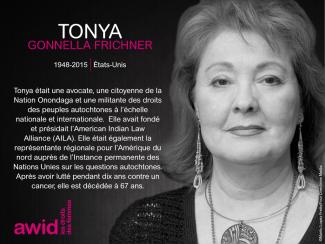
Tonya Gonella Frichner
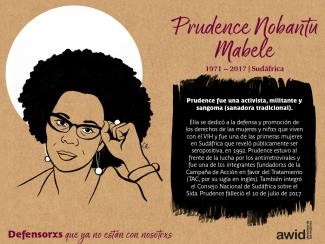
Prudence Nobantu Mabele
.
Snippet Stories of Change Full - Download (EN)
Snippet - Blog post Quote_FR
« Poursuivons notre dynamique de solidarité, d’espoir et d’imagination radicale. »
- Beijing+30 et la CSW : adopter une lecture féministe des multiples défis de notre époque
FRMag - Dieula and the Black Dolls
Dieula y las Muñecas Negras
por Ana María Belique
El Batey Naranjo es una comunidad un poco retirada de la ciudad, pero repleta de personas trabajadoras, llenas de entusiasmo. (...)
< arte: «Tejedoras de sueños», Diana Mar
Je suis une jeune féministe. Comment m’impliquer au sein de l’AWID ?
Les jeunes féministes sont au cœur de l’action de l’AWID.
De fait, 38 % de nos membres sont ont moins de 30 ans.
Nous estimons que les jeunes féministes représentent le présent et l’avenir de la lutte pour les droits des femmes. Nous encourageons les jeunes femmes à devenir des leaders du mouvement et notre programme « Activisme des jeunes féministes » est transversal à tous les autres aspects de notre travail.
Dans le même temps, en définissant les jeunes féministes comme l'un de nos domaines prioritaires, nous apportons de nouvelles perspectives aux débats actuels et veillons à ce que les jeunes activistes puissent exprimer clairement leurs priorités et leurs inquiétudes.
En savoir plus sur le programme Activisme des jeunes féministes
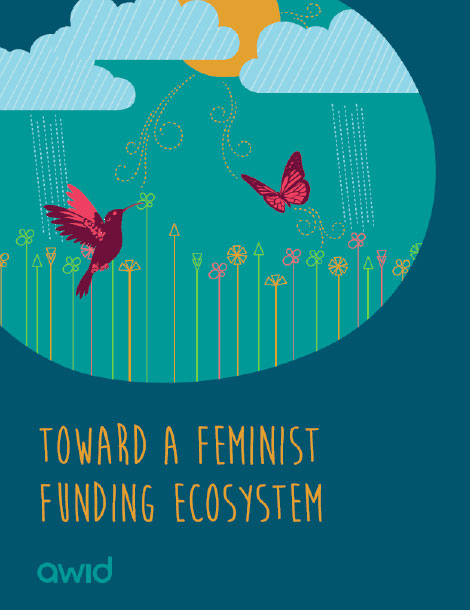
Here are your report and infographics: Toward a feminist funding ecosystem
Download the full guide
Click on the image to open the PDF
 |
Download the individual infographics
Where we are now |
Where we want to be |
Current funding by sector |
 |
 |
 |
| Download & share | Download & share | Download & share |
Sidney Abbott