Left
Half
Left

Análisis Especiales

AWID es un organización feminista internacional de membresía, que brinda apoyo a los movimientos que trabajan para lograr la justicia de género y los derechos de las mujeres en todo el mundo.

La memoria como resistencia: Un Tributo

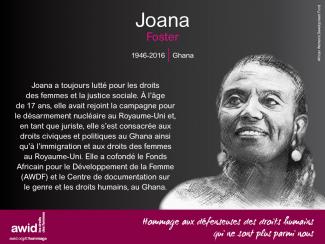
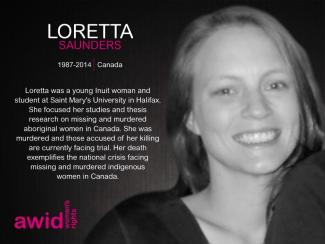
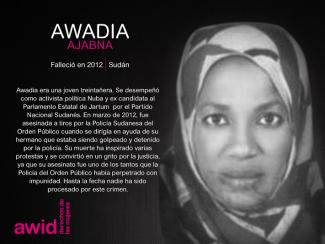
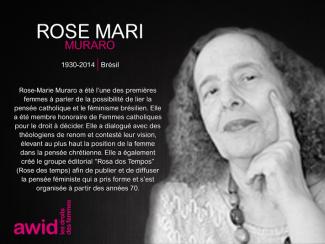
El Tributo de AWID es una exhibición de arte que honra a feministas, a activistas por los derechos de las mujeres y de la justicia social de todo el mundo que ya no están con nosotrxs. 


En 2020, hacemos un cambio

El Tributo de este año cuenta y comparte las historias y narraciones de quienes crearon conjuntamente realidades feministas, ofrecieron visiones de alternativas a los sistemas y actores que nos oprimen, y propusieron nuevas formas de organizarnos, de movilizarnos, de luchar, de trabajar, de vivir y de aprender.

Se agregan a la galería 49 retratos nuevos de feministas y defensorxs de derechos humanos. Aunque muchxs feministas y defensorxs han fallecido debido a edad avanzada o enfermedad, muchísimxs han sido asesinadxs debido a su trabajo y por ser quienes eran. 

Esta violencia creciente (de parte de Estados, empresas transnacionales, crimen organizado, sicarios no identificados, etc.) no se dirige solo a activistas individuales sino a nuestro trabajo común y a las realidades feministas. 

Al compartir las historias de lxs activistas en este Tributo,  mantenemos vivo su legado y nos inspiran para el trabajo futuro de nuestros movimientos. 

Visita nuestra exhibición en línea

Lors retratos de 2020 fueron diseñados por la ilustradora y animadora galardonada, Louisa Bertman

En AWID nos gustaría agradecer a las familias y organizaciones que nos compartieron sus historias personales, y así haber contribuido a este memorial. Nos unimos a ellxs para continuar el extraordinario trabajo de estxs activistas y defensorxs, y en el esfuerzo para asegurarnos de que se logre justicia en los casos que permanecen en la impunidad

"Ellos trataron de enterrarnos pero no sabían que éramos semillas."‐ Proverbio Mexicano


Presentamos el Tributo por primera vez en 2012

Primero tomó forma como una exposición física de retratos y biografías de feministas y activistas que habían fallecido, en el 12º Foro Internacional de AWID, en Turquía. Ahora vive como una galería en línea, que actualizamos cada año. 

Desde 2012 hemos presentado más de 467 feministas y defensorxs.

Visita nuestra exhibición en línea
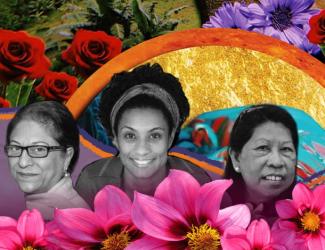
Contenido relacionado

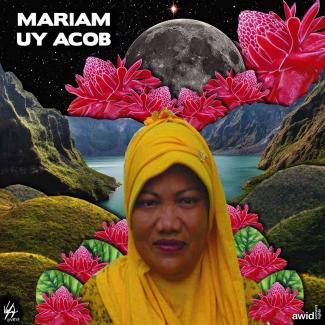
Mariam Uy Acob

Mariam was a paralegal at the Kawagib Moro Human Rights Alliance. 

Mariam was a staunch critic of militarization in Moro communities, and consistently denounced aerial bombardment and encampment. She had to seek sanctuary after exposing and calling out the injustices committed against Muslim communities in the Philippines.

She is believed to have been killed by suspected military agents because of her work as a WHRD. The assailants who killed Mariam waited for her, caught up with the vehicle she was using and shot her seven times. 


Mariam Uy Acob, Philippines

Mujeres indígenas por la defensa de los derechos

Estas defensoras lucharon por los derechos sobre la tierra, de las mujeres y de los pueblos indígenas; haciendo frente a las industrias extractivas, escribiendo poesía y promoviendo el amor. Una de ellas desapareció hace ya 19 años. Únete a nosotras para recordar y honrar a estas defensoras de derechos humanos, su trabajo y su legado, compartiendo los memes aquí incluidos; y tuiteando las etiquetas #WHRDTribute y #16Días.


Por favor, haz click en cada imagen de abajo para ver una versión más grande y para descargar como un archivo.  


Hospital | Content Snippet EN

“Now might be a good time to rethink what a revolution can look like. Perhaps it doesn’t look like a march of angry, abled bodies in the streets. Perhaps it looks something more like the world standing still because all the bodies in it are exhausted—because care has to be prioritized before it’s too late.” 
- Johanna Hedva (https://getwellsoon.labr.io/)

Hospitals are institutions, living sites of capitalism, and what gets played out when somebody is supposed to be resting is a microcosm of the larger system itself. 

Institutions are set out to separate us from our care systems – we find ourselves isolated in structures that are rigidly hierarchical, and it often feels as if care is something done to us rather than given/taken as part of a conversation. Institutional care, because of its integration into capitalist demand, is silo-ed: one person is treating your leg and only your leg, another is treating your blood pressure, etc. 

Photographer Mariam Mekiwi had to have surgery last month and documented the process. Her portraits of sanitized environments – neon white lights, rows after rows of repetitive structures – in a washed-out color palette reflect a place that was drained of life and movement. This was one of the ways Mariam kept her own spirit alive. It was a form of protest from within the confines of an institution she had to engage with.

The photos form a portrait of something incredibly vulnerable, because watching someone live through their own body’s breakdown is always a sacred reminder of our own fragility. It is also a reminder of the fragility of these care systems, which can be denied to us for a variety of reasons – from not having money to not being in a body that’s considered valuable enough, one that’s maybe too feminine, too queer or too brown.  

Care experienced as disembodied and solitary, that is subject to revocation at any moment, doesn’t help us thrive. And it is very different from how human beings actually behave when they take care of each other. How different would our world look like if we committed to dismantling the current capitalist structures around our health? What would it look like if we radically reimagined it?

Florence Adong-Ewoo

Florence fue una activista por los derechos de las personas con discapacidad que trabajó con varias organizaciones de mujeres con discapacidad en Uganda.

También ocupó la Dirección del Distrito de Lira de la Asociación de Mujeres con Discapacidad, así como del foro de Consejeras Mujeres del Distrito de Lira. Formada como consejera para personas con discapacidad y para madres y padres de niñxs con discapacidad, apoyó muchos proyectos que reclamaban mayor representación de las personas con discapacidad.

Murió en un accidente de motocicleta.


Florence Adong-Ewoo, Uganda

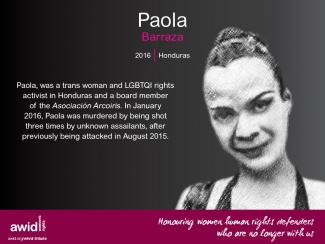
Trans* rights require stronger protection

These transgender women were murdered because of their activism and their gender identity. There are insufficient laws recognizing trans* rights, and even where these laws exist, very little is being done to safeguard the rights of trans* people. Please join AWID in honoring these defenders, their activism and legacy by sharing the memes below with your colleagues, networks and friends and by using the hashtags #WHRDTribute and #16Days.


Please click on each image below to see a larger version and download as a file 


CREDITS | Content Snippet EN

Credits

Editorial Team 
Co-editors
Chinelo Onwualu
Ghiwa Sayegh (Kohl)

Design and Illustration
Sophia Andreazza

Communications Strategist
Zuhour Mahmoud (Kohl)


Arabic Editor
Sabah Ayoub (Kohl)

Translation Manager
Maya Zebdawi (Kohl)

AWID’s Team
Nana Darkoa Sekyiamah
Lola Silva
Kamee Abrahamian
Tanya Lallmon
Maria Olivo
Marianne Asfaw
Ana Abelenda

Arabic Translators
Lina Yahya
Marina Samir
Maya Zebdawi
Nidal Majeed
Rania El Ghazal
Rola Alaeddine
Viviane Akiki    

English to Spanish
Translators 

Gabriela Adelstein
Maria Luisa Peralta
Alejandra Sarda
Gabby De Cicco

Proofreaders
Alejandra Sarda
Gabby De Cicco
María Eugenia Martí
                
English to French
Translators 
Camille Dufour
Morgane Boëdec

Proofreaders
Nathalie Thériault

Portuguese to English
Translator
Luiza Martello

Proofreader
Shaina Greiff


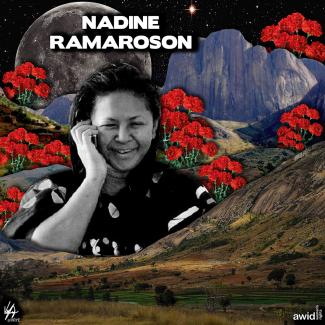
Nadine Ramaroson

Son soutien aux femmes et aux personnes les plus vulnérables de sa communauté a fait que Nadine était un modèle pour beaucoup. Elle était déterminée à aider les pauvres et les sans-abri en particulier.

Bien que sa mort ait été déclarée comme étant accidentelle, la famille Ramaroson, sur l’initiative de son père André Ramaroson, a mené une enquête qui a mis en évidence des preuves de son assassinat. Elle serait décédée dans un accident mortel survenu entre Soanierano - Ivongo et Ste Marie - une histoire qui a été réfutée par sa famille. Elle avait reçu de nombreuses menaces de mort pour ses positions politiques résolues. L’affaire est toujours en cours auprès des tribunaux à Antananarivo (la capitale de Madagascar).


Nadine Ramaroson, Madagascar

1. Gather your resources

This section highlights key resources recommended by AWID so you can conduct your own WITM research.

In this section

People needed

  • 1 or more person(s) to lead overall implementation of research methodology and ensure all key pieces are on track (Sections 2-11)
  • 1 or more person(s) to conceptualize the key research objectives and guiding questions
  • 1 or more person(s) to refine and conduct the research methodology, including collecting data
  • 1 or more person(s) to conduct relevant qualitative and quantitative analysis of collected data
  • 1 or more person(s) to document and package research findings for desired audience(s)
  • 1 or more person(s) to serve as an editor to your final products
  • 1 or more person(s) to conduct outreach to spread the word about your survey and advocacy using your research results

Back to top


Potential expenses

  1. Staff and/or consultant salaries
  2. Data analysis software if conducting analysis of large dataset in-house. Options:
    - SPSS
    - Stata
    - R (this is free)
  3. Cost of producing publications and research products
  4. If desired, incentive prize that survey participants can win if they complete the survey
  5. If desired, incentives to offer your advisors

Back to top


Estimated time

  • For research process: 6 to 18 months, depending on size of dataset(s) and staff capacity
  • For advocacy: 1-2 years, as determined by your organizational goals

Back to top


Resources needed

  • List of advisor organizations, donors and activists
  • List of online spaces and events/networks to distribute your survey and present your survey results
  • List of donors, activists, and women’s rights organizations to interview
  • Prepared interview questions
  • List of publication sources to use for desk research

Back to top


Resources available

Online tools

Once you gather these resources, you can estimate the costs for your research using our “Ready to Go? Worksheet”

Back to top


Previous step

Before you begin

Next step

2. Frame your research


Previous step

Before you begin

Next step

2. Frame your research


The Ready to Go? Worksheet helps you estimate resources, staff and budget needed for your research

Download the toolkit in PDF

Communicating Desire | Small Snippet AR

التعبير عن الرغبة وغ

وغيرها من الممارسات السياسيّة الأيديولوجيّة المجسَّدة

المضيفة: نحن نميل إلى الاعتقاد أنّ التعبير عن الرغبة يقتصر على العلاقة الحميمة داخل غرفة النوم وعلى علاقاتنا الشخصيّة. ولكن هل يمكننا أيضًا اعتبار هذا النوع من التعبير كبُنية، أو ممارسة أيديولوجيّة توجّه عملنا، وما نحن عليه، وكيف سنكون في هذا العالم؟

اقرأ أكثر

Body

Sainimili Naivalu

« J’ai constaté la discrimination dans la rue, que ce soit par des taquineries ou des agressions verbales qui y ont lieu. Je me suis aussi faite plein d’ami·e·s et j’y ai rencontré plusieurs personnes. Il se peut que ce soit dangereux là-bas, mais je suis une survivante, et pour le moment, c’est là où je suis. » -  Sainimili Naival

Sainimili Naivalu était une activiste féministe des droits des personnes handicapées issue du village de Dakuibeqa, sur l’île de Beqa aux Fidji.

Elle a demandé aux responsables et acteurs politiques de fournir des politiques et des services adaptés au handicap, comme la construction de rampes dans les villes et les villages afin d'accroître leur accessibilité. Les barrières physiques n’étaient pas les seules qu’elle aspirait à modifier. Sur la base de sa propre expérience, elle savait que des changements plus difficiles devaient être menés dans les sphères économiques et sociales. Bon nombre des défis avec lesquels sont aux prises les personnes handicapées trouvent leurs racines dans les attitudes discriminantes et stigmatisantes. 

Survivante et combattante, Sainimili a contribué à co-créer des réalités féministes qui renforcent l’inclusion et font évoluer les attitudes par rapport à l’égalité des personnes handicapées. Elle a été membre de la Spinal Injury Association of Fiji (SIA) ainsi que participé à la formation « Démarrez votre entreprise » de l’Organisation internationale du Travail à Suva via le projet « Pacific Enable » (le Pacifique rend possible) du Forum Asie-Pacifique sur le handicap. Elle a ainsi pu transformer ses idées en une entreprise qui lui était propre. Elle était commerçante sur l’étal de marché 7 de Suva, offrant des services de manucure, tout en gérant un stand au marché des femmes SIA pour y vendre de l’artisanat, des suls et des objets historiques. Sainimili planifiait d’élargir son commerce et de devenir une employeuse majeure de personnes handicapées. 

Outre son activisme, elle était également médaillée de tennis de table et une récente championne.

Avec sa personnalité vive, Sainimili était unique. On savait toujours lorsqu’elle était dans la pièce car ses rires et ses histoires étaient la première chose qu’on pouvait remarquer. -  Michelle  Reddy

Sainmili est décédée en 2019.
 

5. Conduct interviews

Interviews produce in-depth information that you cannot easily obtain from surveys. While surveys focuses mainly on quantifiable data and closed questions, interviews allow for expert opinions from activists and donors, and open-ended questions which can provide context to survey data results.

In this section

General tips

1. Before conducting your interviews

Send the interviewees a concept note with your objectives for the interview and for your overall research, as well as a list of questions.

This allows them to prepare answers for more complicated questions and look up information that they may not have immediately on hand.

2. During the interviews

  • You can conduct interviews while your survey is running, in order to save time.
  • Try to keep your interviews as consistent as possible in order to facilitate systematic analysis of results. This means asking the same questions. Coding identical responses to each question will allow you to uncover hidden trends.
  • The interviews can also be used to flesh out some of the survey findings

Do not base your questions on assumptions about your interviewees’ knowledge.
Instead, first clarify what they know – this will reveal information as well.

  • DON’T: “Given the current funding trends in Switzerland, do you know of any opportunities for collaboration? This question assumes that the interviewee knows current funding trends and that their understanding of funding trends matches yours.
  • DO: First ask “What is your understanding of current funding trends in Switzerland?”, followed by “Do you know of any opportunities for collaboration?” This will reveal what their understanding is, giving you even more information than the first question.

Back to top


Specialized interviews

1. Donor interviews

Interviews with donors will allow you to build deeper relationships with them, which will be useful when you conduct post-research advocacy. They will also provide you with deeper insight into funders’ decision-making processes.

Suggested topics of focus for donor interviews:

  • What are their funding priorities? Why and how did they select those priorities? For example, why do they choose project-funding over core support or vice versa?
  • What are annual amounts allocated to the advancement of women’s human rights? This will strengthen overall reliability of data collected.
  • Have they noticed any funding trends, and what do they believe are the origins and politics behind these trends?
  • What is their theory of social change and how does that impact their relationships with women’s rights organizations?
View samples of donor interviews

2. Women’s rights organizations and activists interviews

Interviews with women’s rights organizations and activists will provide you with insight into their on-the-ground realities. Again, these interviews will allow you to build deeper relationships that can be incorporated into your advocacy, particularly to encourage collaboration between donors and activists.

Suggested topics of focus for women’s rights organizations and activist interviews:

  • Long-term funding priority trends noted by women’s organizations and their impact.
  • Successful examples of feminist and collaborative resource mobilization strategies that build strong and complementary movements.
  • “Making the case” for why it is important to support women’s organizations and organizing.
  • How different actors understand the social change process and their role in advancing/achieving gender equality and women’s rights.
View samples of women’s organizations and activists interviews

Back to top


Preliminary findings

Through the course of your WITM research, we recommend analyzing your preliminary findings. Presenting your preliminary findings opens up opportunities to conduct more interviews and get feedback on your research process and initial results. This feedback can be incorporated into your final research.

AWID conducts “WITM convenings” to share preliminary results of survey data and interviews. These gatherings allow participants (activists, women’s rights organizations, and donors) to debate and discuss the results, clarifying the context, creating more ownership amongst members of the movement, and providing more input for final research.

For example, the Resource Mobilization Hub for Indigenous Women’s Rights at the World Summit on Indigenous Philanthropy was used as a space to debut preliminary results.

See the presentation given at the RMH

Back to top


Previous step

4. Collect and analyze your data

Next step

6. Conduct desk research


Estimated time:

• 1.5 - 3 months

People needed:

• 1 or more research person(s)

Resources needed:

• List of donors and women’s rights organizations and activists to interview
• Prepared interview questions
• Concept Note (You can use the research framing you created in the “Frame your research” section)

Resources available:

AWID Sample Interview Questions: Donors
AWID Sample Interview Questions: Activists & Women’s Rights Organizations


Previous step

4. Collect and analyze your data

Next step

6. Conduct desk research


Ready to Go? Worksheet

Download the toolkit in PDF

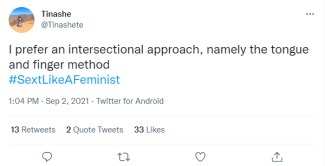
#5 - Sexting like a feminist Tweets Snippet AR

تقديم تحليل كفء للأجساد البحثيّة، يستوجب بالضرورة تسخيرًا شاملا لكافّة الأدوات الحميميّة…

Image of a tweet. Text says: I prefer an intersectional approach, namely the tongue and finger method.

أفضّل المقاربة التقاطعيّة لما تشتمل عليه من مداعبة ممنهجة باللسان والأصابع