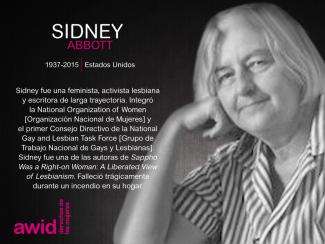
Sidney Abbott
Au cours des dernières années, nous avons observé une nouvelle tendance inquiétante dans les espaces internationaux consacrés aux droits humains. Les discours axés sur « la protection de la famille » sont en effet utilisés pour défendre des violations des droits de membres de la famille, pour renforcer et justifier l’impunité des auteurs de ces violations et pour restreindre l’égalité des droits au niveau de la vie familiale.
La campagne en faveur de la « Protection de la famille » est motivée par une volonté conservatrice d’imposer des conceptions « traditionnelles » et patriarcales de la famille et de priver les membres de la famille de leurs droits pour les transférer à « l’institution familiale ».
Depuis 2014, un groupe d’Etats travaille de front dans les espaces dédiés aux droits humains sous le nom de « Group of Friends of the Family » (Groupe des ami-e-s de la famille) ; des résolutions sur la « Protection de la famille » ont été adoptées chaque année depuis 2014.
Ce programme s’est propagé au-delà du Conseil des droits humains. Nous avons observé l’introduction d’un discours régressif autour de la « famille » à la Commission sur la condition de la femme, ainsi que des tentatives d’introduction dans les négociations sur les Objectifs de développement durable.
L’AWID travaille avec des partenaires et des allié-e-s pour s’opposer ensemble à la « Protection de la famille » et à d’autres programmes régressifs et défendre l’universalité des droits humains.
En réponse à l’influence croissante d’acteurs régressifs au sein des espaces dédiés aux droits humains, l’AWID a rejoint des allié-e-s afin de créer l’Observatoire sur l'Universalité des droits (OURs) (site en anglais). L’OURs est un projet de collaboration qui surveille, analyse et diffuse les informations concernant les initiatives anti-droits telles que la « Protection de la famille ».
Le premier rapport de l’OURs, Nos droits en danger, trace une cartographie des acteurs et actrices qui constituent le lobby mondial anti-droits et identifie leur réthorique et stratégies clés ainsi que leur impact sur les droits humains.
Le rapport précise que le programme de « Protection de la famille » a développé une collaboration entre un large éventail d’acteurs régressifs aux Nations Unies, qu’il décrit comme « un cadre stratégique abritant des positions anti-droits et patriarcales multiples, où le cadre vise entre autres à légitimer et institutionnaliser ces positions. »
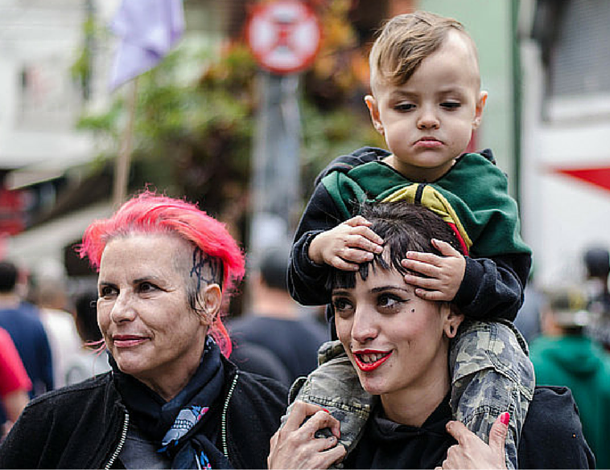
Queremos agradecer al colectivo Amar.ela de mujeres feministas activistas y creativas que hicieron posible esta serie, y especialmente a Natalia Mallo (el pulpo del equipo) por su apoyo y acompañamiento en este viaje.
También extendemos nuestro más profundo agradecimiento y admiración a todos los colectivos y personas que participaron en este proyecto, y les agradecemos por compartir su tiempo, sabiduría, sueños e ilusiones con nosotrxs. Les agradecemos por hacer de este mundo un mundo más justo, feminista y sostenible.
Esperamos que sus historias inspiren al resto del mundo tanto como nos inspiran a nosotrxs.
As we navigate the global polycrisis, movements are tirelessly building power beyond traditional power structures. The wave of US presidential executive orders is intended to scare us, but no amount of fascist ideology can erase our existence and resistance.
We invite you to be a part of the solidarity-building campaign to expose and resist fascist forces undermining feminist and gender justice movements in your contexts!
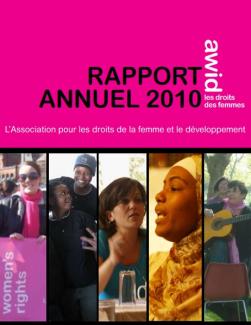
Notre rapport annuel 2010 souligne nos réalisations et l’impact de notre travail durant l'année.
Vous pouvez lire comment nous traduisons notre vision et mission en stratégies et en activités entreprises en collaboration avec les membres, partenaires et allié-e-s de l’AWID pour faire la promotion des droits des femmes et de l’égalité de genre à l’échelle mondiale.
Ce rapport comprend égalment des liens vers nos dernières publications.
por Émilie Herbert-Pontonnier
¿Se acuerdan de Esmeralda? La exótica heroína «gitana» nacida de la pluma del gigante literario francés, Víctor Hugo, y popularizada por los Estudios Disney con su Jorobado de Notre Dame. (...)
< arte: «Si las marronas lo permiten», Nayare Soledad Otorongx Montes Gavilan
« Le privé est politique » - tel est le mantra féministe que personnifiait la fougueuse et courageuse Nadyn Jouny. Nadyn avait personnellement vécu la douleur de la violence structurelle des systèmes juridiques qui refusent aux femmes de jouir de leurs droits.
Lorsqu’elle décide de demander le divorce, les tribunaux religieux chiites – conformément aux lois relatives au statut personnel du Liban – lui refusent la garde de son jeune fils Karam. Comme tant d’autres femmes au Liban et d’autres pays, Nadyn s’est retrouvée dans la situation douloureuse et insoutenable de devoir abandonner ses droits sur son enfant pour pouvoir quitter une relation abusive et non voulue. Mais Nadyn s’est battue, jusqu’au dernier jour.
Elle s’est servie de ses compétences médiatiques pour devenir la voix de celles qui n’en ont pas dans leur combat contre un droit de la famille discriminant, tant au Liban qu’à l’étranger. Nadyn a cofondé le groupe autofinancé « Protecting Lebanese Women » (PLW) et s’est alliée à d’autres mères libanaises vivant des situations similaires. Ensemble, elles ont cherché à sensibiliser la société en manifestant pour leurs droits devant les tribunaux religieux et attirant l’attention des médias sur les très grandes injustices qu’elles subissaient.
Nadyn a également collaboré avec ABAAD – Resource Center for Gender Equality, une autre organisation libanaise pour les droits des femmes, à l’occasion de campagnes pour la défense des droits des femmes, l’égalité dans le droit de la famille et la garde des enfants, et contre le mariage forcé et précoce.
Pour nombre de ses collègues, elle « symbolisait le combat d’une mère libanaise contre toutes les formes de répression et de misogynie » (en anglais), utilisant « son expérience personnelle et sa propre trajectoire d’autonomisation pour donner aux autres l’espoir qu’elles peuvent être des catalyseuses de changement positif ». - ABAAD – Resource Center for Gender Equality, Liban
Nadyn a tragiquement perdu la vie dans un accident de voiture le 6 octobre 2019, alors qu’elle se rendait à une manifestation contre les augmentations de taxes injustifiées, dans un pays qui connaît déjà une crise financière croissante. Nadyn Jouny n’avait que 29 ans au moment de son décès.
Anti-rights discourses continue to evolve. As well as using arguments related to religion, culture, and tradition, anti-rights actors co-opt the language of social justice and human rights to conceal their true agendas and gain legitimacy.

Three decades ago, a US television evangelist and Republican candidate famously said that feminism is an “anti-family political movement that encourages women to leave their husbands, kill their children, practice witchcraft, destroy capitalism and become lesbians.” Today, this conspirative notion gains unprecedented grasp and legitimacy in the form of “gender ideology” discourse, a catch-all bogey-man created by anti-rights actors for them to oppose.
Across a range of discourses employed by anti-rights actors - including notions of “cultural imperialism” and “ideological colonization”, appeals to “conscientious objection” and the idea of a “pre-natal genocide” - a key theme is co-optation. Anti-rights actors take legitimate issues, or select parts of them, and twist them in service of their oppressive agenda.
✉️ By registration only. Register here
📅 Tuesday, March 11, 2025
🕒 6.00-8.00pm EST
🏢 Chef's Kitchen Loft with Terrace, 216 East 45th St 13th Floor New York
Organizer: AWID
par Siufung Law
« 97...! 98…! Où est 98? 98! Veuillez revenir dans la queue!... 99! 100...! » La gérante des coulisses a demandé sans relâche à chaque athlète de faire la queue dans les coulisses humides, en sueur et surpeuplées. (...)
< illustration : « Quand iels nous verront », par Lame Dilotsotlhe
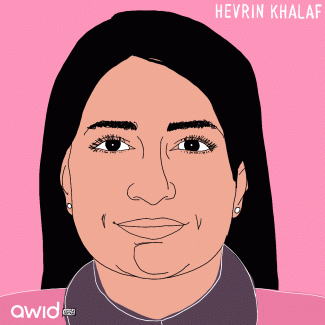
Hevrin Khalaf was a prominent Syrian Kurdish political leader in the autonomous region of Rojava where Kurdish women are risking their lives to resist the Turkish offensive and build a feminist system.
She was Secretary-General of the Future Syria Party (FSP), a group that aimed to build bridges, reconcile different ethnic groups and work towards a “democratic, pluralistic, and decentralized Syria.”
Hevrin was a symbol of this reconciliation effort. She also worked to promote equality between women and men and was a representative for visiting journalists, aid workers, and diplomats.
Hevrin was also a civil engineer from Derik, and was one of the founders of the Foundation for Science and Free Thought in 2012.
On 12 October 2019 she was tortured and murdered by the Turkish-backed militia, Ahrar al-Sharqiya during a military operation against Syrian Democratic Forces in Rojava.
“The killing of Khalaf is a turning point in Syria’s modern history. It once again demonstrated the old Kurdish proverb “no friends but the mountains.” I will always be a friend of Khalaf and her vision of a better world.” - Ahed Al Hendi
 |
Hind and Hind were the first documented queer couple in Arab history. In today’s world, they are a queer artist from Lebanon. |
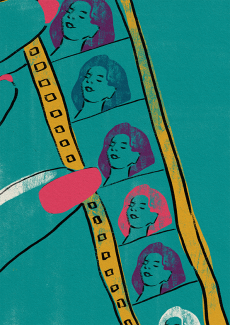
When I was 6, I learned that my grandfather owned a movie theater. My mother recounted to me how it had opened in the early 1960s, when she was also about 6 years old. She remembered that they screened The Sound of Music on the first night.
I would pass by the theater every weekend and watch my grandfather play backgammon with his friends. I didn’t know he was living in the theater, in a room right under the projection booth. I later learned that he moved there after he and my grandmother separated and after the theater closed, in the 1990s, shortly after the Lebanese civil war had ended.
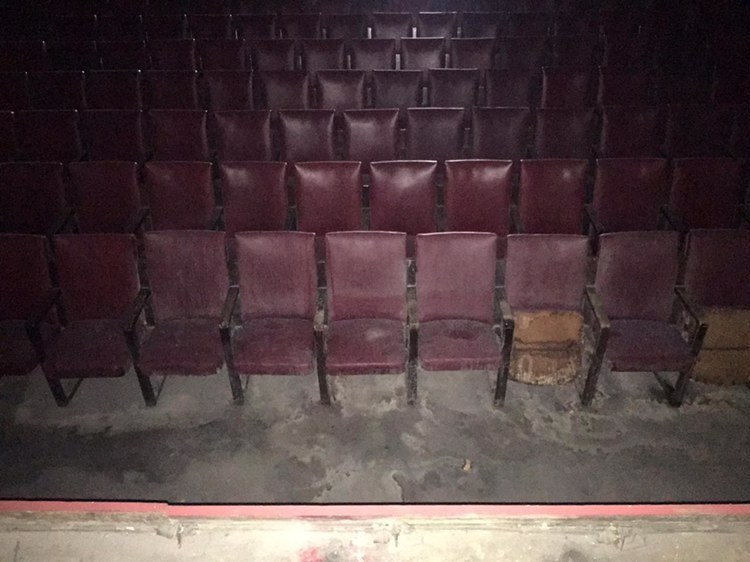
For years and until he passed away, I would mostly see my grandfather play backgammon in the unmaintained reception area of the movie theater. Those repeated scenes are all I remember of him. I never got to properly know him; we never talked about cinema, even though he spent all his time in a run-down movie theater. I never asked him what it was like to live in a place like this. He died when I was 12, on Christmas Eve, from a fall down the spiraling steps that led to the projection booth. It is almost poetic that he passed away in movement, in a house where moving images are perpetually suspended in time.

In the spring of 2020, my cousin called me to say he had cleaned up my grandfather’s movie theater and asked me to meet him there. The two of us had always dreamed of renovating it. I got there before he did. In the reception area, the film poster frames were still there but the posters were gone. I knew there must have been some ticket stubs left somewhere; I found them stacked away in a small rusty tin box, on a shelf in the ticketing booth, and I pocketed some.
I began to walk around. On the main stage, the projection screen was quite dirty and a little torn on the side. I glided my index finger on the screen to remove a patch of dust and noticed that the screen was still white underneath. The fabric seemed to be in good shape too. I looked up to see that my grandmother’s curtains were still in place. They were made of white satin with a little embroidered emblem over the bridge of the curtain, representing the theater. There was a main seating area and a gallery. The chairs seemed to be very worn out.
I noticed the projector peeking out of a small window at the very end of the balcony seating area. I led myself up the spiraling steps of the projection booth.
The room was dark, but a source of light coming from the dusty windows revealed a stack of film reels tossed in a corner. Lifeless celluloid strips were tangled up against the foot of the film projector. The dusty reels were all Western, Bollywood, and Science-Fiction genre films with bad titles like The Meteor that Destroyed Earth, or something of the sort. My attention was caught by the dusty film strips – mostly snippets cut out from reels. One by one, the short strips depicted different kissing scenes, what seemed like a suggestive dance, a nondescript scene of a gathering, a close-up of a woman lying down with her mouth open, opening credits to a Bollywood film, and a “Now Showing” tag that went on for several frames.
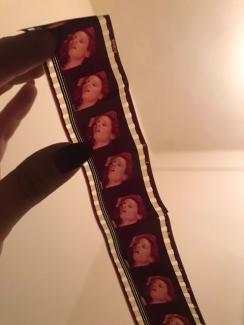
The Bollywood film credits reminded me of my mother. She used to tell me how they would hand out tissues to audience members on their way out of screenings. I kept the kissing scene and suggestive dance strips; I assumed they had been cut out for censorship reasons. The close-up of the woman reminded me of an excerpt from Béla Balázs’ Visible Man, or The Culture of Film, The Spirit of Film, and Theory of the Film. He said that close-ups in film provided a
silent soliloquy, in which a face can speak with the subtlest shades of meaning without appearing unnatural and arousing the distance of the spectators. In this silent monologue, the solitary human soul can find a tongue more candid and uninhibited than any spoken soliloquy, for it speaks instinctively, subconsciously.
Balázs was mostly describing the close-ups of Joan in the silent film La Passion de Jeanne d’Arc. He pointed out how, “...in the silent (movie), facial expression, isolated from its surroundings, seemed to penetrate to a strange new dimension of the soul.”
I examined the film strip further. The woman looked dead, her face almost mask-like. She reminded me of Ophelia by the painter John Everett Millais. In her book On Photography, Susan Sontag says a photograph is “a trace, something directly stenciled off the real, like a footprint or a death mask.” These death masks are like a presence that reminds of an absence.
I remembered encountering a discourse between death and photography in Roberto Rossellini’s forgotten film The Machine that Kills Bad People. In this film, a cameraman goes around taking photographs of people, who would in turn freeze, and are later suspended in time. French film critic André Bazin used to say that photography snatches bodies away from the flow of death and stores them by embalming them. He described this photographic mummification as “the preservation of life by a representation of life.”
This projection booth, its whole layout, all the things that looked like they were moved, the celluloid strips on the ground, everything my grandfather left a mark on – I felt very protective of.
Underneath the strips was an undone dusty film reel. It seemed like someone had been watching the reel manually. At that moment, my cousin made his way up the spiraling steps to find me examining it. He rubbed his fingers along his chin and, in a very-matter-of-fact way, said, “You found the porn.”

I looked at the film strip in my hand and realized it was not a death scene. The strip was cut out of the porn reel. The woman was moaning in ecstasy. Close-ups are meant to convey feelings of intensity, of climax, but I had never really used Balázs’ theories to describe a porn scene. He wrote how “the dramatic climax between two people will always be shown as dialogue of facial expressions in close-up.” I pocketed the film strip and I named the woman Ishtar. She has lived in my wallet ever since. It seemed strange to compare the close depiction of Joan’s fears and courage with Ishtar’s facial expression in ecstasy.
According to my cousin, my grandfather’s brother would wait until my grandfather left the theater and, instead of closing, invite his friends for some after-hour private screenings. I didn’t think much of it. It was a common practice, especially during and after the Lebanese civil war. After the war, television sets were almost in every Lebanese household. I even remember having one in my bedroom in the late 1990s, when I was around 6 years old. I was told that buying porn films on VHS was popular at the time. Mohammed Soueid, a Lebanese writer and filmmaker, once told me that movie theaters used to screen art films and pornography from the mid-1980s to the mid-1990s, so that they could survive. I also heard that projectionists would cut up porn reels to make different montages, so that they could screen something different every night. Eventually, people stayed within the comforts of their homes to watch VHS tapes on their televisions, and movie theaters began to run out of business.

My cousin went back downstairs to go through an archive of paperwork in the office space. I stayed in the booth and began to slip the film strip between my index and middle finger, sliding it up with my thumbs and slowly running the frames through my hands. I lifted the strip against the dusty window and squinted to make sense of the monochrome vignettes. In this series of frames was an extreme close-up of a dick shoved into a vagina. It went on for several frames until I came across a knot in the film, and I imagined the rest.
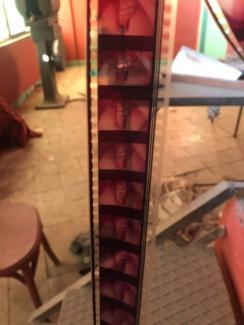
Hank is showcasing his hard-on in front of Veronika who is lying in bed across a Louis XIV secrétaire knockoff. She gets up slowly and slides the thin strap of her see-through négligé off her left shoulder. Hank unties her veiled robe, turns her around, slaps her ass, and pushes her down against the secrétaire. He thrusts his dick inside her pussy repeatedly as the back of the furniture bangs against the wallpaper-adorned wall.
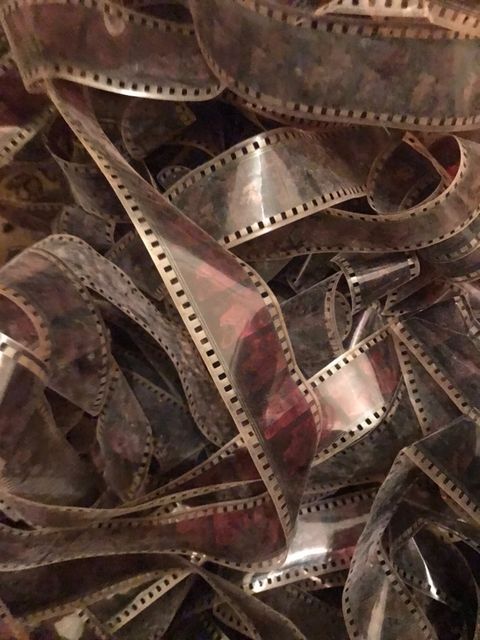
I was always attentive to the interior décor, ever since I was told by my Women in Porn Studies professor that the largest porn archives in North America are interestingly used to examine the middle-class furniture of that epoch. So, while Veronika is bending over and being taken from behind by Hank, a university research assistant could very well be trying to guess the design of the gold motif on the secrétaire, or study the rococo relief on a wooden chair in some corner.
For a moment, the booth became a space for female sexual imagination, disrupting a space otherwise promised for the freedom of male sexuality. I was sure that only men were able to access movie theaters that screened porn films. The film reel was too entangled to undo in a projection booth where dust had accumulated for over a decade, so I stuffed it into my duffle bag and walked out of the theater.
I am not sure what came over me, but I felt compelled to keep it. I wanted to feel the thrill of safeguarding something mysterious, something unorthodox. In my mind, I was sure people knew I was hiding something as I walked down the street. A feeling of guilt intertwined with pleasure came over me. It felt kinky.
I got into the house, preoccupied with the thought of having a porn reel in my duffle bag and the stream of thoughts that had unfolded on my walk home. I immediately went to my bedroom. In some distant part of my mind, I remembered that I shared a wall with Layla’s room next door. She was probably not home, but the possibility of being heard excited me. I closed my bedroom door and I took the film strip of Ishtar out.
I imagined her dressed in a light green veiled dress, dancing seductively in front of me, swinging her hips sideways and smiling with her eyes. I got onto my bed. I slipped my fingers into my panties. I lifted my hips. I trailed my hand down my thighs to part them, and slid two fingers in. I tensed up as I palpated my various creases. I moaned before I could stop myself. I panted and swayed. The rays of sun coming through my window planted reluctant kisses onto my skin. I held my breath in and my limbs quivered. I swallowed my breath and laid flat on the mattress.
When I was an undergraduate student, I had taken an introductory film class and Professor Erika Balsom had scheduled a screening of Bette Gordon’s Variety. I was excited to watch producer Christine Vachon’s first film before she moved onto producing films that are now part of the New Queer Cinema movement. Variety was described as a feminist film about Christine, a woman who begins to work as a ticketing clerk in a porn movie theater in New York city called The Variety Theater. Christine overhears the films at the theater but never goes in. Eventually, she becomes interested in a regular customer, whom she watches closely. She follows him to an adult shop where she stands aside and flips through adult magazines for the first time.
Christine’s voyeurism was displayed in different ways throughout the film. The script was also ridden with excess, and erotic monologues that would be considered obscene or vulgar.
In a scene set in an arcade, she reads erotica to her boyfriend. The camera goes back and forth between a close-up of her boyfriend Mark’s butt as he was playing pinball, swinging his hips back and forth against the arcade machine, and a close-up of Christine’s face as she recited her monologue.
“Sky was hitchhiking and he got a ride from a woman in a pick-up truck. It was late at night and he needed a place to stay, so she offered him her place.
She showed him to his room and offered him a drink. They drank and talked and decided to turn in. He couldn’t sleep, so he put on his pants and walked down the hall to the living room. He was a stop short of being seen, but he could see. The woman was naked and spread on the coffee table with only her legs dangling over. Her whole body was excitingly white as if it’d never seen the sun. Her nipples were bright pink, fire-like, almost neon. Her lips were open. Her long auburn hair licking the floor, arms stretched, fingers tickling the air. Her oiled body was round with no points, no edges. Slithering between her breasts was a large snake curving up around one, and down between the other. The snake’s tongue licking toward the cunt, so open, so red in the lamp light. Hot and confused, the man walked back to his room, and with great difficulty, managed to fall asleep. The next morning, over strawberries, the woman asks him to stay another night. Again, he couldn’t sleep […]”
When I was 23, Lynn, the girl I was dating from film class, surprised me by taking me to watch erotica short films on Valentine’s Day. The event took place at The Mayfair Theater, an independent old movie theater. The architecture of the theater recalled North American Nickelodeons, but with a campy touch. Its balconies were decorated with life-size cardboard cutouts of Swamp Thing and Aliens.
That year, the festival was judged by adult star Kacie May and the program consisted of an hour and a half of short films. The content ranged from soft-core machismo-ridden shorts to scat fetish films. We watched a few minutes of what seemed to be heterosexual soft porn. It followed a couple who start making love in a modern living room space, then move to the bedroom. It was mostly footage of them kissing each other, touching each other, and making love missionary-style. Then a woman with a short brown bob crawled onto the bed, licking the back of her own hand in short strokes. She meowed and crawled over the unconcerned couple. They continued to make love. She crawled out to the kitchen, picked up her empty bowl with her teeth, and placed it onto a pillow. She kept walking over them until the end of the short. It seemed quite absurd. I began to laugh, but Lynn looked a bit uncomfortable. I then looked to our left, watching other audience members chugging beers and inhaling popcorn while laughing hysterically. Their uninterrupted laughter and loud comments really set the tone of the festival. Watching the audience became more interesting than watching the erotic films. The Mayfair Theater often showed cult films, and watching cult films is a communal experience.
It’s not exactly how I imagined my mother’s uncle watching porn in my grandfather’s theater. Movie theaters were openly screening porn films at that time, but I could not picture it happening within my mother’s hometown. I pictured him watching the film from the projector in the booth, so he could quickly stop the screening in case any unexpected guests decided to stop by. His friends sat on the balcony in the back. No one could get in from there unless they had a key, so it was safe. They had to think of everything. It was a conservative Christian neighborhood and they would not want to cause any trouble. They were most likely overcome with excitement and guilt. The voices of loud homoerotic banter merged with sound bites of grunting and moaning, but they reminded each other to keep it down every few minutes. They took turns to check the windows to make sure the sound was not loud enough to alarm any neighbors. Sometimes, they would turn off the speaker and there would be no sound.
After a political protest in 2019, I came across a bookstand on Riad El Solh street, close to Martyr’s Square in downtown Beirut. Towards the end of the table, past the copies of Hugo and de Beauvoir, I found a stack of erotica novels and adult magazines. They were all translations of Western publications. I really did not care which one I picked; I just knew I wanted to own a copy for the thrill of it. I looked for the most interesting cover art.
As he was giving me my change back, the vendor asked me, “Don’t I know you from somewhere?”
He scanned my breasts, gliding his eyes downwards. He probably assumed I worked in the porn or sex industry. I looked into his eyes and said, “No.” I turned around, ready to walk away with my magazine. He then stopped me to say that he had a large archive in his basement, and that he regularly sold porn collections and publications on EBay, to Europe and the USA. Although I was interested in rummaging through that archive, I was not comfortable enough to take his offer. It did not feel safe. I asked him where he found these novels. To my surprise, they were produced in Lebanon.
Walking towards the Riad El Solh statue, I read through the journal I had bought and found the format of the text somewhat canted; the font was a bit smudged, making it illegible. The photographs inside were comprised of faded pornographic collages. It looked raw; I liked that. The title of the novel read, Marcel’s Diaries.
The cover art was clearly a magazine cut-out pasted over a blue sheet. In the picture, a shirtless woman is grabbing her lover’s head, digging her fingers in his hair, while he is kissing her neck from behind. Her skirt is zipped down. Her lover has his hand on her lower right hip. She has her hand over his. Her lips are puckered up and open, almost like she is moaning with pleasure, her 1970s straight blonde hair running down her chest and partially covering her nipples.
I opened the first page. The preface read
which either translates to
“Desire
and deviance”
or to
“Desire
and kink”
I read through the first chapter and I found that whoever translated the text had changed the main character’s name to Fouad, an Arabic name. I assumed they wanted their Lebanese male audience to identify. As I read through, I found that all of his lovers had foreign names like Hanna, Marla, Marcel, Marta.
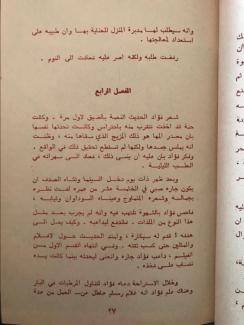
I realized on page 27, chapter four, that Marcel was one of Fouad’s lovers.

The scene took place in a movie theater. Movie theaters were often spaces for sexual freedom in North America, especially since the 1970s after the sexual revolution.
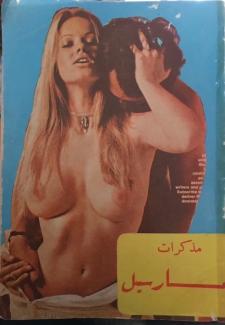
I also assumed they kept all the other foreign names so that it sounds exotic and less taboo. Pornography and erotica were attributed to West Hollywood, despite the fact that the Arab world historically produced erotic texts. Erotica became taboo, and the only way to safely produce it was to market it as foreign, as exotic.
It is interesting how the exotic covers for the erotic. The difference between the two adjectives is rooted in their Greek etymologies: exotic is from exo, “outside,” meaning alien or foreign. Erotic is derived from Eros, the god of sexual love. So, what’s exotic is mysterious and foreign – what’s erotic is sexy.
In Lebanon there is a thin line between the exotic and the erotic in cinema, like the thin line between art films and porn films. In 2015, during a conversation with filmmaker Jocelyne Saab in a Vietnamese restaurant in Paris, I learned that she had to shoot her art film Dunia a second time to change the dialect from Egyptian to Lebanese. She told me that her actors were Egyptian, and that she wasn’t strict about the script. She was not allowed to use Egyptian dialect. It had to be in Lebanese because the producers were concerned about the borderline erotic scenes in the film. So, they made it foreign.
Margarita est une militante féministe et LGBTIQA d'Amérique latine. Elle est passionnée de transformation sociale et de bien-être collectif. Elle est titulaire de diplômes en psychologie, communication et en administration publique, ainsi que de certificats en politiques publiques, leadership, gestion et prise de décision. Durant son parcours professionnel, Margarita a acquis une vaste expérience auprès d'organisations de terrain, d'ONG nationales et régionales, d'universités et du secteur public, développant la facilitation, le renforcement des capacités, le plaidoyer politique, la communication et l'évaluation des politiques.
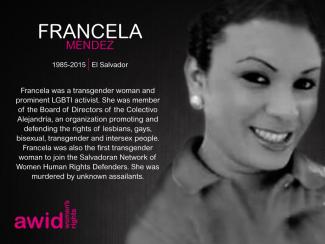
Diana Isabel Hernández Juárez fue una maestra guatemalteca, defensora de los derechos humanos y activista comunitaria y del medioambiente. Fue la coordinadora del programa ambiental de la parroquia de Nuestra Señora de Guadalupe, en la costa sur del país.
Diana dedicó su vida a co-crear conciencia ambiental, y trabajó de modo particularmente estrecho con comunidades locales para abordar problemas ambientales y proteger los recursos naturales. Inició proyectos tales como viveros forestales, granjas municipales, huertas familiares y campañas de limpieza. Participó activamente en programas de reforestación, tratando de recuperar especies nativas y paliar la falta de agua, en más de 32 comunidades rurales.
El 7 de septiembre de 2019, Diana recibió disparos y fue asesinada por dos hombres armados desconocidos mientras se encontraba participando de una procesión en su comunidad. Diana tenía solamente 35 años en el momento de su muerte.