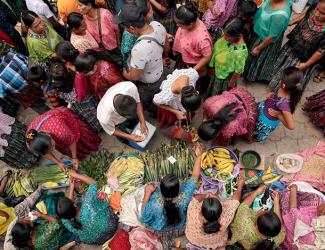
UN Women / Flickr (CC BY-NC-ND 2.0)
Guatemala - Rural Women Diversify Incomes and Build Resilience
Left
Half
Left

Priority Areas

Supporting feminist, women’s rights and gender justice movements to thrive, to be a driving force in challenging systems of oppression, and to co-create feminist realities.

Building Feminist Economies

Building Feminist Economies is about creating a world with clean air to breath and water to drink, with meaningful labour and care for ourselves and our communities, where we can all enjoy our economic, sexual and political autonomy.


In the world we live in today, the economy continues to rely on women’s unpaid and undervalued care work for the profit of others. The pursuit of “growth” only expands extractivism - a model of development based on massive extraction and exploitation of natural resources that keeps destroying people and planet while concentrating wealth in the hands of global elites. Meanwhile, access to healthcare, education, a decent wage and social security is becoming a privilege to few. This economic model sits upon white supremacy, colonialism and patriarchy.

Adopting solely a “women’s economic empowerment approach” is merely to integrate women deeper into this system. It may be a temporary means of survival. We need to plant the seeds to make another world possible while we tear down the walls of the existing one.


We believe in the ability of feminist movements to work for change with broad alliances across social movements. By amplifying feminist proposals and visions, we aim to build new paradigms of just economies.

Our approach must be interconnected and intersectional, because sexual and bodily autonomy will not be possible until each and every one of us enjoys economic rights and independence. We aim to work with those who resist and counter the global rise of the conservative right and religious fundamentalisms as no just economy is possible until we shake the foundations of the current system.


Our Actions

Our work challenges the system from within and exposes its fundamental injustices:

  • Advance feminist agendas: We counter corporate power and impunity for human rights abuses by working with allies to ensure that we put forward feminist, women’s rights and gender justice perspectives in policy spaces. For example, learn more about our work on the future international legally binding instrument on “transnational corporations and other business enterprises with respect to human rights” at the United Nations Human Rights Council.

  • Mobilize solidarity actions: We work to strengthen the links between feminist and tax justice movements, including reclaiming the public resources lost through illicit financial flows (IFFs) to ensure social and gender justice.

  • Build knowledge: We provide women human rights defenders (WHRDs) with strategic information vital to challenge corporate power and extractivism. We will contribute to build the knowledge about local and global financing and investment mechanisms fuelling extractivism.

  • Create and amplify alternatives: We engage and mobilize our members and movements in visioning feminist economies and sharing feminist knowledges, practices and agendas for economic justice.


“The corporate revolution will collapse if we refuse to buy what they are selling – their ideas, their version of history, their wars, their weapons, their notion of inevitability. Another world is not only possible, she is on her way. On a quiet day, I can hear her breathing”.

Arundhati Roy, War Talk
Related Content

Snippet Organising to Win_Fest (EN)

Plenary session:

Organising to Win

Margarita Salas, AWID
Nazik Abylgaziva, Labrys
Amaranta Gómez Regalado, Secretariado Internacional de Pueblos Indígenas frente al VIH/sida, la Sexualidad y los Derechos Humanos
Cindy Weisner, Grassroots Global Justice Alliance
Lucineia Freitas, Movimento Sem Terra

watch plenary


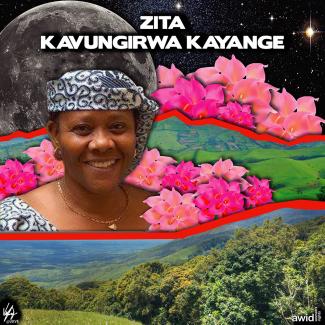
Zita Kavungirwa Kayange

Zita was a women’s rights activist who defended the rights of rural women in Greater Kivu.

She was the first Executive Director of UWAKI - a well known women’s organisation. Through her work with Women's Network for Rights and Peace (RFDP), and the Women's Caucus of South Kivu for Peace, she committed her life to helping to restore peace in the Eastern DRC. She spoke out strongly against the use of sexual violence as a weapon of war.

In 2006, she put herself forward as a candidate in the first democratic elections in the DRC. Although she did not win, she continued to advocate for women’s rights and the South Kivu community remembers her fondly. 


Zita Kavungirwa Kayange, Republic Democratic of Congo

AWID ให้ทุนสำหรับการเข้าร่วมหรือไม่

จากงบประมาณในส่วนของการสร้างการเข้าถึงของเราจะสามารถมีทุนจำกัดจำนวนสำหรับสนับสนุนการเข้าร่วมของนักกิจกรรมที่ไม่สามารถหาทางอื่นๆได้และอีกทั้งยังไม่มีความสัมพัยธ์กับแหล่งทุนที่สามารถสนับสนุนการเข้าร่วมของพวกเขา โดยหากคุณมีหนทางเป็นไปได้อื่นๆกรุณาลองติดต่อประสานงานดูก่อน ส่วนพวกเราจะพยายามอย่างสุดความสามารถที่จะจัดให้มีทุนสนับสนุนให้มากที่สุดเท่าที่จะมากได้ และเราจะแจ้งรายละเอียดของกระบวนการสมัครเพื่อรับทุนนี้ในช่วงต้นปี 2567

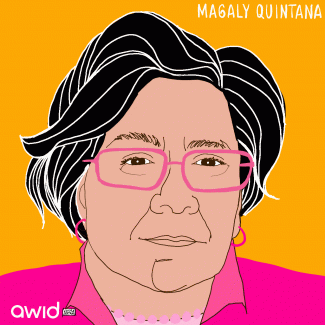
Magaly Quintana

Magaly Quintana was known by many in Nicaragua as ‘La Maga’ (meaning wizard). She was a feminist historian, activist, and an unyielding defender of women’s rights demanding justice for the victims of femicide.

Magaly was committed to documenting and building statistics on women and girls who were killed as a result of sexual violence in the country. 

“She rebuilt the life of each one, of their families, to show those lives that had been torn away.” - Dora María Téllez

Magaly also criticized the government for reforming Law 779 addressing violence against women. A product of the hard work of Nicaraguan women’s movements, this law included important provisions to criminalize femicide before its reform. She argued that legislative reforms weakened the law and limited the definition of femicides to homicides, as a result invisibilizing violent crimes against women.

Magaly’s feminist organizing began in the early 1980s. She was the director of Catholic Women for the Right to Choose, advocating for the right to therapeutic abortion after it was banned in 2006. In 2018, she supported the protests against Daniel Ortega’s government.

Magaly was born in May 1952 and passed away in May 2019.

“See you later, my dearest Magaly Quintana. Thanks so much, thanks for your legacy. We’ll see you again, as strong and powerful as ever.”- Erika Guevara Rosas (American Director of Amnesty International)

ฉันเสนอกิจกรรมไปในฟอรัมที่ผ่านมา ฉันยังจำเป็นต้องสมัครใหม่อีกครั้งหรือไม่

กรุณาสมัครใหม่อีกครั้ง โลกได้เปลี่ยนไปจากปี 2564 และเราขอเชิญชวนให้คุณเสนอกิจกรรมที่ถ่ายทอดความจริงและสิ่งที่คุณให้ความสำคัญในปัจจุบัน

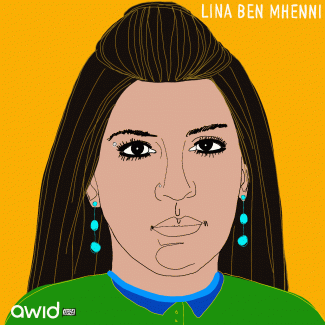
Lina Ben Mhenni

“I want to tell all Tunisians: We have to unite to say no to censorship and opinion trials.” - Lina Ben Mhenni (2013 interview)

Lina Ben Mhenni was a Tunisian blogger, activist and linguistics lecturer. She was vocal against internet censorship, defended the freedom of expression and was an advocate for women’s and human rights. Lina also fought for the release of students arrested under former President Zine El Abidine. 

“It’s true that information and the internet are important but being on the ground is crucial for a revolution. Some people here in Tunisia think that change can occur just by clicking like on the internet. I believe you have to be active on the ground. And of course, join actions on the field with the action on the web.” - Lina Ben Mhenni (Interview in POCIT)

In 2010, she co-organized a protest that challenged the government suppression of media and internet censorship. Lina was widely known for her blog “A Tunisian Girl and recognized for her work during the Tunisian revolution in 2011. In her blog, she reported on the news from the uprising, shared images documenting protests and was among the few voices who spoke about the killings and crackdown on protesters in Sidi Bouzid. Lina blogged using her real name instead of a pseudonym to protect her identity, one of only a few bloggers to do so. 

“Our freedom of expression is in real danger. I am afraid that we are losing the unique fruits of the revolution: the disappearance of fear and our freedom of speech. We have to keep on fighting to protect and preserve this right.” — Lina Ben Mhenni (2013 interview)

Lina was only 36 years old when she passed away on 27 January 2020, as a result of complications from an autoimmune disease. 


"Freedom, better education and health - that's all we wanted. When we failed, she pushed us." Lina’s school teacher Hala.


CFA FAQ - Accessibility and Health - Thai

สุขภาพและการช่วยในการเข้าถึง

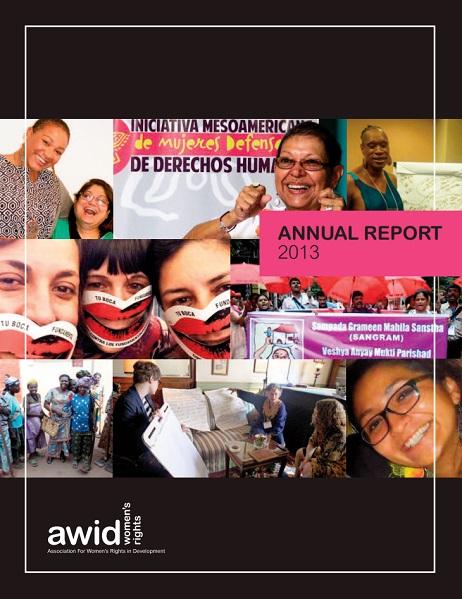
Annual Report 2013

Our 2013 Annual Report provides key highlights of our work during the year to contribute to the advancement of women’s rights and gender equality worldwide.

2013 marked the beginning of our 2013-2016 Strategic Plan, developed in response to the current global context. This report provides highlights of our analysis of the global context, how we position ourselves as a global feminist membership organization in this context, the outcomes we seek to achieve, and how our work is organized to achieve these outcomes.

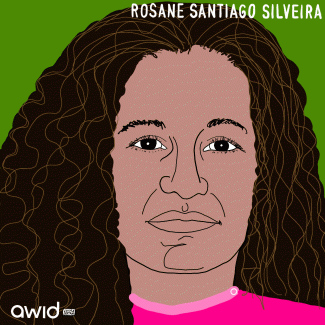
Rosane Santiago Silveira

Rosane Santiago Silveira was affectionately known as Rô Conceição. A Brazilian environmental and human rights activist, she fervently fought to protect the environment where it was most threatened. 

This included defending it on the island of Barra Velha, where it was endangered by oil exploration, as well as safeguarding it by campaigning against land-grabbing and expansion of eucalyptus plantations in Bahia State, where Rosane was a member of the Cassurubá Extractivist Reserve Council.

“Extractive Reserve is a protected area where resident families make their living off natural products extracted from the forest. These activities help maintain the forest integrity.” - Global Justice Ecology Project (original source: Rede Brasil Atual)

She was part of trade union activities, human rights and cultural movements. Rosane dedicated much of herself to causes that were not only close to her but are also of concern to land, forests, rivers, and communities whose rights and lives are continuously at risk.

She was tortured and murdered on 29 January 2019 in Nova Viçosa, a city in southern Bahia. 

“Unfortunately, today there is a feeling of total insecurity, because of the State’s absence in prosecuting these crimes. We were with her at Christmas, and everyone realised that she was worried and now we know that she had received three death threats,”  - Tuian, Rosane’s son in an interview with Rádio Brasil Atual (original source: Rede Brasil Atual)

Snippet - CSW68 Intro

Reclaiming Feminist Power

This year, we, alongside feminist activists from across the world, will be at CSW68 in New York, to challenge capitalist, neoliberal narratives and false solutions around poverty, development and financing. Through in-person events, lives on our socials, an exhibit booth and more; we are showing up to convene, amplify and support the voices and participation of our members, partners and allies.

Learn more about our program this year below.

Stephanie Bracken

Biography

Stephanie Bracken is a feminist who is dedicated to building and supporting strong systems that meet the needs of the moment and the people who interact with them, and serve principles of justice. She holds a Master of Human Rights from the University of Sydney and a BA in Gender Studies, History, and Philosophy from McGill University, and has experience working with feminist and social justice organizations on monitoring, evaluation & learning, strategic work planning, governance, project management, and building operational systems and processes. Stephanie is based in Tiohtià:ke/Montreal, where she enjoys singing with others, camping, fiber arts, and spending time with her kids and community.

Position
Operations Manager
Add to stories
Off

Snippet - Shines light - EN

Shines a light on the financial status of diverse feminist, women’s rights, gender justice, LBTQI+ and allied movements in all regions and all contexts

Juhi

Biography

Juhi is a tech enthusiast with a Bachelor's degree in Computer Engineering from Gujarat Technological University and a postgraduate background in Wireless Telecommunications and Project Management from Humber College. With a passion for problem-solving and a love for staying ahead in the ever-evolving tech landscape, Juhi has found herself navigating through various industries as an IT Technician. to the nurturing environment of the School Board, Juhi has had the opportunity to apply her technical skills in diverse settings, always embracing new challenges with enthusiasm. Beyond the code and circuits, Juhi loves life's adventures. Exploring new places and cultures is like a breath of fresh air to her. Whether it's discovering hidden gems in the city, trying out exotic cuisines, or embarking on thrilling adventure sports, Juhi is always up for new experiences.

Position
IT Support Coordinator
Add to stories
Off

Snippet - WITM Our objectives - EN

Our research objectives

1

Provide AWID members, movement partners and funders with an updated, powerful, evidence-based, and action-oriented analysis of the resourcing realities of feminist movements and current state of the feminist funding ecosystem.

2

Identify and demonstrate opportunities to shift more and better funding for feminist organizing, expose false solutions and disrupt trends that make funding miss and/or move against gender justice and intersectional feminist agendas.

3

Articulate feminist visions, proposals and agendas for resourcing justice.

Fatima Qureshi

Biography

A nomad of cultures, born in Hong Kong, rooted in Turkish-Pakistani heritage, Fatima’s love for narratives - both in reading and co-creating them - fueled her passion for communications activism. Supported by her education in journalism, Fatima has worked for 7 years in digital and media communications fields with NGOs that provide education opportunities and legal aid to refugee and asylum seekers, as well as with the Muslim feminist movement which applies feminist and rights-based lenses in understanding and searching for equality and justice within Muslim legal tradition. She is a regular op-ed writer on feminist issues in the Global South.

Through storytelling in this hyper-digital age of social media, Fatima continues to collaborate with community organizers and grassroots activists to create audiovisual content with the aim to cultivate bridges of understanding towards collective liberation and decolonization. On days when she’s not working, she intently watches independent feminist films coming from Iran, Morocco and Pakistan and on other days, she performs spoken word poetry with her comrades in Kuala Lumpur.

Position
ICM Digital Communications and Partnerships Lead
Add to stories
Off

How can I access the survey?

The survey is available on KOBO, an open-source platform for collecting, managing, and visualizing data. To participate, simply click on the survey link here and follow the instructions to complete the survey. 

What issues does AWID work on?

AWID works towards the realization of gender justice and women’s human rights worldwide. We work to strengthen the voices and impact of women’s rights advocates, organizations and movements. Our main Priority Areas relate to themes that are closely linked to dominant global trends.

These themes reflect growing challenges that negatively impact women’s rights worldwide.

  • Economic Justice
  • Resourcing Women’s Rights
  • Challenging Religious Fundamentalisms
  • Women Human Rights Defenders
  • Young Feminist Activism

Find out more about AWID's Priority Areas

I have responded to the survey but changed my mind and want our response to be withdrawn, what do I do?

If, for any reason, you want your response to be withdrawn and deleted, you have the right to do so. Please contact us via the form here, indicating “WITM Survey” as the title of your message, and we will withdraw and delete your response.

2005: Second High-level Dialogue takes place

Second High-level Dialogue on Financing for Development

  • The overall theme of the Second High-level Dialogue on Financing for Development, from 27-28 June 2005 was The Monterrey Consensus: status of implementation and tasks ahead. 
  • Apart from the traditional six roundtables on each of the individual chapters of the Monterrey Consensus, there was an informal interactive dialogue with the participation of a range of stakeholders including women’s rights groups.  
  • There was a call from ‘developing’ nations that global challenges and local needs and possibilities be taken into account when interacting with different groups including women, youth, people with disabilities etc. on the themes identified in the Monterrey consensus.  

Snippet - WITM To share - RU

Чтобы поделиться опытом финансирования в вашей организации