UN Women / Flickr (CC BY-NC-ND 2.0)
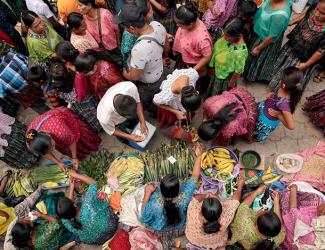
Guatemala - Rural Women Diversify Incomes and Build Resilience
Left
Half
Left

Priority Areas

Supporting feminist, women’s rights and gender justice movements to thrive, to be a driving force in challenging systems of oppression, and to co-create feminist realities.

Building Feminist Economies

Building Feminist Economies is about creating a world with clean air to breath and water to drink, with meaningful labour and care for ourselves and our communities, where we can all enjoy our economic, sexual and political autonomy.


In the world we live in today, the economy continues to rely on women’s unpaid and undervalued care work for the profit of others. The pursuit of “growth” only expands extractivism - a model of development based on massive extraction and exploitation of natural resources that keeps destroying people and planet while concentrating wealth in the hands of global elites. Meanwhile, access to healthcare, education, a decent wage and social security is becoming a privilege to few. This economic model sits upon white supremacy, colonialism and patriarchy.

Adopting solely a “women’s economic empowerment approach” is merely to integrate women deeper into this system. It may be a temporary means of survival. We need to plant the seeds to make another world possible while we tear down the walls of the existing one.


We believe in the ability of feminist movements to work for change with broad alliances across social movements. By amplifying feminist proposals and visions, we aim to build new paradigms of just economies.

Our approach must be interconnected and intersectional, because sexual and bodily autonomy will not be possible until each and every one of us enjoys economic rights and independence. We aim to work with those who resist and counter the global rise of the conservative right and religious fundamentalisms as no just economy is possible until we shake the foundations of the current system.


Our Actions

Our work challenges the system from within and exposes its fundamental injustices:

  • Advance feminist agendas: We counter corporate power and impunity for human rights abuses by working with allies to ensure that we put forward feminist, women’s rights and gender justice perspectives in policy spaces. For example, learn more about our work on the future international legally binding instrument on “transnational corporations and other business enterprises with respect to human rights” at the United Nations Human Rights Council.

  • Mobilize solidarity actions: We work to strengthen the links between feminist and tax justice movements, including reclaiming the public resources lost through illicit financial flows (IFFs) to ensure social and gender justice.

  • Build knowledge: We provide women human rights defenders (WHRDs) with strategic information vital to challenge corporate power and extractivism. We will contribute to build the knowledge about local and global financing and investment mechanisms fuelling extractivism.

  • Create and amplify alternatives: We engage and mobilize our members and movements in visioning feminist economies and sharing feminist knowledges, practices and agendas for economic justice.


“The corporate revolution will collapse if we refuse to buy what they are selling – their ideas, their version of history, their wars, their weapons, their notion of inevitability. Another world is not only possible, she is on her way. On a quiet day, I can hear her breathing”.

Arundhati Roy, War Talk

Related Content

บุคคลหรือองค์กรสามารถส่งใบสมัครหลายกิจกรรมได้หรือไม่

คุณสามารถส่งกิจกรรมได้มากถึง 2 กิจกรรมในฐานะผู้จัดกิจกรรม และคุณยังสามารถเป็นผู้ร่วมจัดในการส่งกิจกรรมของผู้อื่นได้

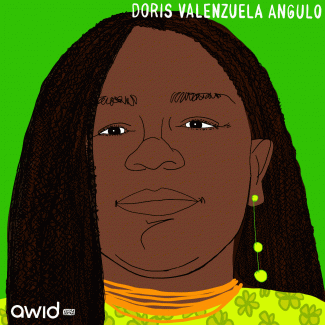
Doris Valenzuela Angulo

Doris Valenzuela Angulo was an Afro-descendant social activist, leader and human rights defender from Buenaventura, Colombia. She was part of Communities Building Peace in the Territories (CONPAZ), a national network of organizations in communities affected by armed conflict that advocate for non-violence and socio-environmental justice. 

Doris defied constant paramilitary violence and pressures from mega projects to displace her community and state collusion. Faced with one of the most difficult contexts in her country, she played a leadership role in an unprecedented initiative of non-violent resistance called Puente Nayero Humanitarian Space, an urban place for community cohesion, safety, creativity and collective action. 

This unique non-violent struggle of the families that belonged to Puente Nayero Humanitarian Space, attracted attention and support from both local and international agencies. By September 2014, the Inter-American Commission on Human Rights had granted precautionary protection measures to the community ordering the Colombian State to adopt necessary measures to preserve their lives and personal integrity. However, the threats and violence from the paramilitaries continued. Doris focused her energies on preventing forced recruitment of children and young people by the neo-paramilitaires, continuing on despite the murder of her son Cristian Dainer Aragón Valenzuela in July 2015. Doris also became a target, continuously receiving threats for her activism and the work she did.  

The continued aggression and threats against her life forced Doris to leave Colombia. She was residing in Spain from February 2017 to February 2018, as part of the Amnesty International temporary protection program for human rights defenders at risk. In April 2018, Doris was murdered in Murcia, Spain by her ex-partner. She was only 39 years old. 


Tributes:

"Doris, spending a whole year with you has taught us how a person can have the ability to transform and generate hope in the face of deeply negative and devastating events during your life...We continue with our commitment in the defense of all human rights. Your courage and your light will always guide us.” - Montserrat Román, Amnesty International Grupo La Palma

Excerpt from “Words for Doris Valenzuela Angulo” by Elsa López

"..You knew it. You always knew. And in spite of everything you stood firm against so many injustices, so many miseries, so much persecution. You stood up, haughty and fierce, against those who wanted to make you again abandon your hopes, humble yourself and surrender. Standing up you cried out for your freedom and ours that was yours. Nothing and no one paralyzed your efforts to change the world and make it more generous and livable. You, live among us, more alive today than ever among us despite death. Always live by your gestures, your courage, your greatness when crying for a promised land that you came to invoke with each of your cries for all the deserts you inhabited. You. Always alive. Doris Valenzuela Angulo.

They are only words. I know. I know it too. But the words unite us, protect us, give us strength and encouragement to continue walking towards the light that you defended so much…” 
วิทยากรหรือรายละเอียดกิจกรรมต่างๆสามารถเปลี่ยนแปลงในปี 2567

ได้หรือไม่ เพราะได้มีการเสนอกิจกรรมเป็นเวลาเกือบ 1 ปีก่อนกิจกรรมจริง

แน่นอน! ในตอนนี้แบบฟอร์มสำหรับเสนอกิจกรรมได้ให้ระบุชื่อวิทยากร แม้วิทยากรเหล่านั้นอาจยังไม่ได้ยืนยันเข้าร่วมเราเข้าใจว่าการเปลี่ยนแปลงอาจเกิดขึ้นได้ภายในระยะเวลา 1 ปี

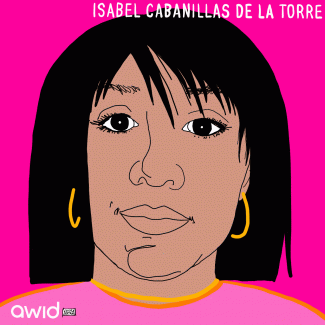
Isabel Cabanillas de la Torre

Isabel Cabanillas de la Torre was a much loved young feminist artist and activist from Ciudad Juárez, Mexico, known for her beautiful and evocative hand-painted clothing with eyes being an emblematic feature in her work. Her murals transformed the run down and vacant buildings in Ciudad Juarez’s downtown, bringing life and political commentary to their walls.

Through her art and political activism Isabel sought to draw attention to the gender based violence pervasive in her hometown. She volunteered with the women’s network Mesa de Mujeres on the Citizen Observatory on Gender to monitor the performance of judges, prosecutors and public defenders on cases of femicides and other gender based violations. She was also a member of Hijas de su Maquilera Madre, a feminist collective whose name makes reference to the daughters of mothers who are maquila workers. Some of these mothers were among the first victims of femicide in the city.

Isabel’s latest project, still in progress, was an art installation to protest a Canadian company that was looking to mine copper in the Samalayuca Desert. 

On 18 January, 2020 Isabel was shot while riding her bike back home in Downtown Juárez, in what appeared to be a targeted killing, her body found beside her bike.

Isabel’s murder, sparked a new wave of outrage against femicides in the region, hundreds marched to the US-Mexico border bridge, blocking it for hours and chanting “Ni una mas” (Not one more) as feminist collectives continue to protest the murders of women throughout Mexico. In 2019 alone, 3142 women and girls were killed in Mexico, many of whom were targeted specifically because of their gender.

She loved riding her bike.

"The bike for her was a symbol of freedom. A symbol of being free in the streets." - Marisol (a friend of Isabel’s)  

CFA FAQ - Other questions - Thai

คำถามอื่นๆ

Snippet - CSW68 - Responding to Anti-rights - EN

Responding to Anti-rights Developments

in Multilateral and Regional Spaces

✉️ By Invite Only
📅Tuesday, March 12
🕒2-3.30pm EST

Organiser: Observatory on the Universality of Rights (OURs) Consortium
🏢Blue Gallery, 222 E 46th St, New York

Snippet - WITM To make - EN

To make the complexity of resourcing diverse forms of feminist organizing visible

Snippet - WITM RESOURCES - EN

Resources

How many questions are in the survey?

There are 47 questions in total, of which 27 are mandatory* and the remaining 20 are optional. The majority of questions are multiple-choice. We invite you to respond to all the questions.

Can I contact someone if I have questions or concerns?

If you have any questions or concerns, please contact us via the form here, indicating “WITM Survey” as the title of your message. You can also write to us at witm@awid.org.

Snippet - WITM to claim - RU

Чтобы заявить о себе как об эксперте по вопросам ресурсного обеспечения феминистских движений

Snippet - WITM Why now_col 1 - PT

Por que devo responder à pesquisa agora?

A monochromatic orange illustration of a woman with curly hair with her hand on her chin. She seems to inquisitive or posing a question.

Os movimentos feministas, de direitos das mulheres, de justiça de género, de LBTQI+ e de aliados em todo do mundo encontram-se num momento crítico, e enfrentam uma forte retaliação contra direitos e liberdades conquistados anteriormente. Os últimos anos trouxeram o crescimento rápido do autoritarismo, a violenta repressão da sociedade civil e a criminalização dos defensores dos direitos humanos das mulheres e de pessoas de género diverso, o aumento da guerra e do conflito em várias partes do nosso mundo, a perpetuação contínua de injustiças económicas e crises de saúde, da ecologia e do clima interligadas.

Snippet - WITM RESOURCES - RU

Ресурсы

(Доступно на английском языке)

Quem deve participar no inquérito?

Grupos, organizações e movimentos cujo foco específico ou principal seja os direitos das mulheres, de jovens, a justiça de género, os direitos das pessoas LBTQI+ e de aliados em todas as regiões e em todos os níveis, quer sejam novos ou já estabelecidos.

هل على مجموعتنا، منظمتنا أو حركتنا تعبئة الاستطلاع مع أننا لم نحشد أو نأخذ تمويلاً من ممولين/ات خارجيين/ات؟

نعم! نلاحظ ونقدّر الأسباب المختلفة لعدم تلق الحركات النسوية التمويل الخارجي، حيث من الممكن أن تكون غير مؤهلة لتقديم الطلبات للتمويل و\ أو تلقّي المال من خارج البلاد، أو الاعتماد على المصادر التي يتم إنتاجها بشكل مستقل كاستراتيجية سياسية. نريد أن نسمع منكم/ن بعيدا عن تجربتكم/ن مع التمويل الخارجي.

Membership why page page - to join as a member block

To join as a member - step by step

  1. Read and endorse the AWID Values and Community Guidelines.
  2. Fill out your membership sign-up form and indicate your contribution to at least one type of action proposed.
  3. Check your mailbox for a confirmation of your membership.
  4. Fulfill your contribution commitment to the type(s) of action you chose in the sign-up form.

Моего языка нет в списке и мне сложно заполнить опрос – что мне делать?

AWID стремится к языковой справедливости, и мы сожалеем, что на данный момент проведение опроса на большем количестве языков не представляется возможным. Если вам нужна помощь в переводе или вы хотите заполнить анкету на любом другом языке, пожалуйста, свяжитесь с нами по адресу witm@awid.org

FRMag - Freeing the Church

Freeing the Church, Decolonizing the Bible for West Papuan Women

by Rode Wanimbo

I was born and grew up in Agamua, the Central Highlands of West Papua. My father belongs to the Lani tribe and my mother comes from Walak. (...)

Read


< artwork: “Offerings for Black Life” by Sokari Ekine

O nosso grupo não recebeu qualquer financiamento nos três anos entre 2021 e 2023. Devemos preencher o questionário mesmo assim?

Sim, ainda queremos a sua resposta, independentemente de terem recebido financiamento em três, dois, um, ou qualquer um dos anos entre 2021 e 2023.

Film club - Tenderness is the sharpest resistance

Our first Feminist Film Club program is now available to view: “Tenderness is the Sharpest Resistance” is a film series on Asian/Pacific Feminist Realities curated by Jess X Snow 

WATCH