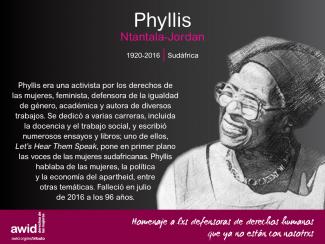
Phyllis Ntantala-Jordan
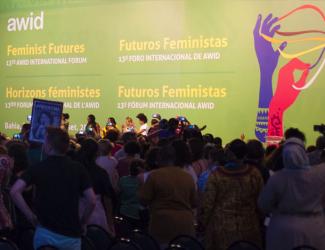
In September 2016, the 13th AWID international Forum brought together in Brazil over 1800 feminists and women’s rights advocates in a spirit of resistance and resilience.
This section highlights the gains, learnings and resources that came out of our rich conversations. We invite you to explore, share and comment!
One of the key takeaways from the 2016 Forum was the need to broaden and deepen our cross-movement work to address rising fascisms, fundamentalisms, corporate greed and climate change.
With this in mind, we have been working with multiple allies to grow these seeds of resistance:
And through our next strategic plan and Forum process, we are committed to keep developing ideas and deepen the learnings ignited at the 2016 Forum.
AWID Forums started in 1983, in Washington DC. Since then, the event has grown to become many things to many peoples: an iterative process of sharpening our analyses, vision and actions; a watershed moment that reinvigorates participants’ feminisms and energizes their organizing; and a political home for women human rights defenders to find sanctuary and solidarity.
Les frais d’inscription au Forum de l’AWID pour tou-te-s les participant-e-s couvrent :
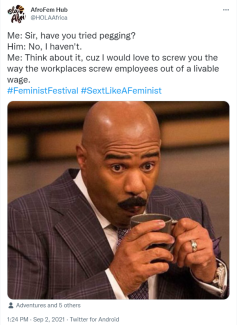
Yo: Señor, ¿probó por el culo?
Él: No, no probé.
Yo: Piénselo, porque me gustaría cogérmelo / joderlo tal como a lxs trabajadorxs nos cogen / joden en los trabajos cuando lo que nos pagan no alcanza para vivir.
La cocréation de nos réalités féministes commence par nous-mêmes, et nos façons de nous traiter les un·e·s les autres. Nous nous efforçons de créer et de protéger des espaces qui sécurisent et soutiennent nos communautés, à la fois en ligne et en personne.
Nous envisageons aussi les espaces sécurisés et accueillants, tout comme cocréés, et dont la possession est partagée. Nous attendons de nos membres qu'iels agissent de façon éthique, responsable et cohérente vis-à-vis des valeurs de l’AWID, et qu'iels assument une responsabilité collective pour garantir un environnement de respect mutuel et de solidarité.
Remarque :
L’AWID se réserve le droit de supprimer des commentaires, suspendre ou révoquer l’adhésion de membres en cas de violation des règles de la communauté. Les membres de l’AWID ne sont pas autorisés à représenter l’AWID à titre officiel, sauf mention écrite contraire. Les membres ne peuvent pas utiliser les espaces de l’AWID à des fins de prosélytisme ou de recrutement de membres pour rejoindre une organisation ou une croyance religieuse. Les membres ne peuvent pas utiliser les espaces de l’AWID pour demander des fonds à des fins personnelles, bien que les liens vers des actions de levée de fonds ou des campagnes de mobilisation soit autorisés.
إن موضوع المنتدى – “النهوض معًا” – هو دعوة للتفاعل مع أنفسنا بالكامل، والتواصل مع بعضنا البعض بتركيز واهتمام وبشجاعة، حتى نتمكن من الشعور بنبض الحركات العالمية والنهوض معًا لمواجهة تحديات هذه الأوقات.
تمر الحركات النسوية وحقوق المرأة والعدالة الجندرية ومجتمع الميم عين والحركات الحليفة في جميع أنحاء العالم بمرحلة حرجة، وتواجه ردة فعل قوية على الحقوق والحريات المكتسبة سابقًا. لقد جلبت السنوات الأخيرة صعوداً سريعاً للأنظمة الاستبدادية، والقمع العنيف للمجتمع المدني، وتجريم النساء والمدافعين عن حقوق الإنسان من مختلف الأنواع الاجتماعية، وتصاعد الحروب والصراعات في أجزاء كثيرة من عالمنا، واستمرار الظلم الاقتصادي، والمشاكل الصحية والأزمات البيئية والمناخية المتقاطعة.
إن حركاتنا تترنح، وفي الوقت نفسه، تسعى إلى بناء والحفاظ على القوة والثبات اللازمين للعمل الذي ينتظرنا. لا يمكننا القيام بهذا العمل بمفردنا، في صوامعنا. يعد الاتصال والشفاء ضروريين لتحويل اختلالات القوة المستمرة والتصدعات داخل حركاتنا. ويجب علينا أن نعمل ونضع الاستراتيجيات بطرق مترابطة، حتى نتمكن من تحقيق النجاح معًا. يعزز منتدى جمعية حقوق المرأة في التنمية هذا العنصر الحيوي المتمثل في الترابط في البقاء أقوياء/ قويات وتأثير النمو والتحول للتنظيم النسوي على مستوى العالم.
Lisez nos recherches sur le financement, sur les défenseuses des droits humains, sur la création de mouvements, sur les fondamentalismes, la justice économique et beaucoup plus
Plus qu’un simple évènement, le Forum de l’AWID s’inscrit dans notre voyage d’exploration des réalités féministes, qui offre de nombreux espaces où se réunir, en ligne et hors ligne, afin d’échanger, discuter, élaborer des stratégies et co-créer des réalités féministes.
Apprenez-en plus sur l’aventure des réalités féministes et sur tout ce qui se passera en amont du Forum. Et restez à l'écoute pour ne pas manquer les annonces post-Forum !
Nous explorons actuellement les possibilités de participer virtuellement au Forum et veillerons à vous partager l'information lorsque nous saurons ce que nous sommes en mesure de vous proposer.
By Alejandra Laprea
What a difficult task, that of condensing all the power and diversity of voices being raised in Latin America to tell the other stories emerging in this vast territory, to speak of the feminist realities we are building in our movement and other community-based organizations.
I spent a long time trying to establish parameters for the search and selection of these films, with the idea that they would enable you to get a little closer to so many dreams and projects that are slowly coming into being in the territories Nuestroamericanos, of our Americas, as we like to call them ourselves. It was a tough job trying to establish parameters, such as geographic location, linguistic justice, and representation of diverse communities — Indigenous, Afro-descendants, migrants — and the many causes and claims for which they raise their voices. I arrived at the conclusion that making such a compilation would be the work of years, one of those projects always under construction.
And so I decided to search for works that have emerged out of organizing and activism, as well as films that will perhaps spark major debates that we are yet to have.
In this selection of films you will find the voices of filmmakers who are not content with simply recording the feminist realities that palpitate in every corner of this vast and diverse territory. These are works that from their very conceptualization are questioning for what, by whom, and how films and videos are made. They understand film to be an instrument of struggle, something more than images to be enjoyed on a screen. These are individual or collective filmmakers who see film and video making as an instrument to promote discussion, open a debate, and thus serve as a resource for popular and feminist pedagogies.
Seen in this light, this small film selection is a journeythrough feminist realities on two levels; on one level are the stories you will see, and on another level, there is the experimentation of filmmakers who are seeking and creating other feminist realities through the ways in which they are making films and telling stories.
Enjoy this journey through films that Resist, Create, and Transform.
Direction: Giovana García Soto
Docu-fiction
Spanish with English subtitles
In Lima is Burning our work plays with documentary and fiction to take us into the life of Gía, a non-binary person, who uses performance art as a tool to denounce and transgress, as a vital manifesto against transfobia in every space, including gays spaces. With Gía we also take a look at transfeminism as a safe community in which Gía feels embraced, where she shares feelings and affections.
Giovana Garcia Sojo is a young peruvian audiovisual producer, specialized in low-budget production, creation for children and adolescents in cinema and cinematographic script by the International School of Cinema and Television - EICTV in San Antonio de Baños - Cuba. Giovana has developed her path as a director towards women and feminized identities, Lima is Burning is one of her first works.
Director: Patricia Ortega
Fiction
Spanish with English subtitles
Patricia Ortega, director of «Yo, Imposible» [“Being Impossible”] explores through the character of Ariel, a young girl whose intersex body was surgically violated as a child, the many ways that society attempts to normalize sexual and gender diversity.
The film tells the story of how Ariel discovers she was born intersex and subjected to several surgeries to normalize her genitals. This discovery leads the character to rediscover her body and reconstruct her identity. The audience is led to question a society dominated by heteronormativity which renders others invisible and condemns them to a life of unhappiness.
Patricia Ortega is a Venezuelan filmmaker living in Argentina who studied at the International School of Film and Television in Cuba, where she specialized in film directing. Patricia uses fiction to address extreme situations that women or feminized bodies go through, and how they overcome them.
«Yo, Imposible»' takes a position vis-à-vis the dominant conception of a world in which only the masculine and feminine exist, which makes others invisible. “They are not sick. They are just genetically different. Interventions are done on their genitals and bodies through hormones without their consent, which is a violation of their human rights and identity, forcing them to fit into established categories'' - Patricia Ortega
Director: Maria Torrellas Liebana
Documentary
Spanish with English subtitles
María Torrellas narrates the story of the Cuban Revolution through the women who brought it to life, Vilma Espín, Celia Sánchez, and Haydee Santamaría, among others.
For women, telling the story of the Cuban Revolution is not something of the past, but a daily struggle that Torrellas shows through the voices of Cuban rural women, professionals, students, and workers in the present. In “Cuban Women in Revolution” we encounter the current challenges facing Cuban women such as the persistence of old prejudices, new forms of violence, and the constant challenge of creating new feminist realities for themselves and the next generations in a territory besieged by USA imperialism for more than 70 years.
María Torrellas is a journalist and documentary filmmaker. She has a long trajectory of filmmaking and has won, among others, the Santiago Alvarez in Memoriam award for her documentary “Memoria de una hija de Oshun” [Memory of a Daughter of Oshun].
“In the documentary I have woven together the struggles of yesterday’s heroines with those of today’s women. The women tell their own stories and also describe those whose struggles they most admire. It made an impression on me to hear the words ‘The Revolution gave us everything’ or ‘What would have become of my family without the Revolution?’ from voices of compañeras who are poor, rural, or Black.” - María Torrellas
Directors: Gabriela Arnal and Marzel Ávila for Fondo de Acción Urgente - LAC
Ecuador 2019
Spanish with English subtitles
CUIDANDERAS joins the words cuidar (to care for) and curanderas (women healers) synthesizing the identities of a series of women in Latin American territories, women who put their bodies and all their energy into protecting the Commons, what Pachamama gives us, with the commitment that we use it as wisely as the rest of living beings doThis mini series of documentary films presents the stories of three collectives of Latin American women who are committed to caring for their territories, healing their bodies, and confronting extractivist and racist projects in Ecuador, Colombia, and Bolivia.
Province of Orellana, Ecuador. For centuries the Waorani women have been engaged in a struggle for their territory in the Amazon and the preservation of their Indigenous culture. Today they confront threats by the oil industry and their death-production model. From the jungle, leaders from the Waorani Women’s Association of the Ecuadoran Amazon (AMWAE, in Spanish) share the motivation behind their resistance and show their greatest power: their inexhaustible joy.
Buenaventura, Colombia. In the largest and most violent port city in Colombia, plagued by decades of armed conflict, racism, and machismo, a group of women refuse to give in to fear and continue to resist in the face of adversity. The Butterflies with New Wings network is made up of Black women from the Pacific coast of Colombia who work together to protect their territory, recuperate their ancestral traditions, and heal the wounds of systematic and structural violence.
Indigenous, rural, and regantes (women in charge of irrigation) in Bolivia are calling for the care and protection of bodies-earth-territories, as they are faced with an extractive production model which threatens their lives, health, physical and sexual integrity, and the survival of their communities and territories. The Network of Defenders of Mother Earth is made up of women from 12 Indigenous communities who are defending the right to water and denouncing mining companies’ violations of human rights and the rights of Nature while working to recuperate their ancestral ways of knowledge and practices of collective care.
“CUIDANDERAS, a combination of the words cuidar (to care for) and curanderas (women healers), presents the stories of Latin American women defenders who are caring for their territories and healing their bodies. The collective power of these women has changed the history of their communities in Ecuador, Colombia, and Bolivia as they confront extractivist and racist production models.”
Director: Carolina Reynoso
Argentina 2013
Spanish
If there is one thing that has marked feminist movements across the continent of Latin America that is the call for abortion to be made available, safe, and free. From North to South feminist movements are rising up and taking to the streets fighting for the liberation of our first territory, our bodies, which is why this selection must include a documentary on abortion to fully understand the power of the women of Nuestramérica.
Yo aborto, Tu Abortas, Todxs Callamos [I abort, you abort, we all keep silent] presents the stories of seven women from different social classes, including the director of the documentary herself, who reflect on something they have all experienced in their own bodies: clandestine abortion.
Through their stories, the film aims to bust myths regarding the voluntary interruption of pregnancy, de-stigmatize the topic, and show one of the most common forms of violence in the Americas in a new light.
Director, researcher, and producer of feminist films. She is also a feminist activist who organizes workshops on screenwriting from a gender perspective so that more films are made showing other counterhegemonic realities and stories. Carolina Reynoso strikes a balance between activism and creation in each one of her works.
“We are a group of filmmakers who make documentaries in order to continue fighting to make abortion available, safe, and free in Argentina. The film presents the testimonies of seven women from different social classes, including the director of the documentary herself, who reflect on something they have all experienced in their own bodies: clandestine abortion.” -The filmmaking team
Nosotras Audiovisuales, collective of Chilean women filmmakers
Chile 2020
Spanish
“Urgent Stories” is a series created by women to make their needs and important experiences visible to the people living in the territories that today comprise Chile. This film series aims to keep alive the flame ignited by the social uprising of October 2019, the flame ofChile in all its diversity that woke up and said, ‘Enough!’
«Resistencia en ollas comunes» [Resistance in the Soup Kitchens] is the first of these “Urgent Stories.” Through the voices of four women from Iquique, Valparaiso, Chillan and Santiago, it shows how by collectively assuming care work they are on the front lines of resistance, creating other feminist realities for themselves and the communities where Latin American women live.
Nosotras audiovisuales
This organization was formed in 2017 to link together women involved in the Chilean filmmaking scene. It helps women filmmakers to network, collaborate, and share information along with their works and perspectives on the field.
Nosotras Audiovisuales contributes to the Chilean uprising by documenting it and collectively generating new material.
Micol Metzner
Argentina 2019
Spanish
Based on her personal experience, director Micol Metzner presents a film mixing documentary with fiction, aligning her filmmaker’s voice with that of thousands of women who have been victims of trafficking across the continent and showing how solidarity among women is the best form of protection.
Filmmaker trained at the Instituto de Arte Cinematográfico de Avellaneda [Avellaneda Institute of Film Arts]. Art director and editor. Metzner belongs to the Video Cluster of the City of Buenos Aires, a community space and multisectorial cooperative for independent projects.
She facilitates filmmaking workshops in working class neighbourhoods and spaces of enclosure (youth group homes and women’s prisons). She is a member of the film production house MVM.
“The production house MVM was born out of the necessity to express a lot of things that we regularly protest on the streets about while also doing it in a creative way through drawing, film, and photography.The production house MVM is a place that interrogates language, image, film from a feminist perspective. It is also a place for processing everything we have gone through and using art to make things sometimes to heal, sometimes to generate public debate as happened with this short film…I didn’t imagine that was going to happen, but when we showed it, a lot of things were set in motion. Discussions happen that are even more enriching than the short film itself. That this can happen based on something we made is so good…” - Micol Metzner
Facebook: @AWIDWomensRights
Instagram: @awidwomensrights
Twitter ENG: @awid
Twitter ES: @awid_es
Twitter FR: @awid_fr
LinkedIn: Association for Women's Rights in Development (AWID)
During Women Deliver, Movement Hubs in Fiji and Georgia are designing their own program rooted in their community to connect virtually to the Women Deliver Conference. Learn about their program!
Interested in hosting Movement Hubs for other global movement events and policy spaces? Get in touch with AWID’s Membership Team: membership@awid.org .
L’AWID examine avec attention la situation mondiale liée au COVID-19, et considère à ce jour pouvoir poursuivre la planification initialement prévue pour le Forum.
Si la situation exige un changement, nous vous en informerons immédiatement..
Le 14ème Forum international de l’AWID devrait ainsi se tenir du 20 au 23 septembre 2021, à Taipei.
We tend to think about communicating desire as something that is limited to the private intimacy of the bedroom and our personal relationships. But can we also think of this kind of communication as a structure, a praxis that informs our work, and how we are, how we do in the world?
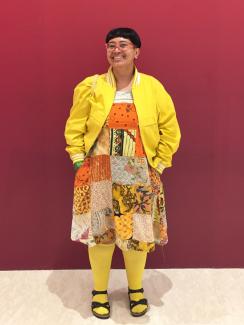
En Indonesia, la bunga [flor] está a menudo asociada a las mujeres. Esto significa que una flor también puede ser asociada a las mujeres transgénero, porque las mujeres transgénero son mujeres. Son igual de bellas, igual de fuertes, y tanto las flores como las mujeres trans no viven solo esperando ser «recogidas», sino que crecen y florecen y mueren como quieren. Esta obra es un tributo a mis amigas mujeres transgénero, en el Día Internacional de la Visibilidad Transgénero.
Fin 2019, les événements en Indonésie - notamment les signes d’intensification de la militarisation et de reculs des droits LGBTQ – nous ont amené·e·s à questionner la capacité de l’AWID à maintenir un environnement sécurisé et accueillant pour les divers·es participant·e·s que nous voulons rassembler au Forum.
Après un examen attentif, la Direction de l’AWID a décidé en novembre 2019 de faire évoluer le lieu de tenue du 14ème Forum international de l’AWID, de Bali à Taipei.
Taipei dispose de fortes capacités logistiques et est accessible pour beaucoup de voyageurs·ses (avec une facilitation de procédure de visa électronique pour les conférences internationales).
Pour plus d’informations :
More than a fun kink to explore for the sensations, BDSM can be a way of addressing emotional pain and trauma. It has been a medium of sexual healing for me, providing a radical form of liberation.