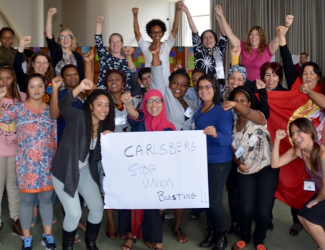
Women human rights defenders (WHRDs) worldwide defend their lands, livelihoods and communities from extractive industries and corporate power. They stand against powerful economic and political interests driving land theft, displacement of communities, loss of livelihoods, and environmental degradation.
Why resist extractive industries?
Extractivism is an economic and political model of development that commodifies nature and prioritizes profit over human rights and the environment. Rooted in colonial history, it reinforces social and economic inequalities locally and globally. Often, Black, rural and Indigenous women are the most affected by extractivism, and are largely excluded from decision-making. Defying these patriarchal and neo-colonial forces, women rise in defense of rights, lands, people and nature.
Critical risks and gender-specific violence
WHRDs confronting extractive industries experience a range of risks, threats and violations, including criminalization, stigmatization, violence and intimidation. Their stories reveal a strong aspect of gendered and sexualized violence. Perpetrators include state and local authorities, corporations, police, military, paramilitary and private security forces, and at times their own communities.
Acting together
AWID and the Women Human Rights Defenders International Coalition (WHRD-IC) are pleased to announce “Women Human Rights Defenders Confronting Extractivism and Corporate Power”; a cross-regional research project documenting the lived experiences of WHRDs from Asia, Africa and Latin America.
We encourage activists, members of social movements, organized civil society, donors and policy makers to read and use these products for advocacy, education and inspiration.
AWID acknowledges with gratitude the invaluable input of every Woman Human Rights Defender who participated in this project. This project was made possible thanks to your willingness to generously and openly share your experiences and learnings. Your courage, creativity and resilience is an inspiration for us all. Thank you!
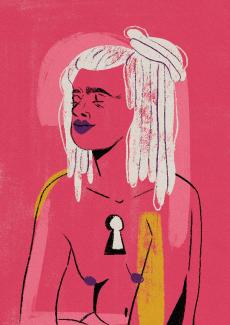
Tshegofatso Senne is a Black, chronically-ill, genderqueer feminist who does the most. Much of their work is rooted in pleasure, community, and dreaming, while being informed by somatic abolitionism and disability, healing, and transformative justices. Writing, researching, and speaking on issues concerning feminism, community, sexual and reproductive justice, consent, rape culture, and justice, Tshegofatso has 8 years of experience theorising on the ways in which these topics intersect with pleasure. They run their own business, Thembekile Stationery, and their community platform Hedone brings people together to explore and understand the power of trauma-awareness and pleasure in their daily lives. Tshegofatso believes deeply in the individual and collective potential of regenerative and sustainable change, pleasure, and care work.
The body. The most permanent home we have.
The body, not the thinking brain, is where we experience most of our pain, pleasure, and joy, and where we process most of what happens to us. It is also where we do most of our healing, including our emotional and psychological healing. And it is where we experience resilience and a sense of flow.
These words, said by Resmaa Menakem in his book My Grandmother’s Hands, have stayed with me.
The body; it holds our experiences. Our memories. Our resilience. And as Menakem has written, the body also holds our traumas. It responds with spontaneous protective mechanisms to stop or prevent more damage. That is the power of the body. Trauma is not the event; it is how our bodies respond to events that feel dangerous to us. It is often left stuck in the body, until we address it. There’s no talking our body out of this response – it just is.
Using Ling Tan’s Digital Superpower app, I tracked how my body felt as I travelled around different parts of my city, Johannesburg, South Africa. The app is a gesture-driven online platform that allows you to trace your perceptions as you move through locations by logging and recording the data. I used it to track my psychosomatic symptoms – physical reactions connected to a mental cause. Whether that be flashbacks. Panic attacks. Tightness in the chest. A fast heartbeat. Tension headaches. Muscle pain. Insomnia. Struggling to breathe. I tracked these symptoms as I walked and travelled to different areas in Johannesburg. And I asked myself.
Where can we be safe? Can we be safe?
Psychosomatic responses can be caused by a number of things, and some are not as severe as others. After experiencing any kind of trauma you may feel intense distress in similar events or situations. I tracked my sensations, ranked on a scale of 1-5, where 1 were the instances I barely felt any of these symptoms – I felt at ease rather than on-guard and jumpy, my breath and heart rate were stable, I was not looking over my shoulder – and number 5 being the opposite – symptoms that had me close to a panic attack.
As a Black person. As a queer person. As a genderqueer person who could be perceived as a woman, depending on what my gender expression is that day.
I asked myself.
Where can we be safe?
Even in neighbourhoods one might consider “safe,” I felt constantly panicked. Looking around me to make sure I wasn’t being followed, adjusting the way my T-shirt sat so my breasts wouldn’t show up as much, looking around to make sure I knew multiple routes to get out of the place I was should I sense danger. An empty road brings anxiety. A packed one does too. Being in an Uber does. Walking on a public road does. Being in my apartment does. So does picking up a delivery from the front of the building.
Can we be safe?
Pumla Dineo Gqola speaks of the Female Fear Factory. It may or may not be familiar, but if you’re someone socialised as a woman, you’ll know this feeling well. The feeling that has you planning every step you take, whether you’re going to work, school, or just running an errand. The feeling that you have to watch how you dress, act, speak in public and private spaces. The feeling in the pit of your stomach if you have to travel at night, get a delivery, or deal with any person who continues to socialise as a cis man. Harassed on the street, always with the threat of violence. Us existing in any space comes with an innate fear.
Fear is both an individual and a socio-political phenomenon. At an individual level, fear can be present as part of a healthy well developing warning system […] When we think about fear, it is important to hold both notions of individual emotional experience and the political ways in which fear has been used in different epochs for control. - Pumla Dineo Gqola, in her book Rape: A South African Nightmare
South African women, femmes, and queers know that every step we take outside – steps to do ordinary things: a walk to the shops, a taxi to work, an Uber from a party – all of these acts are a negotiation with violence. This fear, is part of the trauma. To cope with the trauma we carry in our bodies, we develop responses to detect danger – watching the emotional responses of those around us, reading for “friendliness.” We’re constantly on guard.
Day after day. Year after year. Life after life. Generation after generation.
On the additional challenge of this learned defence system, author of The Body Keeps Score, Bessel Van Der Kolk, has said
It disrupts this ability to accurately read others, rendering the trauma survivor either less able to detect danger or more likely to misperceive danger where there is none. It takes tremendous energy to keep functioning while carrying the memory of terror, and the shame of utter weakness and vulnerability.
As Resmaa Menakem has said, trauma is in everything; it infiltrates the air we breathe, the water we drink, the foods we eat. It is in the systems that govern us, the institutions that teach and also traumatise us, and within the social contracts we enter into with each other. Most importantly, we take it with us everywhere we go, in our bodies, exhausting us and eroding our health and happiness. We carry that truth in our bodies. Generations of us have.
So, as I walk around my city, whether an area is considered “safe” or not, I carry the traumas of generations whose responses are embedded in my body. My heart palpitates, it becomes difficult to breathe, my chest tightens – because my body feels as though the trauma is happening in that very moment. I live hyper vigilant. To the point where one is either too on-guard to mindfully enjoy their life, or too numb to absorb new experiences.
For us to begin to heal, we need to acknowledge these truths.
These truths that live in our bodies.
This trauma is what keeps many of us from living the lives we want. Ask any femme or queer person what safety looks like to them and they’ll mostly share examples that are simple tasks – being able to simply live joyful lives, without the constant threat of violence.
Feelings of safety, of comfort and ease, are spatial. When we embody our trauma, it affects the ways we perceive our own safety, affects the ways we interact with the world, and alters the ways we are able to experience and embody anything pleasurable and joyful.
We have to refuse this burdensome responsibility and fight for a safe world for all of us. Walking wounded as many of us are, we are fighters. Patriarchy may terrorise and brutalise us, but we will not give up the fight. As we repeatedly take to the streets, defying the fear in spectacular and seemingly insignificant ways, we defend ourselves and speak in our own name. - Pumla Dineo Gqola, in her book Rape: A South African Nightmare
Where can we be safe? How do we begin to defend ourselves, not just in the physical sense, but in the emotional, psychological, and spiritual senses?
“Trauma makes weapons out of us all,” adrienne maree brown has said in an interview conducted by Justin Scott Campbell. And her work, Pleasure Activism, offers us multiple methodologies to heal that trauma and ground ourselves in the understanding that healing, justice, and liberation can also be pleasurable experiences. Especially those of us who are the most marginalised, who may have been raised to equate suffering with “The Work.” The Work that so many of us have gone into as activists, community builders and workers, those serving the most marginalised, The Work that we struggle in order to do, burning ourselves out and rarely caring for our minds and bodies. The alternative is becoming more informed about our trauma, able to identify our own needs, and becoming deeply embodied. That embodiment means we are simply more able to experience the world through the senses and sensations in our bodies, acknowledging what they tell us rather than suppressing and ignoring the information it is communicating with us.
Being constantly in conversation with our living body and intentionally practising those conversations connects us to embodiment more deeply; it allows us to make tangible the emotions we feel as we interact with the world, befriend our bodies, and understand all that they try to teach us. When understanding trauma and embodiment paired, we can begin to start the healing and access pleasure more holistically, healthily, and in our daily lives without shame and guilt. We can begin to access pleasure as a tool for individual and social change, tapping into the power of the erotic as Audre Lorde described it. A power that allows us to share the joy we access and experience, expanding our capacity for happiness and understanding that we are deserving of it, even with our trauma.
Tapping into pleasure and embodying the erotic gives us the expansion of being deliberately alive, feeling grounded and stable and understanding our nervous systems. It allows us to understand and shed the generational baggage we’ve been carrying without realising; we can be empowered with the knowledge that even as traumatised as we are, as traumatised as we potentially could be in the future, we are still deserving of pleasurable and joyful lives, that we can share that power with our people. It is the community aspect that is missing from the ways we care for ourselves; self-care cannot exist without community care. We are able to feel a deeper internal trust, safety, and power of ourselves, especially in the face of future traumas that will trigger us, knowing how to soothe and stabilise ourselves. All this understanding leads us to a deep internal power that is resourced to meet any challenges that come your way.
As those living with deep generational traumas, we have come to distrust and perhaps think we are incapable of containing and accessing the power we have. In “Uses of the Erotic: The Erotic as Power,” Lorde teaches us that the erotic offers a source of replenishment, a way to demand better for ourselves and our lives.
For the erotic is not a question only of what we do; it is a question of how acutely and fully we can feel in the doing. Once we know the extent to which we are capable of feeling that sense of satisfaction and completion, we can then observe which of our various life endeavours brings us closest to that fullness.
I don’t say any of this lightly – I know that this is easier said than done. I know that many of us are prevented from understanding these truths, from internalising or even healing them. Resistance comes with acts of feeling unsafe, but is not impossible. Resisting power structures that keep the most powerful safe will always endanger those of us shoved to the margins. Acknowledging the traumas you’ve faced is a reclamation of your lived experiences, those that have passed and those that will follow; it is resistance that embodies that knowledge that we are deserving of more than the breadcrumbs these systems have forced us to lap up. It is a resistance that understands that pleasure is complicated by trauma, but it can be accessed in arbitrary and powerful ways. It is a resistance that acknowledges that our trauma is a resource that connects us to each other, and can allow us to keep each other safe. It is a resistance that understands that even with pleasure and joy, this is not a utopia; we will still harm and be harmed, but we will be better equipped for survival and thrive in a community of diverse care and kindness. A resistance that makes way for healing and connecting to our full human selves.
Healing will never be an easy and rosy journey, but it begins with the acknowledgment of the possibility. When oppression makes us believe that pleasure is not something that we all have equal access to, one of the ways that we start doing the work of reclaiming our full selves — our whole liberated, free selves — is by reclaiming our access to pleasure.
Leah Lakshmi Piepzna-Samarasinha has said in her article in Pleasure Activism (to which she contributed),
I know that for most people, the words “care” and “pleasure” can’t even be in the same sentence. We’re all soaking in ableism’s hatred of bodies that have needs, and we’re given a really shitty choice: either have no needs and get to have autonomy, dignity, and control over your life or admit you need care and lose all of the above.
The power that this has? We understand our traumas, so we understand those of others; we embody the sensations we experience and tend to them rather than distract and avoid. We access pleasure in ways that make us want to share that joy with those in our communities. When we are trauma-informed, we give ourselves more room to experience all this and give ourselves, and others, permission to heal. Imagine, a community in which everyone has access, resources, and time to live pleasurable lives, in whichever way they want and deserve. In which spatial traumas are lessened because the people that occupy them are trauma-aware, are filled with a tender care. Isn’t that healing? Is that not working through generational traumas? Does that not build and sustain healthier futures for us all?
It is time we reconnected with the ancestral knowledge that we deserve to live full lives. We need to get back in touch with our natural right to joy and existing for ourselves. To feel pleasure simply for the sake of it. To not live lives of terror. It sounds radical; it feels radical. In a world where we have been socialised and traumatised to numb, to fear, to feel and remain powerless, to be greedy and live with structural issues that lead to mental illness, what a gift and wonder it is to begin to feel, to be in community with those who feel, to be healthily interdependent in, to love each other boldly. Feeling is radical. Pleasure is radical. Healing is radical.
You have permission to feel pleasure. You have permission to dance, create, make love to yourself and others, celebrate and cultivate joy. You are encouraged to do so. You have permission to heal. Don’t bottle it up inside, don’t try to move through this time alone. You have permission to grieve. And you have permission to live. - adrienne maree brown, “You Have Permission”
Somatic embodiment allows us to explore our trauma, work through it and make meaningful connections to ourselves and the collective. Doing this over time sustains our healing; just like trauma, healing is not a one-time only event. This healing helps move us toward individual and collective liberation.
In “A Queer Politics of Pleasure,” Andy Johnson speaks about the ways in which the queering of pleasure offers us sources of healing, acceptance, release, playfulness, wholeness, defiance, subversion, and freedom. How expansive! When we embody pleasure in ways that are this holistic, this queer, we are able to acknowledge the limitation.
Queering pleasure also asks us the questions that intersect our dreaming with our lived realities.
Who is free or deemed worthy enough to feel pleasure? When is one allowed to feel pleasure or pleased? With whom can one experience pleasure? What kind of pleasure is accessible? What limits one from accessing their full erotic and pleased potential? - Andy Johnson, “A Queer Politics
of Pleasure”
When our trauma-informed pleasure practices are grounded in community care, we begin to answer some of these questions. We begin to understand the liberating potential. As pleasure activists, this is the reality we ground ourselves within. The reality that says, my pleasure may be fractal, but it has the potential to heal not only me and my community, but future bloodlines.
I am a whole system; we are whole systems. We are not just our pains, not just our fears, and not just our thoughts. We are entire systems wired for pleasure, and we can learn how to say yes from the inside out. - Prentis Hemphill, interviewed by Shar Jossell
There’s a world of pleasure that allows us to begin to understand ourselves holistically, in ways that give us room to rebuild the realities that affirm that we are capable and deserving of daily pleasure. BDSM, one of my deepest pleasures, allows me a glimpse into these realities where I can both feel and heal my trauma, as well as feel immeasurable opportunities to say yes from the inside out. While trauma keeps me stuck in a cycle of fight or flight, bondage, kneeling, impact, and breath play encourage me to stay grounded and connected, reconnecting to restoration. Pleasure that is playful allows me to heal, to identify where traumatic energy is stored in my body and focus my energy there. It allows me to express the sensations my body feels through screams of pain and delight, to express my no with no fear and revel in the fuck yes. With a safety plan, aftercare, and a deeper understanding of trauma, kink offers a place of pleasure and healing that is invaluable.
So whether your pleasure looks like cooking a meal at your leisure, engaging in sex, having bed days with your people, participating in disability care collectives, having someone spit in your mouth, going on accessible outings, having cuddle dates, attending an online dance party, spending time in your garden, being choked out in a dungeon,
I hope you take pleasure with you wherever you go. I hope it heals you and your people.
Recognising the power of the erotic within our lives can give us the energy to pursue genuine change within our world. - Audre Lorde, “Uses of the Erotic: The Erotic as Power”
ExploreTransnational Embodiments
This journal edition in partnership with Kohl: a Journal for Body and Gender Research, will explore feminist solutions, proposals and realities for transforming our current world, our bodies and our sexualities.
نصدر النسخة هذه من المجلة بالشراكة مع «كحل: مجلة لأبحاث الجسد والجندر»، وسنستكشف عبرها الحلول والاقتراحات وأنواع الواقع النسوية لتغيير عالمنا الحالي وكذلك أجسادنا وجنسانياتنا.
Notre programme final du Feminist Film Club est maintenant disponible: « Films from Nuestramérica » est une série de films sur les réalités féministes d'Amérique latine et d'Amérique centrale organisée par Alejandra Laprea (Venezuela).
Jaitun, comúnmente conocida como «Amma», estaba comprometida con garantizar los derechos reproductivos de las mujeres y niñas de India. Se dedicó, particularmente, a abogar por quienes viven en la pobreza y son más marginadas, incluidas las mujeres y niñas dalit y musulmanas.
Jaitun fue la fuerza vital detrás del caso Jaitun versus Janpura Maternity Home & Ors. Su perseverancia por la justicia llevó a que la Corte Suprema de Delhi emitiera una sentencia innovadora, que obligó al gobierno indio a hacerse responsable del incumplimiento de cierto número de obligaciones legalmente vinculantes, tales como la atención a la salud reproductiva y el derecho a la alimentación.
A su hija Fatema, quien vivía por debajo de la línea de pobreza, se le negaron los servicios reproductivos, y tuvo que dar a luz en público, bajo un árbol. En ese momento, tanto Jaitun como Fatema estaban en situación de calle, ya que su casa había sido demolida por el gobierno como parte del programa de reurbanización y gentrificación de Nueva Delhi.
«Desde entonces, esta sentencia ha sido utilizada por innumerables abogadxs y activistas de todo el mundo, incluyendo al ex-Relator Especial de la ONU sobre el derecho a la salud, no solamente como fuente de inspiración, sino como una sólida plataforma para promover la justicia.» - Jameen Kaur
Jaitun ha sido una inspiración para que muchas otras mujeres que viven en la pobreza reclamen sus derechos. Falleció en 2017.
«Con la muerte de Jaitun, hemos perdido una incomparable guerrera de la justicia, pero su espíritu de desafío pervive.» -Jameen Kaur
«En mis dieciocho años como defensora de los derechos humanos, nunca he encontrado una mujer que me inspirara ni que conmoviera mi espíritu de la forma en que lo hacía Amma. Su sonora valentía, su inimitable humor (solíamos compararla con la actriz de Bollywood, Hema Melini) cuando se sentía molesta porque habíamos pasado tanto tiempo lejos de ella... con un brillo en los ojos, decía “Ustedes se han olvidado de Amma, Amma ahora no les habla”, y luego con gran dramatismo se ponía de espaldas para darse vuelta enseguida riendo y estirando los brazos para un abrazo. Su bondad y, en definitiva, su amor y su alegría por el amor y el derecho de todxs nosotrxs a vivir con dignidad. La extraño terriblemente.» - Jameen Kaur
Elina es una joven feminista afrodominicana, que trabaja con enfoque interseccional. Es abogada de derechos humanos y está comprometida a usar su voz y sus capacidades para construir un mundo más justo, empático e inclusivo. Ingresó a la facultad de derecho a los 16 años, segura de que iba a obtener herramientas para entender y promover la justicia social. Luego de obtener el título de Juris Doctor [Doctora en Jurisprudencia] en la República Dominicana, cursó una maestría en Derecho Internacional Público y Derechos Humanos en el Reino Unido, como becaria Chevening. Fue la única mujer latinoamericana-caribeña en su clase y se graduó con honores.
Elina ha trabajado en la intersección de derechos humanos, género, migración y política en el gobierno, en colectivos de base y en organizaciones internacionales. Colaboró en el litigio de casos sobre violencia de género ante la Corte Interamericana de Derechos Humanos. Como integrante del Panel Consultivo de Jóvenes de UNFPA, contribuyó al fortalecimiento de los derechos sexuales y reproductivos en la República Dominicana. Fue una de las personas que lideraron la primera campaña de Amnistía Internacional sobre derechos de lxs trabajadorxs sexuales en las Américas, desarrollando una fuerte asociación con las organizaciones de trabajadorxs sexuales, y utilizando la posición de Amnistía para potenciar las voces de quienes defienden los derechos humanos de las mujeres y de lxs trabajadorxs sexuales. Elina es parte del Foro Feminista Magaly Pineda y la Global Shapers Community [Comunidad Global Shapers]. Habla español, francés e inglés.
Gracias a su diversificada trayectoria, Elina trae sólidas capacidades de gobernanza y de planificación estratégica, una experiencia sustancial en las Naciones Unidas y en mecanismos regionales de derechos humanos, además de su profunda determinación para que AWID siga siendo una organización inclusiva para todas las mujeres, especialmente, las feministas jóvenes y caribeñas. Con estas propuestas, se suma a una hermandad global de feministas fantásticas, desde donde podrá seguir cultivando su liderazgo feminista y nunca más se sentirá sola en su camino.
Position
Co-Presidenta
Add to stories
Off
Qu'est-ce que le Forum international de l'AWID ?
Le Forum international de l’AWID est un événement phare que l’association organise tous les trois ou quatre ans. C'est la plus importante manifestation au monde entièrement consacrée aux mouvements féministes et de justice de genre dans toute leur diversité. Il s'agit d'un rassemblement mondial qui réunit activistes féministes, mouvements alliés, universitaires, bailleurs de fonds et décideur·e·s politiques. Les forums se tiennent successivement dans différentes régions et différents pays du sud mondial.
In 2022, AWID celebrates 40 years since our founding. We’re using this moment to reflect on our past and learn from the road traveled as we prepare to look forward, and to forge the journey ahead. As we move through cycles of progress and pushback, we know that struggles for women’s rights and gender justice are iterative and non-linear. In collaboration with artist Naadira Patel, we created a scrapbook that highlights a handful of snapshots from AWID’s last four decades of feminist movement support.
We have not done all this on our own. We share this with deep appreciation for the constellation of feminist activists and groups that have made this work possible. In this context of so many converging crises, we embrace the opportunity to celebrate the power and resilience of feminist movements around the world.
Check out the AWID Feminist Film Club program “Holding up the Skies” - a film series on Feminist Realities from Africa and the African Diaspora curated by Gabrielle Tesfaye
GenderJobs.org:This is a platform with a comprehensive list of job opportunities to work on gender equality and LGBTQI+ rights, curated by gender professionals and intersectional feminists who intimately know the sector and are extremely passionate about supporting other gender professionals and anyone who is aspiring to become one! (source: https://genderjobs.org/about)
Isabel Cabanillas de la Torre était une jeune artiste et activiste féministe très appréciée de Ciudad Juárez, au Mexique. Elle était connue pour ses belles peintures textiles, très expressives. Les yeux faisaient partie des représentations emblématiques de son travail. Ses peintures murales ont métamorphosé les immeubles décrépis et laissés à l’abandon du centre-ville de Ciudad Juárez, ornant leurs façades de messages de vie et de commentaires politiques.
Isabel voulait, à travers son art et son activisme politique, attirer l’attention sur les violences basées sur le genre omniprésentes dans sa ville natale. Elle était bénévole dans le réseau Mesa de Mujeres pour l’Observatoire citoyen sur le genre, qui supervise le travail des juges, procureurs et avocats de la défense dans les affaires de féminicides et autres violations basées sur le genre. Elle était également membre de Hijas de su Maquilera Madre, un collectif féministe dont le nom fait référence aux filles de mères qui travaillent dans les maquiladoras, ou zones de traitement pour l’exportation. Certaines de ces mères ont figuré parmi les premières victimes de féminicide dans la ville.
Le dernier projet d’Isabel, toujours en cours, était une installation artistique pour protester contre une entreprise canadienne qui cherchait à extraire du cuivre dans le désert de Samalayuca.
Le 18 janvier 2020, Isabel a été tuée par balle alors qu’elle rentrait chez elle à vélo dans le centre de Juárez, dansce qui semble avoir été un acte ciblé, son corps ayant été retrouvé à côté de son vélo.
Le meurtre d’Isabel a déclenché une nouvelle vague d’indignation contre les féminicides dans la région, des centaines de personnes ont manifesté jusqu’au pont frontalier entre le Mexique et les États-Unis, le bloquant pendant des heures et scandant « Ni Una Menos » (pas une de plus) alors que des collectifs féministes continuaient de manifester contre les meurtres de femmes dans tout le pays. Au cours de la seule année 2019, 3 142 femmes et filles ont été tuées au Mexique. Un grand nombre ont été spécifiquement ciblées du fait de leur genre.
Elle adorait faire du vélo.
« Le vélo était son symbole de liberté. Il symbolisait le fait d’être libre dans les rues. » - Marisol (une amie d’Isabel)
Jessica est une artiste-activiste queer de Toronto, au Canada, mais qui vit actuellement en Bulgarie. Elle a plus de 15 ans d'expérience dans la riposte au VIH, travaillant aux intersections du genre et du VIH auprès de populations clés (travailleurs·ses du sexe, femmes consommatrices de drogues, communautés LGBTQI, personnes incarcérées et, bien sûr, personnes vivant avec le VIH). Jessica aime créer du mouvement et réfléchir/entreprendre/élaborer des stratégies sur des interventions basées sur les arts. L'un des projets amusants qu'elle a lancé en 2013 était LOVE POSITIVE WOMEN (Femmes positives à l’amour), qui implique plus de 125 groupes et organisations communautaires du monde entier, du 1er au 14 février, pour célébrer les femmes vivant avec le VIH dans leurs communautés.
Position
Responsable de l’Adhésion et de l’Engagement des Membres
Add to stories
Off
When can I register for the Forum? How much does it cost to register? What does Registration Include?
Registration will start early 2024. We will announce the exact registration date and registration fee soon. Registration will include participation in the Forum, plus lunch and snacks (breakfast to be provided at the hotels), and one onsite dinner.
El título de la conversación «¿Pansexual, ginosexual o abrosexual? Una exploración de lo queer, el placer y la positividad sexual» da mucho para pensar. Tiffany Kagure Mugo (escritora, educadora y curadora de HOLAAfrica) comienza la sesión con una lectura de Touch [Tocar/Tacto], una compilación recientemente publicada de ensayos de ficción y no ficción sobre sexo, sexualidad y placer. En este fragmento, la autora propone la idea de que el placer es constante y continuo, que está presente en las actividades cotidianas, y que no se circunscribe a las relaciones sexuales.
Esta idea de que el placer es parte de la vida diaria (al igual que tantas otras cosas) atraviesa la conversación, que también abarca temas sobre el deseo, la atracción y la orientación sexual.
Desde el comienzo, existe una sensación de esperanza y posibilidad. Tiffany presenta opciones y explica alternativas, dándonos un nuevo lenguaje para hablar sobre quiénes somos, qué nos gusta, y cómo lo queremos. Esto se refiere al deseo y al sexo, pero se trata primordialmente de autoconocimiento y empoderamiento. Tiffany habla apasionadamente sobre tomar decisiones desde un lugar de poder: aprender sobre la propia identidad para poder elegir lo mejor para unx mismx.
En una conversación abierta y libre, que representa la actitud que Tiffany propone que todxs adoptemos, aprendemos que el conocimiento sobre sexo y sexualidad está en permanente cambio, que los límites se están desplazando. Lo que podemos haber aprendido o, más fundamentalmente, aquello que se nos ocultó durante la infancia o la adultez es exactamente el lugar desde donde deberíamos comenzar a desaprender y reprogramarnos. Tiffany señala que, actualmente, las personas jóvenes necesitan herramientas para comprender las experiencias que ya están teniendo, un recordatorio para no subestimar jamás lo que lxs niñxs y adolescentes saben sobre la clase de placer/es que quieren procurarse en la vida.
La conversación abrió mi mente a esto: conocerme a mí misma me ayudará a desarrollar mi confianza; podré encarar relaciones con cuidado no solo de mí misma sino de otras personas también. Aprender el lenguaje de orientación, atracción, deseo y placer contribuirá a profundizar mis futuras conexiones. Valoré el espacio para pensar sobre este aspecto de mi vida: las partes privadas e íntimas a las que no accedo habitualmente. El entusiasmo de Tiffany sobre el placer y la identidad desplazó mis propias barreras, permitiéndome considerar nuevas posibilidades personales.
La idea de aprender a establecer conexiones holísticas no es algo común todavía. En general, vivimos en una cultura de conexiones instantáneas y pasajeras. Casi no hay tiempo para reflexionar verdaderamente sobre cómo y por qué buscamos relaciones o parejas... al menos, no hasta que llega un momento de crisis.
Por supuesto, existen espacios privilegiados que están abiertos a preguntas y conversaciones, tales como el festival «Crear Résister Transform» de AWID y otras plataformas o publicaciones en línea que promueven la libertad de pensamiento. Pero el acceso a la información de fuentes útiles y sin prejuicios es algo que todavía debe ser descifrado. Esto puede deberse en parte al hecho de que la gente no se siente segura en el lenguaje de la sexualidad y el placer.
La idea del lenguaje y las herramientas se repite durante toda la presentación de Tiffany. Ella y sus colegas están haciendo el trabajo de hablar, enseñar y nutrir, viendo qué es lo que cada persona necesita, dónde están esas personas, qué quieren para sí mismxs, y caminando junto con ellxs mientras construyen sus mundos ideales, brindándoles nuevas palabras y definiciones para ayudarlxs a configurar sus identidades en las diferentes etapas de sus vidas.
Esta es la clase de conversaciones que se necesita, incluso en una sociedad que permanentemente difunde un sinfín de mensajes sobre el cuidado de la salud, con diferentes grados de detalle. A veces la gente debe retrotraerse de las instancias de perspectiva global, y sentirse alentada a aprender sobre sus opiniones y deseos individuales. Esto es lo que hace la ponencia de Tiffany: genera un espacio para cada persona, dentro del rompecabezas general.
Un punto culminante de la ponencia de Tiffany fue la sección sobre los diferentes tipos de atracción:
Sexual: el deseo expreso de tener relaciones sexuales con una o varias personas Sensual: el deseo de tocar a una o varias personas, de estar físicamente cerca, sin necesariamente incluir una relación sexual Romántica: el deseo de salir con una o varias personas, o de estar en una relación con una o varias personas Platónica: el deseo de construir amistades profundas Estética: el deseo de mirar a una o varias personas, sintiendo placer por su apariencia
Estos cinco tipos o niveles de atracción ofrecen una forma abreviada para definir el deseo y el placer, y ayudan a contextualizar las distintas clases de placer que pueden experimentar las personas.
Pensar la atracción más allá de lo físico o sexual ofrece una nueva perspectiva sobre la conexión. Es una oportunidad para restar presión a las relaciones, abriendo oportunidades para asociaciones diferentes, más esclarecidas y satisfactorias.
Esta libertad y este conocimiento que propone Tiffany configuran una hoja de ruta hacia el futuro. La presentación ofreció una nueva perspectiva sobre aquello que es posible.
Tal como lo expresa el fragmento de apertura, el placer es continuo. A la luz de la ponencia de Tiffany, también resulta claro que el placer es dinámico y apasionante. Siempre hay más para aprender.
Esto puede parecer abrumador al comienzo, pero del otro lado del titubeo se encuentran la esperanza, el potencial y la libertad.
Les discours antidroits continuent à évoluer. Outre le recours à des arguments religieux, culturels et traditionnels, les acteur·rice·s antidroits s’approprient le langage de la justice sociale et des droits humains pour travestir leurs véritables programmes et gagner ainsi en légitimité.
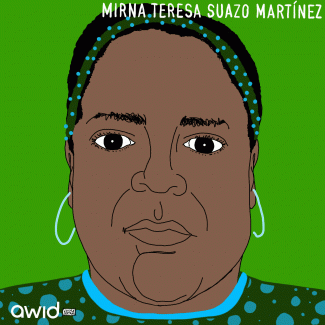
Mirna Teresa Suazo Martínez was part of the Garifuna (Afro-descendent and Indigenous) Masca community, living on the North Caribbean coast of Honduras. She was a community leader and a fervent defender of the Indigenous territory, a land that was violated when the National Agrarian Institute of Honduras gave territorial licenses to people outside of the community.
This deplorable deed resulted in repeated harassment, abuse and violence against the Masca, where economic interests of different groups met those of Honduran armed forces and authorities. According to the Black Fraternal Organization of Honduras (OFRANEH), the strategy of these groups is to evict and exterminate the Indigenous population.
“Masca, the Garifuna community located next to the Cuyamel Valley, is part of the area of influence of one of the supposed model cities, a situation that has triggered territorial pressures along the Garifuna coast.” - OFRANEH, 8 September 2019
Mirna Teresa, president of the Board of Trustees of the Masca Community in Omoa, was also firmly rejecting the construction of two hydroelectric plants on the river that carries the same name as her community, Masca.
“The Garífuna community attributes the worsening of the situation in their region to their opposition to tourist exploitation, the monoculture of African palm and drug trafficking, at the same time that it seeks to build an alternative life through the cultivation of coconut and other products for self-consumption.” - Voces Feministas, 10 September 2019
Mirna Teresa was murdered on 8 September 2019 in her Restaurant “Champa los Gemelos”.
She was one of six Garifuna women defenders murdered between September and October 2019 alone. According to OFRANEH, there was no investigation by the authorities into these crimes.
“In the case of the Garífuna communities, a large part of the homicides are related to land tenure and land management. However, squabbles between organized crime have resulted in murders, such as the recent ones in Santa Rosa de Aguán.” - OFRANEH, 8 September 2019
Leila is a transnational feminist leader, strategist, and advisor with over 25 years of organizing, advocacy and philanthropic experience advancing human rights, gender equality, and sexual and reproductive rights and justice. She was born in Algeria and educated in the U.S., France, and Morocco; over her professional career, she has lived and worked in forty countries across Africa, Europe, Latin America and Asia. Leila currently serves as a Senior International Fellow at the Asfari Institute for Civil Society and Citizenship at the American University of Beirut in Lebanon and as Senior Strategist for various feminist movements and organizations as well as the the Urgent Action Fund-Africa and Trust Africa on an initiative on Reimagining Feminist and Pan-African Philanthropies.
From 2017-2023, Leila held the position as Vice-President of Programs at Global Fund for Women where she oversaw its strategic grantmaking, movement-strengthening, global advocacy and philanthropic collaborations. At GFW, she doubled its grantmaking to over $17 million, launched its feminist and gender-based movements and crises work, created an adolescent girls program led by a girls’ advisory council and led its philanthropic advocacy work. Prior to that she served on the senior leadership team of Ipas from 2002 to 2016 where she published extensively on abortion rights and justice, lead global advocacy efforts and partnered with feminist groups working on self-management, community strategies and stigma reduction around bodily integrity and sexual and reproductive rights.
Leila is currently researching shifts in the philanthropic sector including recognizing non-institutional practices of giving resources in the Global South and efforts to decolonize practices in the Global North. She has written extensively on the political nature of veiling across North Africa and the Middle East, abortion practices in majority Muslim contexts and feminist approaches to sexual and reproductive health, rights and justice.
Leila holds an MPH in public health and a MA in Middle Eastern and North African Studies, studied Islamic law in Morocco and pursued doctoral studies in sociology in France. She studied Arabic and speaks French and English fluently. She is a mother of two feminist young women, an avid scuba diver, mountain bike rider, skier, and outdoor enthusiast.
Position
Treasurer
Add to stories
Off
¿AWID proporciona becas para asistir al Foro?
Nuestro Fondo de Acceso ofrecerá un número limitado de becas para financiar la participación de activistas que de otra manera no podrían asistir y que no tienen relaciones con donantes que puedan cubrir su participación. Por lo tanto, si tienes otras posibilidades, te animamos a explorarlas. Haremos todo lo posible para ofrecer la mayor cantidad de becas y compartiremos más información sobre este proceso y cómo postular a principios de 2024.