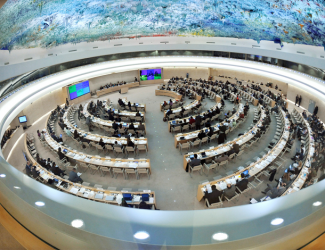
Jean-Marc Ferré | Flickr (CC BY-NC-ND 2.0)
A general view of participants at the 16th session of the Human Rights Council in Geneva, Switzerland.

Special Focus

AWID is an international, feminist, membership organisation committed to achieving gender equality, sustainable development and women’s human rights

Human Rights Council (HRC)

The Human Rights Council (HRC) is the key intergovernmental body within the United Nations system responsible for the promotion and protection of all human rights around the globe. It holds three regular sessions a year: in March, June and September. The Office of the UN High Commissioner for Human Rights (OHCHR) is the secretariat for the HRC.

The HRC works by:

  • Debating and passing resolutions on global human rights issues and human rights situations in particular countries

  • Examining complaints from victims of human rights violations or activist organizations on behalf of victims of human rights violations

  • Appointing independent experts (known as “Special Procedures”) to review human rights violations in specific countries and examine and further global human rights issues

  • Engaging in discussions with experts and governments on human rights issues

  • Assessing the human rights records of all UN Member States every four and a half years through the Universal Periodic Review

Learn more about the HRC


AWID works with feminist, progressive and human rights partners to share key knowledge, convene civil society dialogues and events, and influence negotiations and outcomes of the session.

With our partners, our work will:

◾️ Monitor, track and analyze anti-rights actors, discourses and strategies and their impact on resolutions

◾️ Raise awareness of the findings of the 2017 and 2021 OURs Trends Reports.

◾️Support the work of feminist UN experts in the face of backlash and pressure

◾️Advocate for state accountability
 
◾️ Work with feminist movements and civil society organizations to advance rights related to gender and sexuality.
 

Related Content

Kagendo Murungi

Kagendo is remembered fondly by family and friends as a fierce African feminist activist, artist, and filmmaker.

She dedicated over 20 years to advocate for the rights and dignity of African LGBTIQ and gender non conforming people.

Kagendo’s colleagues remember her as someone with a jovial personality, fierce conviction, and love for life. Kagendo died due to natural causes at her home in Harlem on December 27th, 2017.

On Kagendo’s passing Kenyan writer and activist Shailja Patel noted “Kagendo's lifelong commitment to connecting the dots between all oppressions, showing how colonialism fostered homophobia on the African continent, making Kenya a country where queer Kenyans and free women could live and thrive.”


Kagendo Murungi, Kenya

Eni Lestari

Biography

Eni Lestari est travailleuse domestique indonésienne à Hong Kong et militante des droits des migrant·e·s. Après avoir échappé à son employeur abusif, elle est passée de victime à mobilisatrice de travailleurs·ses domestiques en particulier, et de travailleurs·ses migrant·e·s plus globalement. En 2000, elle a fondé l'Association of Indonesian Migrant Workers (Association des travailleurs·ses migrant·e·s indonésien·ne·s, ATKI-Hong Kong) qui s'est ensuite étendue à Macao, à Taïwan et en Indonésie. Elle a été coordonnatrice et porte-parole de l'Asia Migrants Coordinating Body (Instance de coordination des migrant·e·s en Asie, AMCB) - une alliance d'organisations de terrain de migrant·e·s à Hong Kong venant d'Indonésie, des Philippines, de Thaïlande, du Népal et du Sri Lanka. Elle est également l'actuelle présidente de l’International Migrants Alliance (Alliance internationale des migrant·e·s), la toute première alliance mondiale de migrant·e·s, d'immigré·e·s, de réfugié·e·s et d'autres personnes déplacées.

Elle a occupé des postes importants dans diverses organisations, en tant que membre actuelle du conseil régional de l’Asia Pacific Forum on Women, Law and Development (Forum Asie-Pacifique sur les femmes, le droit et le développement, APWLD), ancienne membre du conseil d'administration de Global Alliance Against Traffic in Women (Alliance mondiale contre la traite des femmes, GAATW), porte-parole du Network of Indonesian Migrant Workers (Réseau des travailleurs·ses migrant·e·s indonésien·ne·s, JBMI), conseillère d’ATKI-Hong Kong et Macao ainsi que de l’Association of Returned Migrants and Families in Indonesia (Association des migrant·e·s et des familles retourné·e·s en Indonésie, KABAR BUMI). Elle a été une personne-ressource impliquée dans des forums organisés par des universitaires, des groupes interreligieux, des sociétés civiles, des syndicats et bien d'autres, à l’échelle nationale, régionale et internationale.

Elle a aussi participé activement aux assemblées/conférences des Nations Unies sur le développement et les droits des migrant·e·s et été choisie comme intervenante pour l'ouverture de l'Assemblée générale des Nations Unies sur les mouvements massifs de migrant·e·s et de réfugié·e·s en 2016 à New York, aux États-Unis. Des nominations et des prix lui ont par ailleurs été décernés, dont celui d’Inspirational Women de BBC 100 Women, ainsi que le prix Public Hero de RCTI, l’Indonesian Club Award et le Non-Profit Leader of Women of Influence de la Chambre américaine de Hong Kong, et celui de Changemaker de Cathay Pacific.

Add to stories
Off

Seven feminist policy recommendations to curb illicit financial flows

The growing dominance of international financial markets and institutions in defining global economic policies has resulted in the capture of people’s power in the interest of global elites and big corporations. 


Our policy brief on Illicit Financial Flows explores their disproportional gender impact and unveils the current legal and political frameworks that allow multinational corporations to benefit from tax abuse to the detriment of people and planet.

The brief concludes with these seven feminist policy recommendations to demand transparency and corporate accountability in order to curb illicit financial flows.


Our recommendations for advocacy

Illicit financial flows are gaining unprecedented attention: whether in development negotiations, like those leading to Agenda 2030 and the Addis Ababa Financing for Development Conference in 2015; or making headlines in mainstream media with the release of leaked documents on offshore finance known as the ‘Panama Papers’. In another example, the Ecuadorean people voted to bar politicians and civil servants from having assets, companies or capital in tax havens, in a referendum in February 2017. The Ecuadorian government is now a leading voice within the group of G77, in the United Nations, to create a UN global tax body to end tax havens.

This public attention potentially builds momentum for feminists, social movements and tax justice advocates to pressure for the transformation of the global financial system, which entrenches global inequalities, including gendered inequalities.

We offer below a set of seven policy asks as a contribution to growing advocacy efforts from social justice, feminist, women’s rights and gender equality actors:

1.  Address IFFs as a violation of human rights and women’s rights:

  • Illicit financial flows are hindering the fulfillment of the obligation of States to mobilise the maximum available resources for the realisation of human rights, including long agreed commitments on women’s rights and gender equality.
  • Strengthening corporate accountability is a possibility on the table at the UN Human Rights Council. An open-ended intergovernmental working group is in place to elaborate an international legally binding instrument to regulate, in international human rights law, the activities of transnational corporations and other business enterprises. This process has the potential to address corporate tax evasion as a violation of human rights, including women’s rights, and should be greater supported by countries in the global North and South.

2.  Ensure multinational corporations pay their share of taxes:

  • Develop international mechanisms that curb abusive tax practices and prevent corporate tax exemptions. UN member states should initiate negotiations to draft a UN convention to combat abusive tax practices. The convention should adopt a consolidation and apportionment system for taxing global corporate profits.
  • Revise specifically national regulations in wealthy countries that demand MNCs pay taxes only in the resident country, rather than in the countries of economic activity. This practice hinders developing countries the most, as they increasingly lose taxable base to low and zero tax jurisdictions. Proposals like the Unitary Taxation approach should be considered in this regard.

3.  Support the establishment of a United Nations intergovernmental tax body:

  • A UN tax body with equal voting rights and universal membership should have the power to review national, regional and global tax policy and ensure states comply with long agreed commitments on human rights, including women’s rights and gender equality.

4.  Promote transparency and gender-sensitive data gathering:

  • Greater efforts must be made at the global level to refine comparable data on tax abuse, for example with gender disaggregated data that shows the gender biases of certain tax systems.
  • Countries must ensure a framework for automatic information exchange, which guarantees public and global access to key data that affects the resources available for the realization of human rights.
  • Implement country-by-country reporting obligations for multinational corporations to publicly disclose, as part of annual reports, profits made and taxes paid for each country in which they operate.
  • Among other financial information, there must be greater cooperation from governments to share their national public registries that disclose beneficial owners of companies, trusts, foundations and similar legal structures.

5.  Promote tax justice through progressive fiscal policies at the national level:

  • Promote tax justice through progressive fiscal policies. This requires increasing the weight of direct taxes on income capital and highly profitable sectors of society, while reducing and removing the burden on women and poor people. Poor segments of society, of which women are overrepresented, should not end up paying more taxes, in relation to their income, than the richest segments that often benefit from government tax subsidies, tax holidays and reductions.
  • Governments must critically review the harmful trade and investment agreements that grant tax incentives and exemptions that perpetuate inequality and gender biases.

6.  Ensure participation of women’s rights organisations, social movements and progressive civil society broadly:

  • Economic and fiscal policy decisions often lack a gender sensitive perspective. Engagement between the ministries of Gender and Finance, and both with civil society and women human rights defenders, is key to better understand the impact that revenue decisions are having on women’s rights and gender equality.
  • An enabling environment should be in place to protect women human rights defenders and others (including whistle-blowers, tax justice activists) that expose tax abuse and report corruption.

7.  Stop the impunity of criminal activities associated with IFFs and ensure accountability:

  • Establish a global coordinated mechanism across national tax authorities, human rights and gender equality machineries, and intelligence units, to ensure criminal activities associated with IFFs do not continue with impunity.
  • Strengthen national and global justice systems to be able to hold individuals and entities to account for funding criminal activities through IFFs.

Read the full report

Snippet FEA Workers Persecution S4 (FR)

Un agent des forces de l'ordre en tenue anti-émeute rose tenant un bâton

LA PERSÉCUTION DES TRAVAILLEUR·EUSES

O nosso grupo, organização e/ou movimento não está registado - devemos participar no inquérito mesmo assim?

É claro que sim, queremos saber mais sobre si e sobre a sua experiência com o financiamento.

Le magazine des Réalités féministes

Le magazine des Réalités féministes

Nous vous présentons une sélection motivante de puissantes histoires et d’images de transformations et de résistances créées par des activistes, des écrivain·e·s et des artistes du monde entier.

Explorez le magazine

Benoîte Groult

Benoîte fue una periodista, escritora y activista feminista francesa.

Benoîte publicó más de 20 novelas y numerosos ensayos sobre feminismo.

En 1975 se publicó su primer libro, Ainsi Soit-Elle (que podría traducirse «Como ella es»). En él analizaba la historia de los derechos de las mujeres, así como la misoginia y la violencia contra las mujeres.

En su último libro, Ainsi Soit Olympe de Gouges, analizaba los derechos de las mujeres durante la Revolución Francesa, centrándose en la pionera feminista francesa. Olympe de Gouges fue guillotinada en 1793 por desafiar la autoridad masculina; dos años antes había publicado una declaración sobre los derechos de las mujeres («Déclaration Des droits de la Femme et de la Citoyenne»). 


Benoïte Groult, France

Jemimah Naburri-Kaheru

Biography

Jemimah Naburri-Kaheru es una consumada estratega internacional en recursos humanos con gran influencia en la región del Cuerno de África. Anteriormente, se desempeñó como gerente regional de Oficina y Recursos Humanos en Strategic Initiative for Women in the Horn of Africa (SIHA, Iniciativa Estratégica para las Mujeres del Cuerno de África). Su influencia se extiende a la dirección de los recursos humanos de más de 70 empleades regionales, debido a que los ingresos anuales de la organización registraron un veloz crecimiento del 40%. A lo largo de su carrera, Jemimah ha organizado iniciativas de reclutamiento sumamente fructíferas, introducido sistemas de desempeño basados en el mérito, y supervisado las relaciones entre el personal y las políticas de recursos humanos. Desempeñó una función crucial brindando apoyo a las estrategias de fuerzas de trabajo globales. Con antecedentes académicos en Estudios sobre el Desarrollo de la Universidad de Makerere (Uganda) y una maestría en Gestión de Recursos Humanos en curso, el compromiso de Jemimah con el desarrollo profesional es más que evidente. Su contribución al alto rendimiento de la fuerza laboral y liderazgo internacional en materia de recursos humanos la convierte en un activo invaluable en cualquier empresa global.

Position
Directora Adjunta de Recursos Humanos
Add to stories
Off

Oficina Administrativa

Para asuntos adminsitrativos puede contactar con nuestra oficina: 

  • +1 416 594 3773
  • 192 Spadina Avenue, Suite 300 |Toronto, ON, M5T 2C2 | Canadá

Snippet FEA HEALTH CONDITIONS (EN)

An illustration of a white-skinned person in yellow uniform of a nurse with stethoscope in their hand.

HEALTH CONDITIONS

هل على مجموعتنا، منظمتنا أو حركتنا تعبئة الاستطلاع مع أننا لم نحشد أو نأخذ تمويلاً من ممولين/ات خارجيين/ات؟

نعم! نلاحظ ونقدّر الأسباب المختلفة لعدم تلق الحركات النسوية التمويل الخارجي، حيث من الممكن أن تكون غير مؤهلة لتقديم الطلبات للتمويل و\ أو تلقّي المال من خارج البلاد، أو الاعتماد على المصادر التي يتم إنتاجها بشكل مستقل كاستراتيجية سياسية. نريد أن نسمع منكم/ن بعيدا عن تجربتكم/ن مع التمويل الخارجي.

Reason to join 3

Share your stories and hear from others. By connecting our experiences, narratives and proposals we help co-create and amplify Feminist Realities.

So'oalo Roger

So'oalo était une fervente défenseure des droits humains, notamment en ce qui concerne les droits de la communauté LGBTQI dans le Pacifique.

Elle était membre de la Samoa Fa’afafine Association (SFA) et militait avec passion pour la reconnaissance d’un troisième genre dans le pays insulaire. Sous sa direction, la SFA a fait pression pour la reconnaissance du bien-fondé des droits de la communauté des fa’afafine et leur respect.

Elle a également été une pionnière dans l’articulation des liens entre les droits humains, l’exploitation des fa’afafines à Samoa et dans le Pacifique et la santé, le bien-être et la sécurité de la communauté LGBTQI.

Inspirante et visionnaire, on se souviendra de son dévouement admirable au service des droits de sa communauté.


So'oalo Roger, Samoa

Ekaete Judith Umoh

Biography

Ekaete Judith Umoh est une défenseure internationale des droits des personnes en situation de handicap et experte en développement inclusif. Elle analyse avec finesse les questions relatives au genre, au handicap et au développement inclusif. Son rêve est d’accroître la visibilité des femmes et des filles en situation de handicap au sein du mouvement féministe international et dans tous les efforts de développement à travers le monde.

Passionnée d’activisme et de politique, Ekaete devient la première femme élue présidente de l’Association nationale des personnes en situation de handicap (Joint National Association of Persons with Disabilities, JONAPWD), au Nigéria. À ce titre, elle dirige les organisations de personnes en situation de handicap dans la lutte pour la signature de la loi nigériane sur le handicap de 2019, qu’elle défendait sans relâche depuis plus de 17 ans. Par la suite, elle rejoint CBM Global en tant que directrice nationale et joue un rôle pionnier à la tête de son équipe pendant trois ans, pour briser le cercle de la pauvreté et du handicap au Nigéria. Outre son activisme dans le domaine du handicap, Ekaete a été consultante auprès de plusieurs agences de développement, proposant son expertise technique de l’inclusion des personnes en situation de handicap dans la conception de programmes et projets.

Add to stories
Off

框架與主題

第十四屆AWID國際論壇的主題是:“女性主義理念實現:行動的力量”。

在第十四屆論壇上,我們將表揚與彰顯在我們身邊,處於各種發展階段的女性主義理念實現行動。

我們希望將本次論壇變成我們的女性主義理念實現行動:在這裡你可以進入在一個不同的世界,帶著你的勝利佳績、你所設計的解決方案前來,分享讓你更加強大、充滿希望、做好前行準備的事物。本次盛會有別於您之前參加過的其他會議。

請您務必共襄盛舉,攜手創造世界。絕對值得​!


每個論壇都有一個主題,該主題反映了我們成員和運動的需求,並回應我們對當前背景脈絡的分析。

全球背景脈絡

當前,全球各地的法西斯主義、基本教義主義、威權主義以及不受約束的企業權力方興未艾。我們看到,這些威脅與國家協力形塑了公共規範、敘事論述和政策,在公共論述中深植了恐懼和仇恨的文化,並煽動暴力。國家,曾經是我們權利倡議和主張權利的對象,但在許多情況下,國家不再覺得需要負責,甚至在某些情況下,國家自己也不再具有維護權利的權力了。

這個動盪、複雜和充滿不確定性的時代,更需要發揮創造力,組織各種運動,保持需求的連貫性並大膽提出主張。

從女性主義的將來到女性主義的理念實現

2016年的AWID論壇以女性主義的未來及付諸實現所需的條件為中心。無論是當時還是現在都很明顯不過,對於許多社會正義運動來說,若想跳出當前的體制之外去思考結構性的解決方案是一個艱鉅挑戰。長期的不平等和壓迫的經驗會限縮想像力。但是當時我們周遭的所見所聞顯示女性主義運動確實生機勃發,以各種大小規模都有的方式推動了權利和正義為導向理念實現與解決方案。

我們確實看到了對於動員的迫切需求,但動員的起點不是從最低的共同點開始,動員應源於希望。這分希望源自於肯定,世界各地的經驗與實踐體現了更加正義的生存方式,儘管不盡完美,從這些經驗出發,藉由分享、加強與壯大,我們可以幫助其擴大影響力。

這些並非不可能實現的夢想,而是以實現的生活。凡事皆有可能的感受啟發我們去重新審視和重新欣賞我們的工作具備的轉化面向。


全球女性主義理念實現的一些例子

在AWID,我們知道鮮活的女性主義理念實現典範是,代表一個有望實現的世界。這些多元的理念實現經驗蘊含再現了希望和力量。深植於多種生活思考與實踐的方式,向我們證明有不一樣的可能:從我們日常生活和彼此之間的關係的日常表達到治理和正義的替代制度。女性主義理念實現經驗抵制諸如父權制度、資本主義和白人至上的宰制權力制度。

以上皆為強而有力的主張,引導我們看到具備可能性的願景,並證明了女性主義組織是如何在世界各地的運動和社群中開疆拓土,開闢通往正義的道路。 

  • 在美國密西西比州傑克遜城一個被深度邊緣化的黑人社區透過傑克遜合作(Cooperation Jackson)平台,展開了社區團結和合作經濟的實驗,這項計劃雄心勃勃,有別於資本主義的生產方式,要建立社群共有精神。

  • 在西非,女性農民對抗圈地並拒絕工業化的農業計畫,勇敢主張「我們就是解決方案(We Are The Solution)」,此運動旨在建立農業生態解決方案,以女性農民及其知識為中心,讓社群可以獲得溫飽並減緩氣候變遷

  • 同樣,在印度有5000名婦女根據地方知識,共同建立了以社群為基礎的糧食主權制度,包括穀物和種子銀行

  • 墨西哥的婦女開創了一個無錢交易的經濟計畫,該計畫由婦女主導,並為其他婦女以及她們所認識的每個人服務。在El Cambalache計畫中,一切交換物都具有相同的價值:人們用不再需要的東西去交換他們想要的東西,也包括想分享的知識、能力和互助。El Cambalache計畫建立在當地社會運動的反制度、反資本主義價值觀之上

  • 在羅賈瓦,庫德人在沒有國家的情況下建立了民主制度。庫爾德婦女將女性學(Jineology)作為挑戰父權制度、資本主義和國家機器的框架,創建了將這一框架付諸實踐的制度和機構

  • 在英國,Anarcho Agony Aunts是一個關於性和約會的諮詢節目,涵蓋了女性主義者、反法西斯主義者和無政府主義者的各種觀點。主持人羅文和馬里亞姆正在從另類右派中奪回空間,讓人們(主要是男人)在不受批判的空間內提出棘手問題

  • 非洲女性主義判決計畫起草並廣傳了一系列關於重大非洲里程碑司法案件的另類判決。該計畫的核心精神提出了女性主義司法實踐和替代性的女性主義判決,對非洲法學、法律實務和司法決貢獻卓著。

  • 印度的烏沙合作社(Usha Cooperative)是在主流銀行拒絕向Sonagachi地區的性工作者提供服務時成立的。性工作者自發組織起來,優先解決其經濟問題並建立自己的金融機構。烏沙合作社是一家合作銀行,服務2萬多名性工作者,並在一年內提供7231名性工作者470萬美元的貸款。該銀行完全由性工作者組成,為合作社的治理和管理帶來了真正的所有權和影響力,為個人和社群服務,開創了建立經濟實力的自主先驅模式

  • 在波多黎各,一個社區土地信託基金協助了非正式居住區轉型為永續的社區,該社區處於受到污染的易氾濫河道。該基金為改善城市中的非正式定居區域點提供了一種新模式,如果沒有她們的幫助,當地的原始居民根本負擔不起

  • 在幾個拉丁美洲國家,社運人士提供了醫療人工流產提同儕的諮詢和陪伴,奪回女性身體的自主權和獲得醫療知識的權利。(出於安全原因,此處未提供相關的鏈接)


第十四屆AWID國際論壇

AWID論壇將按照6大主軸安排:

  • 社群、運動和經濟正義的資源
  • 治理、當責與正義
  • 數位化的現實
  • 身體、愉悅和健康
  • 女性主義星球與生命
  • 組織女性主義運動

主軸詳情請見此

基於這些理念實現的經驗,我們希望2020年的論壇能夠:

  • 鞏固女性主義理念實現的力量:通過點名、表揚、壯大和貢獻等方式,從這些經驗及主張出發,累積動能,凸顯可能性並豐富我們的集體想像力。
  • 補充希望和能量的泉源:為人權與正義社會運動及韌性提供必要的能量。
  • 加強聯繫、互惠和團結:服務各種多元的女性主義運動以及其他權利和正義為本的社會運動。

論壇是一個協作過程

該論壇不僅僅是一個四天的會議,是女性主義理念實現的運動茁壯旅程的一個中繼站,我們已經出發,論壇結束後也會繼續前行。

加入我們的旅程吧!

Snippet FEA WE ARE LEGAL AND ALWAYS WERE (ES)

España

Sindicato OTRAS


SOMOS LEGALES Y

SIEMPRE LO FUIMOS

Моего языка нет в списке и мне сложно заполнить опрос – что мне делать?

AWID стремится к языковой справедливости, и мы сожалеем, что на данный момент проведение опроса на большем количестве языков не представляется возможным. Если вам нужна помощь в переводе или вы хотите заполнить анкету на любом другом языке, пожалуйста, свяжитесь с нами по адресу witm@awid.org

Values - intersectionality

Interseccionalidad

Creemos que para que los movimientos feministas sean transformadores y sólidos debemos seguir trabajando en nuestras similitudes y diferencias. También debemos cuestionar el poder y los privilegios, tanto dentro como fuera de nuestros movimientos.