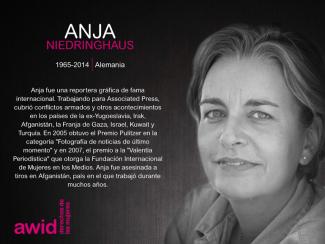
Anja Nedringhous
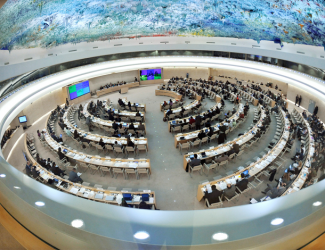
The Human Rights Council (HRC) is the key intergovernmental body within the United Nations system responsible for the promotion and protection of all human rights around the globe. It holds three regular sessions a year: in March, June and September. The Office of the UN High Commissioner for Human Rights (OHCHR) is the secretariat for the HRC.
Debating and passing resolutions on global human rights issues and human rights situations in particular countries
Examining complaints from victims of human rights violations or activist organizations on behalf of victims of human rights violations
Appointing independent experts (known as “Special Procedures”) to review human rights violations in specific countries and examine and further global human rights issues
Engaging in discussions with experts and governments on human rights issues
Assessing the human rights records of all UN Member States every four and a half years through the Universal Periodic Review
AWID works with feminist, progressive and human rights partners to share key knowledge, convene civil society dialogues and events, and influence negotiations and outcomes of the session.
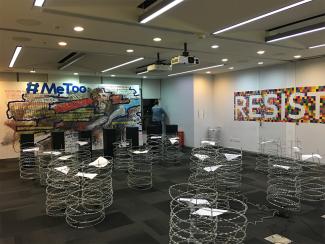
Le mouvement #MeToo en Chine s'est enflammé en janvier 2018, impulsé par l'élan du mouvement #MeToo dans le monde entier. Le mouvement était une réponse aux problèmes culturels et systémiques liés au genre et au pouvoir en Chine. Les fondations du mouvement ont été construites pendant des décennies, avec de nombreuses années de débat et de plaidoyer pour l'égalité des genres qui ont finalement jailli en une formidable force à travers la société. #MeToo a été mené principalement par des jeunes, parmi lesquels d'innombrables femmes anonymes et leurs allié·e·s, à la recherche d’opportunités qui leur permettraient de réaliser le "rêve chinois" ultime : transformer la Chine en un pays où règne l'égalité des genres.
L'environnement du mouvement #MeToo est extrêmement hostile en Chine: l'état de droit, l'équité et la transparence de l'action gouvernementale, ainsi que la liberté d'expression ne peuvent être considérés comme acquis par le mouvement en Chine, mais ce sont ces mêmes objectifs pour lesquels i.e.lles se battent. Depuis le début, il s'agit d'une lutte intense, chaque victime ou activiste qui dénonce courre d’énormes risques. Qu'il s'agisse d'être réduit·e au silence, humilié·e, ou de subir des représailles, ou encore de voir sa sécurité mise en péril, chaque succès du mouvement #MeToo a été remporté par celleux qui ont eu le courage d'assumer les coûts de la prise de parole et de défier la censure.
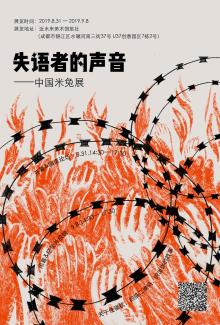
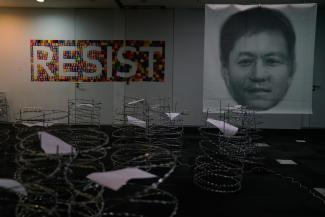
L'exposition #MeToo en Chine a été organisée pour la première fois en 2019 et a effectué une tournée dans 5 villes. L'objectif de l'exposition est de mettre davantage en avant les expériences personnelles des victimes et des activistes et, en prenant part à ces histoires, d'inspirer notre public à se joindre à la lutte. L'exposition est elle-même devenue une partie de la lutte #MeToo; elle a fait face à d’innombrables défis lors de sa tournée à travers la Chine et a même risqué la fermeture à plus d'une occasion.
Опрос будет доступен до конца августа 2024 года. Пожалуйста, заполните его в течение этого срока, чтобы ваши ответы были включены в анализ.
"I participated in a member-only activity and I was particularly moved to see how there was space for everyone to share and that there was no judgment whatsoever. The entire session was energetic and vibrant."
- Kirthi Jayakumar, Founder, The Gender Security Project, India
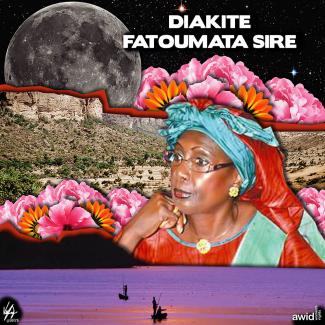
Diakite was actively involved in advocating for women in political and public life in Mali.
She worked to support training of women candidates in elections, and spoke out against the practice of Female Genital Mutilation (FGM). She was a strong proponent of reproductive health and rights.
Curated by Jess X. Snow With assistance from Kamee Abrahamian and Zoraida Ingles
Across Asia and the Pacific, and all of it’s vast diaspora, fierce women and trans folks have been fighting for a future where they can all be free. As rising sea levels threaten the Pacific islands, and the coasts of continental Asia, the fight to protect other Earth and the Ocean intensifies all over the globe. Our planet stores a geologic memory of everything that it has experienced. The rise of colonization, industrialization, and environmental destruction is connected to the rise of the binary patriarchal nation state. The power within the Earth, to reincarnate, heal, and bloom in the face of violence, must then be connected to the woman, to motherhood, to indigeneity and all forces that are expansive, sacred and queer. It is no coincidence that Feminist Realities unite the fight to protect the rights of women, trans and LGBTQ+ people with the fight to protect the Earth. From mother-daughter protectors of Mauna Kea in the Kingdom of Hawaii, to the complex mother-child relationships of Vietnamese refugees, to queer sexual awakenings in conservative India, the reclaimation of home in Inner Mongolia, to the struggle toward LGBTQ liberation in the Phillipines -- this collection of films is a cosmology of the ways current-day Asian Pacific women and queer and trans folks champion the journey to our collective liberation across oceans and borders.
All of these films have a strong sense of place: indigenous activists protect their sacred lands, youth peel back colonial narratives of their homeland to uncover hidden truths, complex motherhood and relations of care are explored, and characters turn to their own bodies and sexuality as sanctuary when the family and city that surrounds them threaten their safety.
By Jess X. Snow
“A haunting film with stunning shots invoking feminist environmental resistance and how deeply rooted this is in connection to cultural history and land…”
- Jessica Horn, PanAfrican feminst strategist, writer and co-creator of the temple of her skin
In the experimental documentary, Afterearth, four women fight to preserve the volcano, ocean, land and air for future generations. Through music, poetry, and heartfelt testimonial that honors locations touched by the Pacific Ocean–Hawaiʻi, the Philippines, China, and North America, Afterearth is a poetic meditation on four women’s intergenerational and feminist relationship to the lands and plants they come from.
By Jalena Keane Lee
In Standing Above the Clouds, Native Hawaiian mother-daughter activists stand together to protect their sacred mountain, Mauna Kea from being used as a site to build one of the world’s largest telescopes. As protectors of Mauna Kea, this film highlights the interconnected relationship between Aloha ʻĀina (love of the land) and love for one’s elders and the future generations to come.
By Quyên Nguyen-Le
In the experimental narrative short, Nước (Water/Homeland) a Vietnamese-American genderqueer teen challenges dominant narratives of the Vietnam War in Los Angeles, California. Through striking dream sequences and breaks from reality, this film follows their journey to piece together and understand their mother's experience as a Vietnam War refugee.
By Kimi Lee
In Kama’āina, a queer sixteen-year-old girl must navigate life on the streets in Oahu, until she eventually finds refuge by way of guidance from an auntie at Pu’uhonua o Wai’anae–Hawaiʻi’s largest organized homeless encampment.
By Karishma Dev Dube
In Devi (goddess in Hindi) a young closeted lesbian, Tara risks both family and tradition to embrace her attraction to her family’s maid. Set in New Delhi, Devi is a coming of age story, as it is a commentary on the social and class lines that divide women in contemporary India today.
By Yuan Yuan
In Heading South, Chasuna, an 8 year old girl, raised by her mother in the Inner Mongolian Plateau, visits her abusive father in the big city. While at her father’s house, she is introduced to a new addition to the family, and must come to terms with the fact that her true home is inseparable from her mother and land.
By Johnny Symons & S. Leo Chiang
In the feature film, Outrun, we follow the journey of the first transgender woman in the Philippine Congress. Facing oppression in a predominantly Catholic nation, her triumphant journey becomes an outcry for the rights of LGBTQ+ people globally.
Spanning documentary, narrative, and experimental forms, these films illustrate that community care, self-love, and deep transformative listening between our loved ones is a portal to the Feminist Realities we are bringing into existence today. From all across the Asia Pacific and it’s diaspora, these stories teach us that in the face of violence, tenderness is the sharpest force of resistance.
Watch our conversation with the filmmakers
Facebook: @AWIDWomensRights
Instagram: @awidwomensrights
Twitter ENG: @awid
Twitter ES: @awid_es
Twitter FR: @awid_fr
LinkedIn: Association for Women's Rights in Development (AWID)
Linda Porn es una otra heroína de la organización sindical feminista y del activismo de las trabajadoras sexuales a nivel nacional (en España) y transnacional.
Originaria de México, vive en España desde los años 2000. Es trabajadora sexual, activista, madre soltera y artista multidisciplinar.
Partiendo de estas diferentes identidades, utiliza la performance, el videoarte y el teatro para visibilizar las luchas en las intersecciones del transfeminismo, el trabajo sexual, la migración, el colonialismo y la maternidad. Combina el arte y el trabajo sexual mientras cuida a su hija como madre soltera.
Linda también pertenece a colectivos de trabajadoras sexuales que luchan por sus derechos, como el sindicato OTRAS y CATS Murcia. También cofundó el grupo 'Madrecitas' - que visibiliza y denuncia la violencia institucional racista contra las familias migrantes. Violencia de la que ella y su hija fueron objeto por ser trabajadora sexual y madre soltera migrante.
¡No te pierdas su trabajo artístico aquí!
Building on our 20-year history of mobilizing more and better funding for feminist-led social change, AWID invites you to complete the new iteration of our flagship survey, WITM.
El Foro de AWID estará organizado alrededor de 6 tópicos interconectados. Estos «ejes» se centran en las realidades feministas.
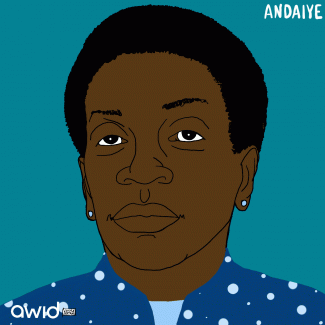
Andaiye was seen as a transformative figure on the frontlines of the struggles for liberation and freedom. She was an early member and active in the leadership of the Working People’s Alliance (WPA), a socialist party in Guyana which fought against authoritarian rule and continued throughout her life to focus on justice for the working-class and rural women’s rights and on bridging ethnic barriers between Indo and Afro-Guyanese women.
Andaiye was a founding member of Red Thread Women, an organization that advocated for women’s care work to be fairly remunerated, worked at the University of the West Indies and with CARICOM. Never afraid to challenge governments, she pointed out gender imbalances in state boards, laws that discriminated against sex workers, called for abortion rights in Jamaica and spoke out against trade agreements such as the Caribbean Single Market and Economy (CSME) that allowed for the free movement of women domestic migrant workers but did not give their children the same rights.
Andaiye published several scholarly essays, wrote newspaper columns and also edited the last books of Walter Rodney, the Guyanese political activist and fellow WPA leader, who was assassinated in 1980. A cancer survivor, Andaiye was one of the founders of the Guyana Cancer Society and the Cancer Survivors’ Action Group. She also served on the executive of the Caribbean Association for Feminist Research and Action (CAFRA), as a Director of Help and Shelter and as Board Member of the Guyana National Commission on Women. She received a number of awards, including the Golden Arrow of Achievement in Guyana (the fourth highest national award).
Andaiye passed away on 31 May 2019 at the age of 77. The subsequent tributes that flowed in from activists, friends and those inspired by her life spoke eloquently to her amazing legacy and her beautiful humanity.
Here are but a few:
“Andaiye had a profound effect on me...she was so many things, an educator, fighter, she taught me to be self-critical, to think more clearly, she taught me about survival, about incredible courage, about compassion, about going beyond external appearances and treating people as people and not being distracted by status, class, race...anything.”
- Peggy Antrobus, Feminist Activist, Author, Scholar, Barbados
“The kind of confident idealism Andaiye expressed, this willingness to confront the world and a stubborn belief that you could actually change it... That politics of hope...How else to honour her life, legacy and memory but to keep doing the work ethically and with ongoing self-critique? And to put women’s caring work at the center of it.”
- Tonya Haynes, Barbados
“I can hear her quip at our collective keening. So through the tears I can laugh. Deep bows to you beloved Andaiye, thank you for everything. Love and light for your spirit’s journey. Tell Walter and all the ancestors howdy.” - Carol Narcisse, Jamaica
Una red compleja de actores anti-derechos, en constante evolución, está ejerciendo cada vez más influencia en los espacios internacionales y en las políticas nacionales. Respaldados a menudo por financiaciones poco transparentes, estos actores construyen alianzas tácticas sobre distintos temas y cruzando diferentes regiones y credos para aumentar su impacto.
Estamos viendo actores fascistas y fundamentalistas que, si bien tienen un discurso nacionalista, son completamente transnacionales en lo que respecta a sus basamentos ideológicos, sus alianzas políticas y sus redes de financiamiento. En algunos casos, estos grupos están respaldados por flujos financieros poco transparentes vinculados con grandes empresas o con partidos políticos de extrema derecha. Sin embargo, también crean alianzas estratégicas, que incluyen, en algunos casos, segmentos de los movimientos feministas y por los derechos de las mujeres, y se distancian de los elementos más evidentemente extremistas para parecer más legítimos. Los actores anti-derechos también se expanden y replican su estilo de organización antiderechos (ya sea a través de campañas y grupos de presión, o de litigios estratégicos) en todo el planeta.

"[Ella] era una persona que se caracterizaba por su arduo trabajo a favor de la defensa de los derechos humanos y la construcción de la paz en Nariño, especialmente en el municipio de Samaniego-Nariño". - Jorge Luis Congacha Yunda para Página10.
Paula se especializó en los derechos civiles y políticos, las problemáticas de la impunidad y la justicia, y contribuyó a descubrir abusos de poder, incluida la corrupción. Paula participó también en proyectos para la consolidación de la paz en su ciudad natal, Samaniego, a través del Consejo Municipal de Paz y la Junta Municipal de Mujeres.
Paula recibió amenazas de muerte tras exponer el manejo irregular de los recursos y de denunciar actos de corrupción en el Hospital Lorencita Villegas del municipio nariñense. Fue asesinada el 20 de mayo de 2019, cuando dos hombres se acercaron y le dispararon a corta distancia.