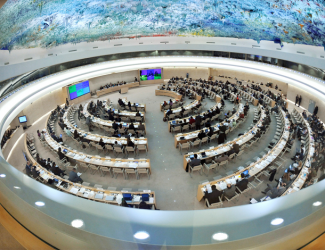
The Human Rights Council (HRC) is the key intergovernmental body within the United Nations system responsible for the promotion and protection of all human rights around the globe. It holds three regular sessions a year: in March, June and September. The Office of the UN High Commissioner for Human Rights (OHCHR) is the secretariat for the HRC.
The HRC works by:
Debating and passing resolutions on global human rights issues and human rights situations in particular countries
Examining complaints from victims of human rights violations or activist organizations on behalf of victims of human rights violations
Appointing independent experts (known as “Special Procedures”) to review human rights violations in specific countries and examine and further global human rights issues
Engaging in discussions with experts and governments on human rights issues
Assessing the human rights records of all UN Member States every four and a half years through the Universal Periodic Review
AWID works with feminist, progressive and human rights partners to share key knowledge, convene civil society dialogues and events, and influence negotiations and outcomes of the session.
With our partners, our work will:
◾️ Monitor, track and analyze anti-rights actors, discourses and strategies and their impact on resolutions
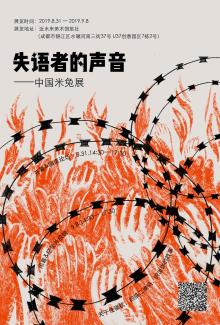
Le mouvement #MeToo en Chine s'est enflammé en janvier 2018, impulsé par l'élan du mouvement #MeToo dans le monde entier. Le mouvement était une réponse aux problèmes culturels et systémiques liés au genre et au pouvoir en Chine. Les fondations du mouvement ont été construites pendant des décennies, avec de nombreuses années de débat et de plaidoyer pour l'égalité des genres qui ont finalement jailli en une formidable force à travers la société. #MeToo a été mené principalement par des jeunes, parmi lesquels d'innombrables femmes anonymes et leurs allié·e·s, à la recherche d’opportunités qui leur permettraient de réaliser le "rêve chinois" ultime : transformer la Chine en un pays où règne l'égalité des genres.
L'environnement du mouvement #MeToo est extrêmement hostile en Chine: l'état de droit, l'équité et la transparence de l'action gouvernementale, ainsi que la liberté d'expression ne peuvent être considérés comme acquis par le mouvement en Chine, mais ce sont ces mêmes objectifs pour lesquels i.e.lles se battent. Depuis le début, il s'agit d'une lutte intense, chaque victime ou activiste qui dénonce courre d’énormes risques. Qu'il s'agisse d'être réduit·e au silence, humilié·e, ou de subir des représailles, ou encore de voir sa sécurité mise en péril, chaque succès du mouvement #MeToo a été remporté par celleux qui ont eu le courage d'assumer les coûts de la prise de parole et de défier la censure.
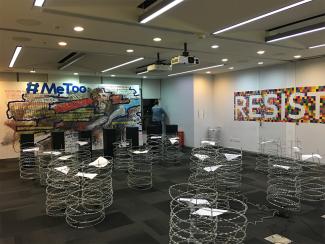
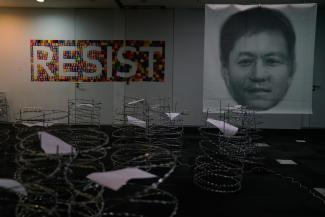
L'exposition #MeToo en Chine a été organisée pour la première fois en 2019 et a effectué une tournée dans 5 villes. L'objectif de l'exposition est de mettre davantage en avant les expériences personnelles des victimes et des activistes et, en prenant part à ces histoires, d'inspirer notre public à se joindre à la lutte. L'exposition est elle-même devenue une partie de la lutte #MeToo; elle a fait face à d’innombrables défis lors de sa tournée à travers la Chine et a même risqué la fermeture à plus d'une occasion.
Yelena Grigoriyeva, que ses ami·e·s appelaient souvent Lena, était une défenseure connue des droits des personnes LGBT en Russie.
Membre de mouvements démocratiques, pacifistes et LGBT, Yelena était une féroce opposante au président Vladimir Poutine et son administration. Elle a notamment exprimé son opposition à l’annexion de la péninsule ukrainienne de la Crimée par la Russie ainsi que critiqué les mauvais traitements infligés aux détenu·e·s.
Yelena a fait part de sa bisexualité en 2019.
« Sa déclaration m’a surprise et je ne l’approuvais pas. Je lui ai dit : « Écoute, Lena, tu portes déjà une cible sur la poitrine du fait de ton activisme politique. Tu viens de t’en peindre une autre dans le dos », Olga Smirnova, compagne de lutte politique et amie.
Yelena a effectivement reçu plusieurs menaces de mort, et des proches ont déclaré que son nom figurait sur un site Web homophobe qui incitait ses visiteur·euse·s à tuer les personnes LGBT. Elle a fait part de ces menaces à la police, mais l’État russe ne l’a pas protégée.
Mais même dans une société où l’opposition politique, les activistes et les membres de la communauté LGBT, qui se battent pour leurs droits, font face à une violence croissante, Yelena continuait à défendre la justice sociale et l’égalité.
« Elle ne manquait pas une seule action militante. Et ils l’ont arrêtée plus de fois que je n’ai pu en compter », Olga Smirnova.
Yelena a été assassinée le 21 juillet 2019, à proximité de chez elle. Un suspect a été arrêté, mais certaines sources et plusieurs de ses ami·e·s et compagnes et compagnons de lutte pensent que ce suspect sert de bouc émissaire, et qu’en fait, il s’agit d’un assassinat politique ciblé.
Pour la famille et les ami·e·s de Yelena, son assassinat demeure irrésolu, bien que le suspect ait avoué.
En 2013, la Russie a passé une loi interdisant la propagation de ce qu’elle a appelé la « propagande gay ». En 2014, Human Rights Watch a publié un rapport à ce propos (en anglais et en russe).
Snippet FEA Sabrina Sanchez Bio (EN)
Meet Sabrina Sanchez, remarkable trans migrant woman, sex worker, organizer, transfeminist and one of the founders of the union OTRAS.
Originally from Mexico City, she migrated to Spain 17 years ago after getting a degree in communications and started working as a sex worker.
It didn’t take long before she became involved with trans activism and sex worker activism in Barcelona. After joining the collective Asociación de Profesionales del Sexo (Association of Sex Workers, Aprosex), she started working in its secretariat and founded the Spanish sex workers union OTRAS.
Curated by Jess X. Snow With assistance from Kamee Abrahamian and Zoraida Ingles
Across Asia and the Pacific, and all of it’s vast diaspora, fierce women and trans folks have been fighting for a future where they can all be free. As rising sea levels threaten the Pacific islands, and the coasts of continental Asia, the fight to protect other Earth and the Ocean intensifies all over the globe. Our planet stores a geologic memory of everything that it has experienced. The rise of colonization, industrialization, and environmental destruction is connected to the rise of the binary patriarchal nation state. The power within the Earth, to reincarnate, heal, and bloom in the face of violence, must then be connected to the woman, to motherhood, to indigeneity and all forces that are expansive, sacred and queer. It is no coincidence that Feminist Realities unite the fight to protect the rights of women, trans and LGBTQ+ people with the fight to protect the Earth. From mother-daughter protectors of Mauna Kea in the Kingdom of Hawaii, to the complex mother-child relationships of Vietnamese refugees, to queer sexual awakenings in conservative India, the reclaimation of home in Inner Mongolia, to the struggle toward LGBTQ liberation in the Phillipines -- this collection of films is a cosmology of the ways current-day Asian Pacific women and queer and trans folks champion the journey to our collective liberation across oceans and borders.
All of these films have a strong sense of place: indigenous activists protect their sacred lands, youth peel back colonial narratives of their homeland to uncover hidden truths, complex motherhood and relations of care are explored, and characters turn to their own bodies and sexuality as sanctuary when the family and city that surrounds them threaten their safety.
AFTEREARTH
By Jess X. Snow
“A haunting film with stunning shots invoking feminist environmental resistance and how deeply rooted this is in connection to cultural history and land…”
- Jessica Horn, PanAfrican feminst strategist, writer and co-creator of the temple of her skin
In the experimental documentary, Afterearth, four women fight to preserve the volcano, ocean, land and air for future generations. Through music, poetry, and heartfelt testimonial that honors locations touched by the Pacific Ocean–Hawaiʻi, the Philippines, China, and North America, Afterearth is a poetic meditation on four women’s intergenerational and feminist relationship to the lands and plants they come from.
STANDING ABOVE THE CLOUDS
By Jalena Keane Lee
In Standing Above the Clouds, Native Hawaiian mother-daughter activists stand together to protect their sacred mountain, Mauna Kea from being used as a site to build one of the world’s largest telescopes. As protectors of Mauna Kea, this film highlights the interconnected relationship between Aloha ʻĀina (love of the land) and love for one’s elders and the future generations to come.
NƯỚC (WATER/HOMELAND)
By Quyên Nguyen-Le
In the experimental narrative short, Nước (Water/Homeland) a Vietnamese-American genderqueer teen challenges dominant narratives of the Vietnam War in Los Angeles, California. Through striking dream sequences and breaks from reality, this film follows their journey to piece together and understand their mother's experience as a Vietnam War refugee.
KAMA’ĀINA
By Kimi Lee
In Kama’āina, a queer sixteen-year-old girl must navigate life on the streets in Oahu, until she eventually finds refuge by way of guidance from an auntie at Pu’uhonua o Wai’anae–Hawaiʻi’s largest organized homeless encampment.
DEVI
By Karishma Dev Dube
In Devi (goddess in Hindi) a young closeted lesbian, Tara risks both family and tradition to embrace her attraction to her family’s maid. Set in New Delhi, Devi is a coming of age story, as it is a commentary on the social and class lines that divide women in contemporary India today.
HEADING SOUTH
By Yuan Yuan
In Heading South, Chasuna, an 8 year old girl, raised by her mother in the Inner Mongolian Plateau, visits her abusive father in the big city. While at her father’s house, she is introduced to a new addition to the family, and must come to terms with the fact that her true home is inseparable from her mother and land.
Outrun
By Johnny Symons & S. Leo Chiang
In the feature film, Outrun, we follow the journey of the first transgender woman in the Philippine Congress. Facing oppression in a predominantly Catholic nation, her triumphant journey becomes an outcry for the rights of LGBTQ+ people globally.
Spanning documentary, narrative, and experimental forms, these films illustrate that community care, self-love, and deep transformative listening between our loved ones is a portal to the Feminist Realities we are bringing into existence today. From all across the Asia Pacific and it’s diaspora, these stories teach us that in the face of violence, tenderness is the sharpest force of resistance.
Jess X. Snow is a film director, artist, pushcart-nominated poet, children’s book author and community arts educator who creates queer asian immigrant stories that transcend borders, binaries and time.
Follow us on Social Media to receive news about upcoming events and screenings:
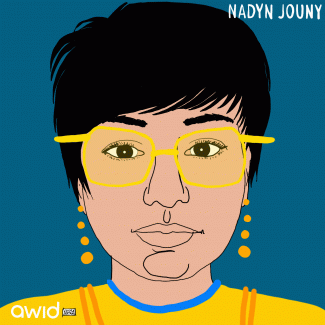
The personal is political - and fiery and courageous Nadyn Jouny personified this feminist mantra. Nadyn experienced firsthand the pain of structural violence in legal systems that strip women of their rights.
When she decided to file for divorce, the religious Shitte courts under the Lebanese Personal Status laws, denied her custody of her young son Karam. Nadyn, like so many other women across Lebanon and other countries, was caught in the impossible pain of leaving an unwanted and abusive relationship and also losing the rights to her child. But Nadyn fought back, as she would until her last day.
She used her media savvy to become an outspoken voice to women fighting discriminatory family laws in Lebanon and internationally. Nadyn co-founded the self-funded group, “Protecting Lebanese Women” (PLW) and banded with many other Lebanese mothers facing similar custody issues. Together, they advocated to raise awareness of the injustices they were facing, protesting in front of the religious courts for their rights and bringing international media attention to extreme injustices they were facing.
Nadyn also worked with ABAAD - Resource Center for Gender Equality, another women’s rights organization in Lebanon, to campaign for women’s rights, equality in family law and custody and against forced and early marriages.
For many of her colleagues, she came to “symbolize a Lebanese mother’s fight against suppression and misogyny of all sorts," using “her personal experiences and her individual journey of empowerment to give hope to others that they can be a catalyst for positive change.”- ABAAD - Resource Centre for Gender Equality, Lebanon
On October 6, 2019 Nadyn was tragically killed in a car accident on her way to protest unfair tax increases in a country already facing spiralling financial crisis. Nadyn Jouny was only 29 years old at the time of her death.
Enciende tu fuego feminista leyendo nuestras investigaciones y publicaciones varias sobre financiamiento, defensoras de derechos humanos, construcción de movimientos, fundamentalismos, justicia económica, seguimiento y evaluación feminista y más
Building on our 20-year history of mobilizing more and better funding for feminist-led social change, AWID invites you to complete the new iteration of our flagship survey, WITM.
Una red compleja de actores anti-derechos, en constante evolución, está ejerciendo cada vez más influencia en los espacios internacionales y en las políticas nacionales. Respaldados a menudo por financiaciones poco transparentes, estos actores construyen alianzas tácticas sobre distintos temas y cruzando diferentes regiones y credos para aumentar su impacto.
Estamos viendo actores fascistas y fundamentalistas que, si bien tienen un discurso nacionalista, son completamente transnacionales en lo que respecta a sus basamentos ideológicos, sus alianzas políticas y sus redes de financiamiento. En algunos casos, estos grupos están respaldados por flujos financieros poco transparentes vinculados con grandes empresas o con partidos políticos de extrema derecha. Sin embargo, también crean alianzas estratégicas, que incluyen, en algunos casos, segmentos de los movimientos feministas y por los derechos de las mujeres, y se distancian de los elementos más evidentemente extremistas para parecer más legítimos. Los actores anti-derechos también se expanden y replican su estilo de organización antiderechos (ya sea a través de campañas y grupos de presión, o de litigios estratégicos) en todo el planeta.
Índice de contenidos
CitizenGo
Alliance Defending Freedom (ADF)
Financiación de actores antiderechos
Los vínculos entre feministas trans-excluyentes y fundamentalistas cristianxs
Ejercicio: Esquematicemos el panorama
Historia de movimiento de resistencia: Catolicadas, una poderosa herramienta de comunicación para promover la igualdad de género y los derechos sexuales y reproductivos
Doris Valenzuela Angulo fue una activista social afrodescendiente, líder y defensora de los derechos humanos, de Buenaventura, Colombia. Fue parte de Comunidades Construyendo Paz en los Territorios (CONPAZ), una red nacional de organizaciones de comunidades afectadas por el conflicto armado que propugnan la no violencia y la justicia socioambiental.
Doris desafiaba la constante violencia paramilitar y las presiones de los megaproyectos para desplazar a su comunidad, así como la complicidad del Estado. Enfrentando uno de los contextos más difíciles de su país, tuvo un rol de liderazgo en una iniciativa de resistencia no violenta sin precedentes llamado «Espacio Humanitario Puente Nayero», una zona urbana para la cohesión comunitaria, la seguridad, la creatividad y la acción colectiva.
Esta singular lucha no violenta de las familias que pertenecían al «Espacio Humanitario Puente Nayero» atrajo la atención y el apoyo de organismos locales e internacionales. Hacia septiembre de 2014, la Comisión Interamericana de Derechos Humanos había establecido medidas cautelares de protección para la comunidad, y había ordenado al Estado colombiano hacer lo necesario para preservar sus vidas y su integridad personal. Sin embargo, las amenazas y la violencia de los paramilitares continuaron. Doris centró sus energías en evitar el reclutamiento forzoso de niñxs y jóvenes por parte de los neo-paramilitares, y siguió haciéndolo a pesar del asesinato de su hijo Cristian Dainer Aragón Valenzuela en julio de 2015. Doris también se convirtió en blanco de ataques, y recibía amenazas por su activismo y el trabajo que realizaba continuamente.
Las persistentes agresiones y amenazas contra su vida forzaron a Doris a abandonar Colombia. Residió en España desde febrero de 2017 hasta febrero de 2018, e integró el Programa de Protección Temporal de Defensores y Defensoras de los Derechos Humanos de Amnistía Internacional para activistas cuyas vidas están en riesgo.
En abril de 2018, Doris fue asesinada por su ex-marido en Murcia, España. Tenía solamente 39 años.
Tributos:
«Doris, pasar un año entero contigo nos ha enseñado cómo una persona puede tener la capacidad de transformar y generar esperanza ante hechos profundamente negativos y devastadores sucedidos durante tu vida...Seguimos con nuestro compromiso en la defensa de todos los derechos humanos. Siempre nos guiará tu valentía y tu luz.» Montserrat Román, Amnistía Internacional Grupo La Palma
Fragmento de «Palabras para Doris Valenzuela Angulo» por Elsa López
«Tú lo sabías. Siempre lo supiste. Y a pesar de todo te levantaste firme contra tantas injusticias, tantas miserias, tanta persecución.Te alzaste, altiva y feroz, contra aquellos que querían hacerte de nuevo abandonar tus esperanzas, humillarte y rendirte. Puesta en pie clamaste por tu libertad y la nuestra que era la tuya. Nada ni nadie paralizó tus esfuerzos por cambiar el mundo y hacerlo más generoso y habitable. Tú, viva entre nosotras, más viva hoy que nunca entre nosotras a pesar de la muerte. Viva siempre por tus gestos, tu valor, tu grandeza al clamar por una tierra prometida que llegaste a invocar con cada uno de tus gritos por todos los desiertos que habitaste. Tú. Siempre viva. Doris Valenzuela Angulo.
Son sólo palabras. Lo sé. Yo también lo sé. Pero las palabras nos unen, nos protegen, nos dan fuerza y aliento para seguir caminando hacia la luz que tanto defendías.»
Lorsqu’on effectue une recherche en ligne sur les « Mutilations génitales féminines » ou « MGF », un schéma en quatre parties sur l’anatomie des femmes apparaît à côté d’une page Wikipédia dédiée. (...)