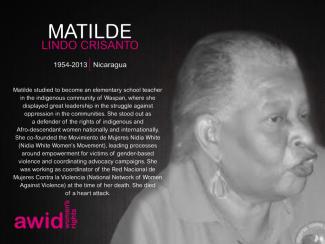
Matilde Lindo Crisanto
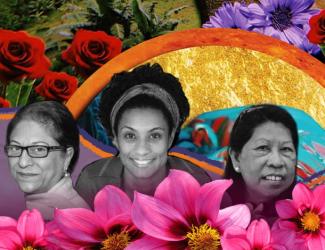
AWID’s Tribute is an art exhibition honouring feminists, women’s rights and social justice activists from around the world who are no longer with us.
This year’s tribute tells stories and shares narratives about those who co-created feminist realities, have offered visions of alternatives to systems and actors that oppress us, and have proposed new ways of organising, mobilising, fighting, working, living, and learning.
49 new portraits of feminists and Women Human Rights Defenders (WHRDs) are added to the gallery. While many of those we honour have passed away due to old age or illness, too many have been killed as a result of their work and who they are.
This increasing violence (by states, corporations, organized crime, unknown gunmen...) is not only aimed at individual activists but at our joint work and feminist realities.
The portraits of the 2020 edition are designed by award winning illustrator and animator, Louisa Bertman.
AWID would like to thank the families and organizations who shared their personal stories and contributed to this memorial. We join them in continuing the remarkable work of these activists and WHRDs and forging efforts to ensure justice is achieved in cases that remain in impunity.
“They tried to bury us. They didn’t know we were seeds.” - Mexican Proverb
It took shape with a physical exhibit of portraits and biographies of feminists and activists who passed away at AWID’s 12th International Forum, in Turkey. It now lives as an online gallery, updated every year.
To date, 467 feminists and WHRDs are featured.
Jessica est une artiste-activiste queer de Toronto, au Canada, mais qui vit actuellement en Bulgarie. Elle a plus de 15 ans d'expérience dans la riposte au VIH, travaillant aux intersections du genre et du VIH auprès de populations clés (travailleurs·ses du sexe, femmes consommatrices de drogues, communautés LGBTQI, personnes incarcérées et, bien sûr, personnes vivant avec le VIH). Jessica aime créer du mouvement et réfléchir/entreprendre/élaborer des stratégies sur des interventions basées sur les arts. L'un des projets amusants qu'elle a lancé en 2013 était LOVE POSITIVE WOMEN (Femmes positives à l’amour), qui implique plus de 125 groupes et organisations communautaires du monde entier, du 1er au 14 février, pour célébrer les femmes vivant avec le VIH dans leurs communautés.
La encuesta está disponible en KOBO, una plataforma de fuente abierta para recopilar, gestionar y visualizar datos. Para participar, simplemente haz clic en el enlace a la encuesta aquí. Sigue las instrucciones para responder la encuesta.
Leila is a transnational feminist leader, strategist, and advisor with over 25 years of organizing, advocacy and philanthropic experience advancing human rights, gender equality, and sexual and reproductive rights and justice. She was born in Algeria and educated in the U.S., France, and Morocco; over her professional career, she has lived and worked in forty countries across Africa, Europe, Latin America and Asia. Leila currently serves as a Senior International Fellow at the Asfari Institute for Civil Society and Citizenship at the American University of Beirut in Lebanon and as Senior Strategist for various feminist movements and organizations as well as the the Urgent Action Fund-Africa and Trust Africa on an initiative on Reimagining Feminist and Pan-African Philanthropies.
From 2017-2023, Leila held the position as Vice-President of Programs at Global Fund for Women where she oversaw its strategic grantmaking, movement-strengthening, global advocacy and philanthropic collaborations. At GFW, she doubled its grantmaking to over $17 million, launched its feminist and gender-based movements and crises work, created an adolescent girls program led by a girls’ advisory council and led its philanthropic advocacy work. Prior to that she served on the senior leadership team of Ipas from 2002 to 2016 where she published extensively on abortion rights and justice, lead global advocacy efforts and partnered with feminist groups working on self-management, community strategies and stigma reduction around bodily integrity and sexual and reproductive rights.
Leila is currently researching shifts in the philanthropic sector including recognizing non-institutional practices of giving resources in the Global South and efforts to decolonize practices in the Global North. She has written extensively on the political nature of veiling across North Africa and the Middle East, abortion practices in majority Muslim contexts and feminist approaches to sexual and reproductive health, rights and justice.
Leila holds an MPH in public health and a MA in Middle Eastern and North African Studies, studied Islamic law in Morocco and pursued doctoral studies in sociology in France. She studied Arabic and speaks French and English fluently. She is a mother of two feminist young women, an avid scuba diver, mountain bike rider, skier, and outdoor enthusiast.
Oui, elle est accessible aux personnes ayant une diversité de capacités d’audition, de mouvement, de vision et cognitives.
EN CIFRAS
Culturellement nomade, née à Hong Kong et enracinée dans un héritage turco-pakistanais, l'amour de Fatima pour les récits - tant pour les lire que pour les cocréer - a alimenté sa passion pour l'activisme à travers la communication. Forte de sa formation en journalisme, Fatima a travaillé pendant 7 ans dans les domaines de la communication numérique et médiatique avec des ONG qui offrent des opportunités d'éducation et de l’aide juridique aux réfugié·e·s et demandeur·se·s d'asile, ainsi qu'avec le mouvement féministe musulman qui applique une perspective féministe et fondée sur les droits dans la compréhension et la quête d’égalité et de justice au sein de la tradition juridique musulmane. Elle rédige régulièrement des tribunes sur les questions féministes dans les pays du Sud.
Grâce à la narration dans cette ère ultra digitale des réseaux sociaux, Fatima continue de collaborer avec des animateur·rice·s communautaires et des activistes de terrain pour créer du contenu audiovisuel dans le but de cultiver des ponts de compréhension vers la libération collective et la décolonisation. Les jours où elle ne travaille pas, elle regarde attentivement des films féministes indépendants venant d’Iran, du Maroc et du Pakistan, et les autres jours elle interprète de la poésie orale avec ses camarades à Kuala Lumpur.

If you wish to save your responses and come back to the survey later, you are able to do this whenever needed. KOBO will save your draft responses on the top left corner of the survey page and reload your record when you return to the survey. Just make sure to continue from the same computer and browser.
À l’AWID, nous concevons ces réalités féministes comme les exemples vivants des mondes que nous savons possibles. Nous concevons ces diverses réalités féministes comme des revendications et des incarnations d’espoir et de pouvoir. Elles sont ancrées dans les multiples manières de vivre, de penser et de faire autrement, que ce soit au niveau des expressions quotidiennes de nos modes de vie ou nos manières d'être en relations les un.e.s avec les autres ou au niveau de systèmes alternatifs de gouvernance et de justice.
Les Réalités féministes combattent les systèmes de pouvoir dominants tels que le patriarcat, le capitalisme et la suprématie blanche.
Télécharger le magazine complet (PDF)
Si por algún motivo deseas que retiremos y borremos tus respuestas, tienes todo el derecho a hacerlo. Puedes contactarnos a través del formulario disponible aquí indicando «Encuesta WITM (¿Dónde está el dinero?) » en el título del mensaje, y procederemos a retirar y borrar tu respuesta.
The Nadia Echazú Textile Cooperative carries the name of a pioneer in the struggle for trans rights in Argentina. In many ways, the work of the cooperative celebrates her life and legacy.
Nadia Echazú had a remarkable activist trajectory: she was one of the co-founders of "El Teje", the first trans newspaper in Latin America, alongside Lohana Berkins, Diana Sacayán and Marlene Wayar. Nadia was part of the Argentinian Association of Travestis, Transexual and Transgender people (Asociación de Travestis y Transexuales de Argentina, ATTA) and founded The Organization of Travestis and Transgender People of Argentina (Organización de Travestis y Transexuales de Argentina, OTTRA).
Shortly after her death, her fellow activists founded the cooperative in her name, to honor the deep mark she left on trans and travesti activism in Argentina.
A dynamic network of people around the world, AWID members are researchers, academics, students, educators, activists, business people, policy-makers, development practitioners, funders, and more. Our members - of every age - are those who make AWID a unique global feminist association.
We offer different types of memberships geared to income level and whether you are an individual or an organization. Currently we have over 5000 members, individual and institutional, from 164 countries.
We collaborate for advocacy on specific issues, members vote in elections for our Board, and can also participate in and contribute to our Priority Areas through webinars, surveys, or urgent actions, for example.
Our institutional membership draws from a broad range of organizations interested in advancing gender justice and women’s human rights, including women’s rights organizations, from the local to the global levels, grassroots networks, major international institutions, government departments, university programs and more. 63% of our members are from the global South and 38% are under the age of 30.