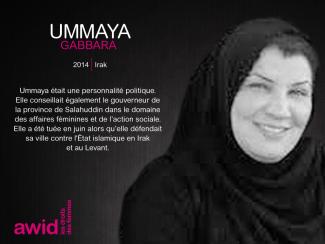
Ummaya Gabbara
WHRDs are self-identified women and lesbian, bisexual, transgender, queer and intersex (LBTQI) people and others who defend rights and are subject to gender-specific risks and threats due to their human rights work and/or as a direct consequence of their gender identity or sexual orientation.
WHRDs are subject to systematic violence and discrimination due to their identities and unyielding struggles for rights, equality and justice.
The WHRD Program collaborates with international and regional partners as well as the AWID membership to raise awareness about these risks and threats, advocate for feminist and holistic measures of protection and safety, and actively promote a culture of self-care and collective well being in our movements.
WHRDs are exposed to the same types of risks that all other defenders who defend human rights, communities, and the environment face. However, they are also exposed to gender-based violence and gender-specific risks because they challenge existing gender norms within their communities and societies.
We work collaboratively with international and regional networks and our membership
We aim to contribute to a safer world for WHRDs, their families and communities. We believe that action for rights and justice should not put WHRDs at risk; it should be appreciated and celebrated.
Promoting collaboration and coordination among human rights and women’s rights organizations at the international level to strengthen responses concerning safety and wellbeing of WHRDs.
Supporting regional networks of WHRDs and their organizations, such as the Mesoamerican Initiative for WHRDs and the WHRD Middle East and North Africa Coalition, in promoting and strengthening collective action for protection - emphasizing the establishment of solidarity and protection networks, the promotion of self-care, and advocacy and mobilization for the safety of WHRDs;
Increasing the visibility and recognition of WHRDs and their struggles, as well as the risks that they encounter by documenting the attacks that they face, and researching, producing, and disseminating information on their struggles, strategies, and challenges:
Mobilizing urgent responses of international solidarity for WHRDs at risk through our international and regional networks, and our active membership.
Con una asistencia de hasta 2500 participantes presenciales y 3,000 conectadxs de manera virtual, este será el Foro de AWID más grande hasta ahora. Vislumbramos múltiples espacios para establecer conexiones significativas, aprender, intercambiar ideas, tener conversaciones estratégicas, sanar y celebrar. Es la primera vez que nos reunimos en este espacio desde la pandemia, y estamos muy deseosxs de hacerlo.
Anti-rights discourses continue to evolve. As well as using arguments related to religion, culture, and tradition, anti-rights actors co-opt the language of social justice and human rights to conceal their true agendas and gain legitimacy.
"¿Dónde está el dinero para las organizaciones feministas?
¿Cuánto sabes sobre la movilización de recursos feminista? Responde el cuestionario de AWID “¿Dónde está el dinero para las organizaciones feministas?” y pon a prueba tus conocimientos
Responde el cuestionario en línea Descárgalo e imprímelo.
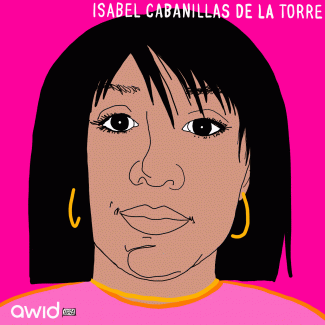
Isabel Cabanillas de la Torre was a much loved young feminist artist and activist from Ciudad Juárez, Mexico, known for her beautiful and evocative hand-painted clothing with eyes being an emblematic feature in her work. Her murals transformed the run down and vacant buildings in Ciudad Juarez’s downtown, bringing life and political commentary to their walls.
Through her art and political activism Isabel sought to draw attention to the gender based violence pervasive in her hometown. She volunteered with the women’s network Mesa de Mujeres on the Citizen Observatory on Gender to monitor the performance of judges, prosecutors and public defenders on cases of femicides and other gender based violations. She was also a member of Hijas de su Maquilera Madre, a feminist collective whose name makes reference to the daughters of mothers who are maquila workers. Some of these mothers were among the first victims of femicide in the city.
Isabel’s latest project, still in progress, was an art installation to protest a Canadian company that was looking to mine copper in the Samalayuca Desert.
On 18 January, 2020 Isabel was shot while riding her bike back home in Downtown Juárez, in what appeared to be a targeted killing, her body found beside her bike.
Isabel’s murder, sparked a new wave of outrage against femicides in the region, hundreds marched to the US-Mexico border bridge, blocking it for hours and chanting “Ni una mas” (Not one more) as feminist collectives continue to protest the murders of women throughout Mexico. In 2019 alone, 3142 women and girls were killed in Mexico, many of whom were targeted specifically because of their gender.
She loved riding her bike.
"The bike for her was a symbol of freedom. A symbol of being free in the streets." - Marisol (a friend of Isabel’s)
Si votre groupe ou votre organisation est récipiendaire de fonds, vous feriez bien de vous entretenir dès maintenant avec votre organisme de financement pour savoir si ce dernier est en mesure de prendre en charge votre voyage et votre participation au Forum. De nombreuses institutions planifient leur budget pour l'année prochaine dès le début de l'année 2023, aussi vaudrait-il mieux ne pas reporter cette discussion à l'année prochaine.
¿Es usted una persona que diseña políticas en la ONU y quiere saber quiénes son los principales grupos anti-derechos y frente a qué discursos mantenerse alerta? ¿O unx feminista que busca argumentos para refutar esos discursos rápidamente? Esta cartilla de 8 páginas le ofrece información importante de un vistazo.
Ce rapport révèle la réalité du financement des organisations féministes et de défense des droits des femmes dans un contexte de bouleversements politiques et financiers. S’appuyant sur plus de dix ans d’analyse depuis la dernière étude Où est l’argent ? de l’AWID, il dresse un bilan des progrès réalisés, des lacunes persistantes et des menaces croissantes dans le domaine du financement féministe.
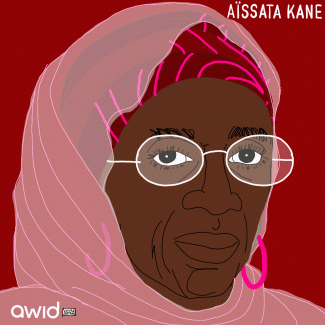
Aïssata Kane, también conocida afectuosamente como «Yaye Kadia»” [«Madre Kadia»], fue una feminista comprometida, durante toda su vida, con la defensa de los derechos de las mujeres africanas y, en especial, mauritanas.
En 1975 fue la primera mujer en ocupar el cargo de Ministra de Protección Familiar y Asuntos Sociales, puesto desde el cual Aïssata trabajó fervientemente para mejorar el estatus de las mujeres de su país.
Este trabajo incluyó el fomento de la educación de niñas y mujeres, la lucha contra la práctica de alimentación forzada de mujeres jóvenes, la incidencia para la inclusión de una legislación sobre derechos maritales, y la promoción de la creación de un cupo de representación femenino en el Parlamento.
«[Aïssata] materializaba todas sus pasiones con humildad, valentía y determinación. No quería molestar a nadie con su lucha en todos estos frentes simultáneos.» - Ball Halimata Dem, sobrina de Aïssata
Fundó la Unión Nacional de Mujeres de Mauritania (UNFM), creando y publicando con otras activistas Marienou, una revista dedicada a la emancipación de las mujeres mauritanas. Aïssata también dirigió varias organizaciones subregionales y locales, por ejemplo, como Presidenta de la Asociación Internacional de Mujeres Francófonas (AIFF) y, como firme ecologista, fue Presidenta de la Asociación para la Protección del Medio Ambiente de Mauritania (APEM).
En 2018, recibió el Premio a la Mujer Pionera, en honor a su trabajo para la promoción del estatus de las mujeres de Mauritania y como reconocimiento de su fuerte liderazgo y su sentido de la innovación.
Aïssata falleció el 10 de agosto de 2019.
We believe so! It is still very early in the planning process, so please stay tuned as plans are forming.
Le premier rapport de l’Observatoire sur l’universalité des droits (OURs) - disponible en anglais et en espagnol - compile les informations disponibles sur les tendances antidroits dans les sphères internationales. Découvrez les principaux groupes religieux, les discours et les tactiques antidroits à l’œuvre au sein de l’ONU.
Le sommet climat organisé par et pour les mouvements.
📅 12 novembre - 16 novembre 2025
📍 Université fédérale du Pará, Belém
Site web en anglais
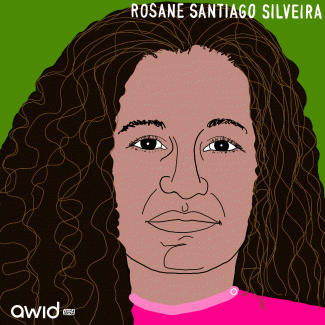
Rosane Santiago Silveira, que l’on appelait affectueusement Rô Conceição, était une activiste brésilienne pour l’environnement et les droits humains qui se battait inlassablement pour protéger l’environnement, là où il était le plus menacé.
Il pouvait entre autres s’agir de le défendre sur l’île de Barra Valha, mise en danger par une exploitation pétrolière, ou de le protéger avec des campagnes contre l’accaparement des terres et l’expansion de plantations d’eucalyptus dans l’État de Bahia, où Rosane était membre du conseil de la réserve d’extractivistes de Cassurubá.
« La réserve d’extractivistes est une zone protégée où les familles résidentes vivent des produits naturels extraits de la forêt. Ces activités contribuent à protéger l’intégrité de la forêt. » - Global Justice Ecology Project (source initiale : Rede Brasil Atual)
Elle participait à des activités syndicales et des mouvements culturels et de défense des droits humains. Rosane consacrait une grande partie de sa vie à des causes qui lui étaient chères, mais qui concernaient également la terre, les forêts, les rivières et les communautés dont les droits et vies sont constamment en danger.
Elle a été torturée et assassinée le 29 janvier 2019 à Nova Viçosa, une ville du sud de Bahia.
« Malheureusement, un sentiment d’insécurité totale règne désormais, parce que l’État ne juge pas ces crimes. Nous étions avec elle à Noël, et tout le monde s’est rendu compte qu’elle était inquiète. Nous savons maintenant qu’elle avait reçu trois menaces de mort », Tuian, le fils de Rosane dans un entretien avec Rádio Brasil Atual. (source initiale : Rede Brasil Atual)
Te invitamos a que te pongas en contacto con nosotrxs para explorar formas de colaborar de manera más significativa con el Foro.
Avec Manal Tamimi, Bubulina Moreno, Karolina Więckiewicz et Anwulika Ngozi Okonjo..
As world leaders gather in Brazil, it’s vital that feminist movements especially from the Global Majority have autonomous spaces to gather, strategize, and disrupt.
These Hubs challenge the elitism of climate talks, center lived experiences, and aim to build collective power across borders. They offer a critical counterbalance to top-down, often exclusionary international negotiations. The Hubs aim to foster community-driven solutions, amplify feminist demands, and ensure that feminist principles of care and solidarity shape the climate agenda. It’s not just about being present at COP30, it’s about reshaping the conversation on climate justice on feminist terms.
For the first time, the AWID Forum offers three modes of participation
Participants will come together in Bangkok, Thailand. We can’t wait!