Philippe Leroyer | Flickr (CC BY-NC-ND 2.0)

Special Focus

AWID is an international, feminist, membership organisation committed to achieving gender equality, sustainable development and women’s human rights

Women Human Rights Defenders

WHRDs are self-identified women and lesbian, bisexual, transgender, queer and intersex (LBTQI) people and others who defend rights and are subject to gender-specific risks and threats due to their human rights work and/or as a direct consequence of their gender identity or sexual orientation.

WHRDs are subject to systematic violence and discrimination due to their identities and unyielding struggles for rights, equality and justice.

The WHRD Program collaborates with international and regional partners as well as the AWID membership to raise awareness about these risks and threats, advocate for feminist and holistic measures of protection and safety, and actively promote a culture of self-care and collective well being in our movements.


Risks and threats targeting WHRDs  

WHRDs are exposed to the same types of risks that all other defenders who defend human rights, communities, and the environment face. However, they are also exposed to gender-based violence and gender-specific risks because they challenge existing gender norms within their communities and societies.

By defending rights, WHRDs are at risk of:

  • Physical assault and death
  • Intimidation and harassment, including in online spaces
  • Judicial harassment and criminalization
  • Burnout

A collaborative, holistic approach to safety

We work collaboratively with international and regional networks and our membership

  • to raise awareness about human rights abuses and violations against WHRDs and the systemic violence and discrimination they experience
  • to strengthen protection mechanisms and ensure more effective and timely responses to WHRDs at risk

We work to promote a holistic approach to protection which includes:

  • emphasizing the importance of self-care and collective well being, and recognizing that what care and wellbeing mean may differ across cultures
  • documenting the violations targeting WHRDs using a feminist intersectional perspective;
  • promoting the social recognition and celebration of the work and resilience of WHRDs ; and
  • building civic spaces that are conducive to dismantling structural inequalities without restrictions or obstacles

Our Actions

We aim to contribute to a safer world for WHRDs, their families and communities. We believe that action for rights and justice should not put WHRDs at risk; it should be appreciated and celebrated.

  • Promoting collaboration and coordination among human rights and women’s rights organizations at the international level to  strengthen  responses concerning safety and wellbeing of WHRDs.

  • Supporting regional networks of WHRDs and their organizations, such as the Mesoamerican Initiative for WHRDs and the WHRD Middle East and North Africa  Coalition, in promoting and strengthening collective action for protection - emphasizing the establishment of solidarity and protection networks, the promotion of self-care, and advocacy and mobilization for the safety of WHRDs;

  • Increasing the visibility and recognition of  WHRDs and their struggles, as well as the risks that they encounter by documenting the attacks that they face, and researching, producing, and disseminating information on their struggles, strategies, and challenges:

  • Mobilizing urgent responses of international solidarity for WHRDs at risk through our international and regional networks, and our active membership.

Related Content

Snippet - That Feminist Fire Logo (FR)

Texte blanc qui dit le titre de notre podcast en français : Notre flamme féministe

Snippet - CSW69 On autonomous resourcing - ES

Sobre las alternativas de dotación de recursos autónomos

FRMag - Ashawo Work na Work

« Ashawo Work na Work » : Comment les jeunes féministes ghanéennes transforment des horizons féministes en réalité

par Fatima B. Derby

En 2017, la campagne #ManifestezVotreSolidarité a mis en évidence la manière dont les jeunes féministes pouvaient construire un avenir féministe en étant là les unes pour les autres, en participant à des conversations transrégionales, en marchant en solidarité avec d'autres activistes et en collaborant entre les mouvements. (...)

Lire

< illustration : « Laisse-les pousser », par Gucora Andu

¿AWID puede financiar mi proyecto de desarrollo?

No, lamentablemente AWID no es una organización financiadora.

No podemos considerar propuestas o solicitudes de financiamiento.

Les invitamos a consultar nuestra lista de donantes que potencialmente puedan financiar su trabajo por los derechos de las mujeres.

Ver la lista de donantes 

Encontrarás más recursos en la página de nuestra área prioritaria «Financiamiento de los movimientos feministas»

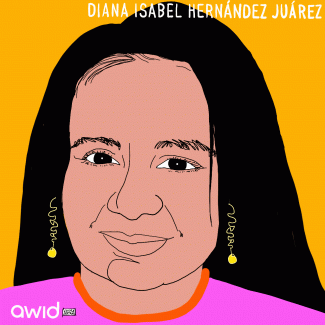
Diana Isabel Hernández Juárez

Diana Isabel Hernández Juárez was a Guatemalan teacher, human rights defender and environmental and community activist. She was the coordinator of the environmental program at Our Lady of Guadalupe Parish on the South coast of the country. 

Diana dedicated her life to co-creating environmental awareness, working especially closely with local communities to address environmental issues and protect natural resources. She initiated projects such as forest nurseries, municipal farms, family gardens and clean-up campaigns. She was active in reforestation programmes, trying to recover native species and address water shortages, in more than 32 rural communities.

On 7 September 2019, Diana was shot and killed by two unknown gunmen while she was participating in a procession in her hometown. Diana was only 35 years old at the time of her death.
 

Snippet Forum Stories Story 1 (EN)

Case study 1 - Three Boats, a Horse and a Taxi: Pacific Feminists at the AWID Forums

This story is about how an increasingly diverse group of feminists from the Pacific organized through the years to attend the AWID Forums and how that process changed them personally, as organizations, and as a movement through what they learned, discovered and experienced. It illustrates the importance of the Forums as a space through which a region that tends to be marginalized or ignored at the global level can build a strong presence in the feminist movement that is then replicated at other international women’s rights spaces.

Snippet - GenderJobs.org

Logo for website GenderJobs.org

GenderJobs.org: This is a platform with a comprehensive list of job opportunities to work on gender equality and LGBTQI+ rights, curated by gender professionals and intersectional feminists who intimately know the sector and are extremely passionate about supporting other gender professionals and anyone who is aspiring to become one! (source: https://genderjobs.org/about)

FRMag - Between Two Worlds

Between Two Worlds: The Double Consciousness of Women in The Gambia

by Haddy Jatou Gassama

The Mandinka tribe of The Gambia has a custom of measuring the first wrapa used to carry a newborn baby on its mother's back. (...)

Read

artwork: “Sacred Puta” by Pia Love >

Je suis une jeune féministe. Comment m’impliquer au sein de l’AWID ?

Les jeunes féministes sont au cœur de l’action de l’AWID.

De fait, 38 % de nos membres sont ont moins de 30 ans.

Nous estimons que les jeunes féministes représentent le présent et l’avenir de la lutte pour les droits des femmes. Nous encourageons les jeunes femmes à devenir des leaders du mouvement et notre programme « Activisme des jeunes féministes » est transversal à tous les autres aspects de notre travail.

Dans le même temps, en définissant les jeunes féministes comme l'un de nos domaines prioritaires, nous apportons de nouvelles perspectives aux débats actuels et veillons à ce que les jeunes activistes puissent exprimer clairement leurs priorités et leurs inquiétudes.

En savoir plus sur le programme Activisme des jeunes féministes

Jaitun

Jaitun, comúnmente conocida como «Amma», estaba comprometida con garantizar los derechos reproductivos de las mujeres y niñas de India. Se dedicó, particularmente, a abogar por quienes viven en la pobreza y son más marginadas, incluidas las mujeres y niñas dalit y musulmanas.

Jaitun fue la fuerza vital detrás del caso Jaitun versus Janpura Maternity Home & Ors. Su perseverancia por la justicia llevó a que la Corte Suprema de Delhi emitiera una sentencia innovadora, que obligó al gobierno indio a hacerse responsable del incumplimiento de cierto número de obligaciones legalmente vinculantes, tales como la atención a la salud reproductiva y el derecho a la alimentación.

A su hija Fatema, quien vivía por debajo de la línea de pobreza, se le negaron los servicios reproductivos, y tuvo que dar a luz en público, bajo un árbol. En ese momento, tanto Jaitun como Fatema estaban en situación de calle, ya que su casa había sido demolida por el gobierno como parte del programa de reurbanización y gentrificación de Nueva Delhi.

«Desde entonces, esta sentencia ha sido utilizada por innumerables abogadxs y activistas de todo el mundo, incluyendo al ex-Relator Especial de la ONU sobre el derecho a la salud, no solamente como fuente de inspiración, sino como una sólida plataforma para promover la justicia.» - Jameen Kaur

Jaitun ha sido una inspiración para que muchas otras mujeres que viven en la pobreza reclamen sus derechos. Falleció en 2017.

«Con la muerte de Jaitun, hemos perdido una incomparable guerrera de la justicia, pero su espíritu de desafío pervive.» -Jameen Kaur

«En mis dieciocho años como defensora de los derechos humanos, nunca he encontrado una mujer que me inspirara ni que conmoviera mi espíritu de la forma en que lo hacía Amma. Su sonora valentía, su inimitable humor (solíamos compararla con la actriz de Bollywood, Hema Melini) cuando se sentía molesta porque habíamos pasado tanto tiempo lejos de ella... con un brillo en los ojos, decía “Ustedes se han olvidado de Amma, Amma ahora no les habla”, y luego con gran dramatismo se ponía de espaldas para darse vuelta enseguida riendo y estirando los brazos para un abrazo. Su bondad y, en definitiva, su amor y su alegría por el amor y el derecho de todxs nosotrxs a vivir con dignidad. La extraño terriblemente.» - Jameen Kaur

Snippet Forum Location Announcement Body (EN)

The AWID Forum is the world’s largest event that wholeheartedly centers feminist and gender justice movements in all their diversity. It is a transformative space created by and for the movements - where Global South feminists and historically marginalized communities take centerstage, strategize to shift power, and connect with allied movements, funders and policy-makers. And so it is with full and fiery hearts that we share…

The 15th AWID International Forum will take place from December 2-5, 2024 in Bangkok, Thailand!


We hope to gather 2,500 in-person and 3,000 online/hybrid participants. When thousands of feminists come together, we create a sweeping force of solidarity that has the power to change the world! We’re excited, and we know you’re excited too - so stay tuned for more

Snippet - WCFM Database blurb 2 - En

Know a Funder? Add them to the Database!

Are you a funder? Or do you know funders that support feminist and gender justice movements? Apply to be a part of the Who Can Fund Me? Database now!

Join the database

Film club - swana

Ya puedes mirar el programa «Feminist Embodiments of Hope and Power» [«Corporizaciones feministas de esperanza y poder»] del Club de Cine Feminista de AWID, una serie de películas sobre realidades feministas de la región del Sudoeste Asiático y África del Norte, curada por Esra Ozban.

MIRAR

I am experiencing violence in one or more of my relationships. Can AWID advocate on my behalf?

Unfortunately, no. AWID is not a direct service or individual advocacy organization.

It would be better for you to seek legal advice and contact a women’s shelter or referral centre in your area.

The HotPeachPages is an online resource that offers links to women’s shelters around the world. AWID cannot vouch for the accuracy or quality of its listings, but it may be a good place to start if you don’t know of organizations in your area.

Isabel Cabanillas de la Torre

Isabel Cabanillas de la Torre était une jeune artiste et activiste féministe très appréciée de Ciudad Juárez, au Mexique. Elle était connue pour ses belles peintures textiles, très expressives. Les yeux faisaient partie des représentations emblématiques de son travail. Ses peintures murales ont métamorphosé les immeubles décrépis et laissés à l’abandon du centre-ville de Ciudad Juárez, ornant leurs façades de messages de vie et de commentaires politiques.

Isabel voulait, à travers son art et son activisme politique, attirer l’attention sur les violences basées sur le genre omniprésentes dans sa ville natale. Elle était bénévole dans le réseau Mesa de Mujeres pour l’Observatoire citoyen sur le genre, qui supervise le travail des juges, procureurs et avocats de la défense dans les affaires de féminicides et autres violations basées sur le genre. Elle était également membre de Hijas de su Maquilera Madre, un collectif féministe dont le nom fait référence aux filles de mères qui travaillent dans les maquiladoras, ou zones de traitement pour l’exportation. Certaines de ces mères ont figuré parmi les premières victimes de féminicide dans la ville.

Le dernier projet d’Isabel, toujours en cours, était une installation artistique pour protester contre une entreprise canadienne qui cherchait à extraire du cuivre dans le désert de Samalayuca. 

Le 18 janvier 2020, Isabel a été tuée par balle alors qu’elle rentrait chez elle à vélo dans le centre de Juárez, dansce qui semble avoir été un acte ciblé, son corps ayant été retrouvé à côté de son vélo.

Le meurtre d’Isabel a déclenché une nouvelle vague d’indignation contre les féminicides dans la région, des centaines de personnes ont manifesté jusqu’au pont frontalier entre le Mexique et les États-Unis, le bloquant pendant des heures et scandant « Ni Una Menos » (pas une de plus) alors que des collectifs féministes continuaient de manifester contre les meurtres de femmes dans tout le pays. Au cours de la seule année 2019, 3 142 femmes et filles ont été tuées au Mexique. Un grand nombre ont été spécifiquement ciblées du fait de leur genre.

Elle adorait faire du vélo.

« Le vélo était son symbole de liberté. Il symbolisait le fait d’être libre dans les rues. » - Marisol (une amie d’Isabel) 
Snippet Join Forum Dreaming (ES)

¿Quieres construir el Foro con nosotrxs?

Hazte afíliadx de AWID ahora y participa en nuestro próximo evento para afiliadxs "Soñando el Foro" el 20 de junio.

Snippet - WITM Infographic annual budget - EN

In 2023, feminist and 
women's rights organizations 
had a median annual budget of $22,000

In contrast, over $1 billion went to three anti-rights groups 2021-2022, with funding for anti-gender networks still rising.1

1 Global Philanthropy Project, 2024