AWID Forum: Co-creating Feminist Futures

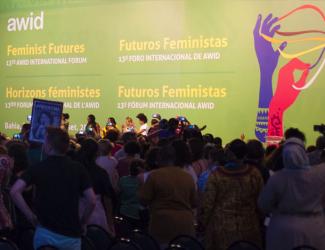
In September 2016, the 13th AWID international Forum brought together in Brazil over 1800 feminists and women’s rights advocates in a spirit of resistance and resilience.

This section highlights the gains, learnings and resources that came out of our rich conversations. We invite you to explore, share and comment!


What has happened since 2016?

One of the key takeaways from the 2016 Forum was the need to broaden and deepen our cross-movement work to address rising fascisms, fundamentalisms, corporate greed and climate change.

With this in mind, we have been working with multiple allies to grow these seeds of resistance:

And through our next strategic plan and Forum process, we are committed to keep developing ideas and deepen the learnings ignited at the 2016 Forum.

What happens now?

The world is a much different place than it was a year ago, and it will continue to change.

The next AWID Forum will take place in the Asia Pacific region (exact location and dates to be announced in 2018).

We look forward to you joining us!

About the AWID Forum

AWID Forums started in 1983, in Washington DC. Since then, the event has grown to become many things to many peoples: an iterative process of sharpening our analyses, vision and actions; a watershed moment that reinvigorates participants’ feminisms and energizes their organizing; and a political home for women human rights defenders to find sanctuary and solidarity.

Learn more about previous Forums

Related Content

Beijing Unfettered: the Power of Young Feminist Movements

In partnership with young feminist activists and youth-led organizations, AWID co-organized Beijing Unfettered in parallel to and independently from Beijing+25. 

Learn more

Snippet - WITM Why now_col 2 - EN

Resourcing feminist movements is fundamental to securing a more just and peaceful present and liberated future.

While funders committed significantly more money to gender equality over the last decade, still only 1% of philanthropic and development funding has actually been moved to directly resource feminist-led social change. 

In solidarity with movements that continue to be invisibilized, marginalized and without access to core, long-term, flexible and trust-based funding, the WITM survey highlights the actual state of resourcing, challenges false solutions, and points to how funding models must change for movements to thrive and meet the complex challenges of our times.

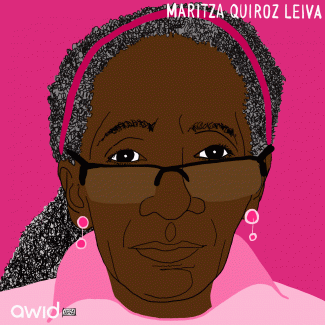
Maritza Quiroz Leiva

Maritza Quiroz Leiva was an Afro Colombian social activist, a community leader and women human rights defender. Among the 7.7 million Colombians internally displaced by 50 years of armed conflict, Maritza dedicated her advocacy work to supporting the rights of others, particularly in the Afro Colombian community who suffered similar violations and displacement.

Maritza was the deputy leader of the Santa Marta Victim's Committee, and an important voice for those seeking justice in her community, demanding reparations for the torture, kidnapping, displacement, and sexual violence that victims experienced during the armed conflict. She was also active in movement for land redistribution and land justice in the country. 

On 5 January 2019, Maritza was killed by two armed individuals who broke into her home. She was 60 years old. 

Maritza joined five other Colombian social activists and leaders who had been murdered just in the first week of 2019. A total of 107 human rights defenders were killed that year in the country. 

Why did AWID choose Taipei as the location for the Forum?

We see Taipei as the location in the Asia Pacific region that will best allow us to build that safe and rebelious space for our global feminist community.

Taipei offers a moderate degree of stability and safety for the diversity of Forum participants we will convene. It also has strong logistical capacities, and is accessible for many travellers (with a facilitated e-visa process for international conferences).

The local feminist movement is welcoming of the Forum and keen to engage with feminists from across the globe.

Read more about our considerations when choosing Taipei

Snippet Opening Dance Performance EN

Número de baile de apertura

Por Pia Love

dancer with angel wings

Ver la apertura

Snippet - WITM Provide members - EN

Provide AWID members, movement partners and funders with an updated, powerful, evidence-based, and action-oriented analysis of the resourcing realities of feminist movements and current state of the feminist funding ecosystem.

Identify and demonstrate opportunities to shift more and better funding for feminist organizing, expose false solutions and disrupt trends that make funding miss and/or move against gender justice and intersectional feminist agendas.

Articulate feminist visions, proposals and agendas for resourcing justice.

START THE SURVEY

Roxana Reyes Rivas

Roxana Reyes Rivas, filósofa, feminista, lesbiana, poeta, política y activista por los derechos humanos de las mujeres y las personas LGBTI en Costa Rica. Dueña de una pluma afilada y un humor agudo, con la risa a flor de piel. Nació en 1960 y creció en San Ramón de Alajuela, cuando era una zona rural, y su vida entera rompería con los mandatos de lo que significaba ser mujer. 

Desde El Reguero (grupo de lesbianas en Costa Rica) organizó festivales lésbicos por más de 10 años, espacios lúdico-formativos de encuentro en momentos donde el gobierno y la sociedad costarricense perseguía y criminalizaba la existencia lésbica. Para cientos de mujeres los festivales lésbicos eran el único lugar donde podían ser ellas mismas y encontrarse con otras como ellas.

Roxana decía que fundar partidos políticos era uno de sus pasatiempos. “Es importante que en Costa Rica la gente entienda que hay otras formas de hacer política, que muchos temas es necesario resolverlos colectivamente”. Fue una de lxs fundadores de los partidos Nueva Liga Feminista y VAMOS, un partido centrado en los derechos humanos.  

“El oficio de la filosofía es meter la puya, ayudar a que la gente empiece a preguntarse cosas. La filósofa que no irrita a nadie, no está haciendo bien su trabajo”. Durante 30 años, Roxana fue profesora de filosofía en universidades públicas costarricenses. De su mano generaciones enteras de estudiantes reflexionaron sobre los dilemas éticos en la ciencia y la tecnología. 

La herramienta favorita de Roxana era el humor, ella creó el premio del Chiverre Incandescente, un reconocimiento a la estupidez que otorgaba vía redes sociales a diferentes figuras públicas, ridiculizando sus exabruptos y afirmaciones anti-derechos.

Un cáncer agresivo se llevó a Roxana a fines del 2019, antes de que alcanzara a publicar la compilación de sus poemas, un último regalo de la mente creativa de una feminista que siempre levantó la voz para denunciar la injusticia. 

Snippet She is on her way_Fest (FR)

Session plénière:

"Elle est en chemin":
alternatives, féminismes et monde alternatif

Felogene Anumo, AWID
Dr. Vandana Shiva, India
Dr. Dilar Dirik, Kurdistan
Nana Akosua Hanson, Ghana

regarder la session plénière


Who should participate in the survey?

Groups, organizations and/or movements working specifically or primarily for women, girls, gender justice, LBTQI+ and allied people’s rights in all regions and at all levels, both newly formed and long-standing.

Dorothy Masuka

“Je n’avais pas prévu d’être chanteuse; c’est le chant qui avait prévu de m’habiter”  - Dorothy Masuka (interview avec Mail & Guardian)

Dorothy Masuka, née en 1935 à Bulawayo (alors en Rhodésie du Sud, aujourd’hui le Zimbabwe), a grandi en Afrique du Sud. Elle est devenue une auteure, compositrice, chanteuse de jazz et activiste renommée, et fervente partisane de la lutte contre l’apartheid. Qualifiée d’“architecte du discours de la musique populaire de libération africaine”, Dorothy a souvent chanté la politique dans des langues africaines autochtones et tout au long de son oeuvre, et s’est opposée aux politiques racistes du gouvernement sud-africain. 

L’une de ses chansons, intitulée "Dr Malan" (du nom de l'homme politique pro-apartheid D.F. Malan) a été censurée. Elle a poursuivi avec l’enregistrement de "Lumumba" (1961), une chanson sur l'assassinat du leader anticolonialiste Patrice Lumumba. Le travail et l'activisme de Dorothy ont alors attiré l'attention de la section spéciale de la police sud-africaine, ce qui la contraignit à un exil politique qui s’étendit sur plus de 3 décennies. Tout au long de cette période, elle travailla avec des groupes pro-indépendantistes, dont le Congrès national africain. En 1992, alors que l'apartheid commençait à s'effondrer et que Nelson Mandela fut libéré de prison, elle retourna en Afrique du Sud. 

Parmi ses autres œuvres, on peut citer sa première chanson, enregistrée en 1953 et intitulée "Hamba Notsokolo", qui fut un tube des années 1950 et un grand classique. Elle composa également "El Yow Phata Phata", une chanson adaptée par Miriam Makeba qui contribua à offrir une popularité internationale à "Pata, Pata"

Ancrés dans la résistance, la musique et l’activisme de Dorothy étaient entrelacés et laissent un merveilleux héritage inspirant. Elle était également très connue sous le nom de “Auntie Dot”.   

Le 23 février 2019, Dorothy s’est éteinte à Johannesburg à 83 ans des suites d’une maladie.


Regardez l'interview de Dorothy Masuka pour Mail & Guardian (seulement en anglais)

Écoutez sa musique :

Hamba Nontsokolo
El Yow Phata Phata
Snippet "un"Inclusive Feminism_Fest (EN)

"un"Inclusive Feminism:
The voiceless girls in the Haitian feminist movement

Naike Ledan
Semi Kaefra Alisha Fermond, Trans Rights Activist ACIFVH
Natalie Desrosiers
Fédorah Pierre-Louis

watch panel

divider

Nuestra agrupación, organización o movimiento no ha tomado ni movilizado financiamiento de donantes externos, ¿deberíamos responder la encuesta?

¡Sí! Reconocemos y valoramos las distintas razones por las que los feminismos en sus contextos respectivos no cuentan con financiamiento externo, ya sea por no reunir los requisitos para solicitar donaciones o para recibir dinero del exterior, o bien porque se financian con recursos generados de manera autónoma como estrategia política en sí misma. Deseamos saber de ustedes con independencia de su experiencia de financiamiento externo.

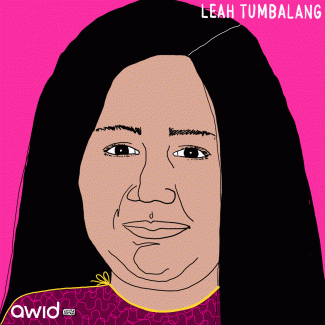
Leah Tumbalang

Leah Tumbalang was a Lumad woman of Mindanao in the Philippines. The story of Lumad Indigenous peoples encompasses generations of resistance to large-scale corporate mining, protection of ancestral domains, resources, culture, and the fight for the right to self-determination. 

Leah was a Lumad  leader as well as a leader of Kaugalingong Sistema Igpasasindog to Lumadnong Ogpaan (Kasilo), a Lumad and peasant organization advocating against the arrival of mining corporations in Bukidnon, Mindanao province. She was unwavering in her anti-mining activism, fervently campaigning against the devastating effects of mineral extraction on the environment and Indigenous peoples’ lands. Leah was also an organizer of the Bayan Muna party-list, a member of the leftist political party Makabayan.

For almost a decade, Leah (along with other members of Kasilo) had been receiving threats for co-leading opposition against the deployment of paramilitary groups believed to be supported by mining interests. 

“Being a Lumad leader in their community, she is at the forefront in fighting for their rights to ancestral land and self-determination.” - Kalumbay Regional Lumad Organization

Being at the forefront of resistance also often means being a target of violence and impunity and Leah not only received numerous death threats, but was murdered on 23 August 2019 in Valencia City, Bukidnon. 

According to a Global Witness report, “the Philippines was the worst-affected country in sheer numbers” when it comes to murdered environmental activists in 2018. 


Read the Global Witness report, published July 2019

Find out more about Lumad women in the Philippines and their inter-generational struggle for self-determination