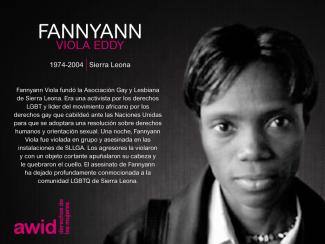
Fannyann Viola Eddy
Women human rights defenders (WHRDs) worldwide defend their lands, livelihoods and communities from extractive industries and corporate power. They stand against powerful economic and political interests driving land theft, displacement of communities, loss of livelihoods, and environmental degradation.
Extractivism is an economic and political model of development that commodifies nature and prioritizes profit over human rights and the environment. Rooted in colonial history, it reinforces social and economic inequalities locally and globally. Often, Black, rural and Indigenous women are the most affected by extractivism, and are largely excluded from decision-making. Defying these patriarchal and neo-colonial forces, women rise in defense of rights, lands, people and nature.
WHRDs confronting extractive industries experience a range of risks, threats and violations, including criminalization, stigmatization, violence and intimidation. Their stories reveal a strong aspect of gendered and sexualized violence. Perpetrators include state and local authorities, corporations, police, military, paramilitary and private security forces, and at times their own communities.
AWID and the Women Human Rights Defenders International Coalition (WHRD-IC) are pleased to announce “Women Human Rights Defenders Confronting Extractivism and Corporate Power”; a cross-regional research project documenting the lived experiences of WHRDs from Asia, Africa and Latin America.
"Women Human Rights Defenders confronting extractive industries: an overview of critical risks and Human Rights obligations" is a policy report with a gender perspective. It analyses forms of violations and types of perpetrators, quotes relevant human rights obligations and includes policy recommendations to states, corporations, civil society and donors.
"Weaving resistance through action: Strategies of Women Human Rights Defenders confronting extractive industries" is a practical guide outlining creative and deliberate forms of action, successful tactics and inspiring stories of resistance.
The video “Defending people and planet: Women confronting extractive industries” puts courageous WHRDs from Africa, Asia, and Latin America in the spotlight. They share their struggles for land and life, and speak to the risks and challenges they face in their activism.
Challenging corporate power: Struggles for women’s rights, economic and gender justice is a research paper outlining the impacts of corporate power and offering insights into strategies of resistance.
AWID acknowledges with gratitude the invaluable input of every Woman Human Rights Defender who participated in this project. This project was made possible thanks to your willingness to generously and openly share your experiences and learnings. Your courage, creativity and resilience is an inspiration for us all. Thank you!
AWID no ofrece descuentos para grupos, pero sí ofrece descuentos en la inscripción a sus afiliadxs. (Haz clic aquí para obtener más información sobre cómo sumarte a la membresía)
In the African Commission and the Inter-American System, anti-rights actors push essentialist notions of culture and gender to hamper progress on rights and undermine accountability. As we see, anti-rights actors are exerting influence in regional human rights systems, as well as international spaces.
In 2023, feminist and women's rights organizations had a median annual budget of USD 22,000. Behind that median lies disparity and inequality: while a few groups access large-scale resources, the vast majority survive on shoestring budgets.
A closer look at actual budgets reveals major income diversity and inequality.
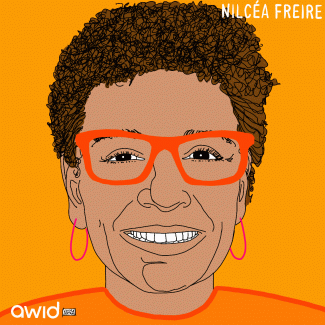
Nilcéa Freire was a Brazilian feminist activist, politician and academic. A persevering advocate for women’s rights and those of underrepresented minorities in the country, her life and work carried a long history of struggles and victories.
"While resisting we have to keep pushing for progress, and what we can achieve at this time, in my view, will be through the stupendous organization of young white women, and especially black women, in all of the state capitals and large cities of Brazil." - Nilcéa Freire
In 1999 she became the first woman to occupy the position of Dean at the State University of Rio de Janeiro. Here, she spearheaded the implementation of the first affirmative action policy for students graduating from public schools, requiring reserved places specifically for low-income black students in a public university. This system was adopted in dozens of other public universities.
Some years later, Nilcéa headed the Special Secretariat of Policies for Women in the government of former president Luiz Inácio Lula da Silva. In this capacity, she led the first National Women’s Conference. Over 12,000 women from across the country participated and the result of this collective work was embodied in the National Plan for Policies for Women.
Her commitment to women, Afro-Brazilians and indigenous peoples was also strongly reflected in her work to promote their rights through initiatives of the Brazil Ford Foundation office where she was a regional director.
The feminist activist Manoela Miklos recounted Nilcéa to be "a woman without equal".
At the age of 66, Nilcéa passed away in Rio de Janeiro on 29 December 2019 of cancer.
"Without words for the news of the death of dear Nilcea Freire. It is too sad to know that she left so early. She was always part of the ranks of those who do not settle for the injustices of the world. She was the Minister of Women, an activist, always active in the feminist cause. Much missed!” - Jandira Feghali, Federal Deputy
Watch Brazilian feminist Nilcea Freire on why we need to show solidarity with Brazil
Le corps est une entité puissante. En tant que femmes, notre corps est contrôlé, opprimé et policé depuis l'utérus. Notre apparence, nos mouvements, nos vêtements, notre façon de marcher, de parler, nos gestes et notre rire. Je me suis souvent interrogée sur les raisons des peurs patriarcales liées au pouvoir du corps féminin.

Là d'où je viens, le travail du sexe et les travailleur.se.s du sexe étaient évoqué.e.s avec un mélange de mépris, de dégoût, de fascination, de pitié et de condamnation.
J'ai entré en contact avec le travail du sexe et les travailleur.se.s du sexe pour la première fois à l'âge de 22 ans. À partir de simples conversations, assis.e.s en cercle, autour d'un café ou d'un thé, nous avons exploré la vie, les expériences, les pensées et les sentiments de chacun.e.
Pour les travailleur.se.s du sexe, le travail du sexe était le choix le plus intéressant parmi toutes les autres options : payer les factures, soutenir la famille, bénéficier d’horaires de travail plus flexibles, avoir des relations sexuelles. Tout comme j'ai choisi mon travail comme étant le choix le plus intéressant pour payer les factures, soutenir la famille, avoir des heures de travail plus flexibles.
Ces personnes, femmes et hommes, m'ont appris que je prenais mes propres décisions concernant mon corps... duquel je concentre sa vie et son énergie, si je l'utilise pour le plaisir ou la douleur, si je l'échange ou le donne librement, et comment je veux m’y sentir. Cette prise de conscience était aussi excitante qu’autonomisante.
Crear | Résister | Transform : un festival pour les mouvements féministes - 2021... vous m'avez accompagnée dans une série de moments qui ont changé ma vie (!!!)
Nous appelons cela des « événements », mais en réalité, vos espaces d'apprentissage féministes sont selon moi des lieux où je prends un peu de ce que j'ai en moi, un peu de ce que disent vos intervenants et un peu des discussions pour approfondir notre compréhension.
Partager... Participer... S'immerger...
dans la force, dans la vulnérabilité, dans le plaisir.
Être simplement la féministe transformatrice que je suis, sans prétentions, sans appréhensions...
Accueillir la féministe transformatrice que j'ai toujours été, sans même connaître le terme ou le reconnaître de cette manière ou en ces termes...
Trouver un foyer pour la féministe transformatrice féroce qui vit en moi...
Malgré la colère, la rage et la frustration de ne pas être traitée sur un pied d'égalité et d'être traitée comme « moins __ que ».
Je ne me suis pas toujours considérée comme une féministe ni reconnue dans le mouvement ou le discours féministe... En réalité, j'apprécie que l'on m'ouvre les portes, que l'on me tire les chaises pour m'asseoir, que l'on reconnaisse ma féminité en tant que femme.
Parfois, j'ai rejeté le patriarcat avec agacement, parfois j'ai réagi avec frustration et colère, mais je ne l'ai pas abordé... Je n'ai pas remarqué sa toxicité sinistre et insidieuse... J'étais assez privilégiée de pouvoir travailler à travers lui, d'y survivre, de le surmonter, d'exceller malgré lui... Je n'ai pas suffisamment remis en question, pas suffisamment défié, pas suffisamment repoussé mes limites... Je n'en ai pas fait assez...
se connecter avec les travailleur.se.s du sexe, explorer la sexualité, et les femmes pour la paix et la sécurité....
Jusqu'à ce que je prenne pleinement conscience et comprenne que les implications des privilèges et de l'oppression étaient intersectionnelles.
Jusqu'à ce que je réalise ce que signifie se battre pour la justice de genre et pas seulement pour « l'égalité pour tous ».
Je ne suis plus une praticienne et une animatrice, mais bien une praticienne et une animatrice féministe transformatrice.
Être féministe signifie que je vais agir
Plonger dans un avenir incertain, fragile, complexe (et peut-être assez violent)...
Je vous suis profondément reconnaissante et je promets de rester féroce dans la prise en compte et le redressement des questions problématiques liées au genre, à la race, à l'ethnicité, à la classe sociale, à l'orientation sexuelle et aux capacités, et de rester présente et fidèle à la lutte pour l'inclusion, l'équité et la justice.
Khin Khin
Ayant conscience des nombreuses difficultés que les déplacements impliquent, nous vous fournirons davantage d’informations et de détails sur les modalités de voyage jusqu’à Bangkok lorsque les Inscriptions ouvriront, au début de l’année prochaine.
¿Quieren sumarse al creciente número de personas que le están diciendo «basta» a la infiltración de lxs actores anti-derechos en la ONU?
Con 1773 cabilderos de los combustibles fósiles presentes en la COP29 del año pasado, nos dirigimos, junto con otres feministas a Belém (Brasil) del 10 al 21 de noviembre de 2025. Allí continuaremos denunciando las soluciones falsas, llamando la atención sobre la captura corporativa, y exigiendo que los Estados cumplan sus compromisos bajo las Responsabilidades Comunes pero Diferenciadas y las Capacidades Respectivas (en inglés) para impulsar las alternativas económicas feministas.
USD 2,7 billones para gasto militar. USD 300.000 millones para la justicia climática. Estamos aquí para dar vuelta el relato.
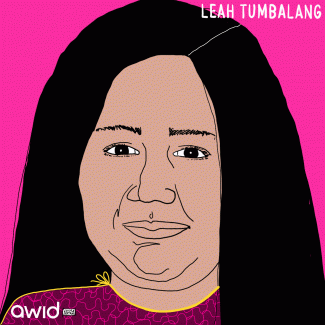
Leah Tumbalang fue una mujer lumad de Mindanao, en Filipinas. La historia del pueblo indígena lumad abarca generaciones de resistencia contra la minería corporativa a gran escala, de protección de los territorios ancestrales, los recursos y la cultura, y de lucha por la autodeterminación.
Leah era una líder lumad, y dirigente de Kaugalingong Sistema Igpasasindog to Lumadnong Ogpaan (Kasilo), una organización lumad y campesina que lucha contra la instalación de corporaciones mineras en Bukidnon, en la provincia de Mindanao. Fue inclaudicable en su activismo anti minería, al emprender con fervor campañas contra los efectos devastadores de la extracción de minerales en el medio ambiente y las tierras de los pueblos indígenas. Era también una organizadora política de la lista electoral Bayan Muna, que integra el partido político de izquierda Makabayan.
Durante casi una década Leah (junto con otrxs integrantes de Kasilo) recibió amenazas debido a su oposición al despliegue de grupos paramilitares, que se cree son respaldados por intereses mineros.
«Como líder lumad de su comunidad, ella está en la primera línea de lucha por sus derechos a la tierra ancestral y a la autodeterminación.» - Kalumbay Regional Lumad Organization
Estar en la vanguardia de la resistencia también significa, a menudo, ser un blanco para la violencia y la impunidad, y Leah no solamente recibió numerosas amenazas de muerte, sino que fue asesinada el 23 de agosto de 2019 en la ciudad de Valencia, en Bukidnon.
Según un informe de Global Witness, «en números absolutos, Filipinas fue el país peor afectado» en lo que respecta a activistas ambientalistas asesinadxs en 2018.
Lee el informe de Global Witness, publicado en julio de 2019
Across the world and social movements, those who want to innovate tend to feel lonely and powerless before the ‘movement status quo’. Historically, the AWID Forums have played a role in supporting these innovators by offering them a platform where their ideas and practices are welcomed and strengthened by the thoughts and actions of others – in different regions and communities – who have already explored them. Sara Abu Ghazal, Palestinian feminist in Lebanon, tells the story of what the Forums meant for a new generation of feminists in the MENA (Middle East and North Africa) region that introduced new ways of organising, new understandings of feminism and new issues to the regional women’s rights landscape.
Asking ourselves the same question, we believe there are no simple answers. For many participants the AWID Forum might be one of the few international trips they undertake in their life. The pandemic taught us the possibilities but also the limitations of virtual spaces for movement-building: there is nothing like in-person connection. Movements need cross-border connections to build our collective power in the face of the threats we face, notably the climate crisis. We believe that the upcoming AWID Forum can be a strategic space to hold these conversations and to explore alternatives to international travel. The hybrid element of the Forum is an important part of this exploration.