None On Record

Young Feminist Activism

Organizing creatively, facing an increasing threat

Young feminist activists play a critical role in women’s rights organizations and movements worldwide by bringing up new issues that feminists face today. Their strength, creativity and adaptability are vital to the sustainability of feminist organizing.

At the same time, they face specific impediments to their activism such as limited access to funding and support, lack of capacity-building opportunities, and a significant increase of attacks on young women human rights defenders. This creates a lack of visibility that makes more difficult their inclusion and effective participation within women’s rights movements.

A multigenerational approach

AWID’s young feminist activism program was created to make sure the voices of young women are heard and reflected in feminist discourse. We want to ensure that young feminists have better access to funding, capacity-building opportunities and international processes. In addition to supporting young feminists directly, we are also working with women’s rights activists of all ages on practical models and strategies for effective multigenerational organizing.

Our Actions

We want young feminist activists to play a role in decision-making affecting their rights by:

  • Fostering community and sharing information through the Young Feminist Wire. Recognizing the importance of online media for the work of young feminists, our team launched the Young Feminist Wire in May 2010 to share information, build capacity through online webinars and e-discussions, and encourage community building.

  • Researching and building knowledge on young feminist activism, to increase the visibility and impact of young feminist activism within and across women’s rights movements and other key actors such as donors.

  • Promoting more effective multigenerational organizing, exploring better ways to work together.

  • Supporting young feminists to engage in global development processes such as those within the United Nations

  • Collaboration across all of AWID’s priority areas, including the Forum, to ensure young feminists’ key contributions, perspectives, needs and activism are reflected in debates, policies and programs affecting them.

Related Content

FRMag - Dieula and the Black Dolls

Dieula and the Black Dolls

by Ana María Belique

The Naranjo Batey community is far from the city, but it’s full of hard-working people brimming with enthusiasm. A girl named Dieula lived there. (...)

Read

< artwork: “Fury” by Diana Manilla Arroyo

Fadila M.

Fadila M. fue una activista tribal soulaliyate de Azrú, en la región Ifrane de  Marruecos. Luchó contra una forma específica de discriminación territorial dirigida a  las mujeres tribales.

Como parte del Movimiento de Mujeres Soulaliyate por el Derecho a la Tierra, trabajó para reformar el marco legislativo relacionado con la administración de la propiedad comunitaria, a través de la adopción, en 2019, de tres proyectos de ley que garantizan la igualdad de mujeres y varones.

Según las leyes consuetudinarias vigentes, las mujeres no tenían derecho a beneficiarse de la tierra, en especial aquellas que eran solteras, viudas o divorciadas. En Marruecos, los derechos a las tierras colectivas eran transmitidos tradicionalmente entre los varones de la familia mayores de 16 años. Desde 2007, Fadila M. ha sido parte del movimiento de mujeres, la primera movilización nacional de base por los derechos a la tierra. Una de sus conquistas ha sido que, en 2012, las mujeres soulaliyate pudieron registrarse por primera vez en las listas de beneficiarixs, y recibir compensaciones relacionadas con la cesión de tierras. El movimiento también logró la enmienda del dahir (decreto del Rey de Marruecos) de 1919, para garantizar el derecho a la igualdad de las mujeres.

Fadila M. falleció el 27 de septiembre de 2018. Las circunstancias de su muerte no son claras. Participó en una marcha de protesta relacionada con el tema de las tierras colectivas y, si bien las autoridades informaron que su muerte fue accidental y que tuvo un paro cardíaco camino al hospital, la sección local de la Asociación de Derechos Humanos de Marruecos (AMDH) señaló que Fadila fue sofocada por un miembro de la fuerza policial utilizando una bandera marroquí. Su familia solicitó una investigación, pero los resultados de la autopsia no fueron dados a conocer.

Más información sobre el Movimiento de Mujeres Soulaliyate por el Derecho a la Tierra (en inglés)


Nota: Como no ninguna fotografía/imagen de Fadila M. disponible, la obra de arte (en lugar de un retrato) pretende representar por lo que luchó y trabajó: la tierra y los derechos a vivir y tener acceso a esa tierra y lo que crece en ella.

Framework & Theme

The theme of the 14th AWID International Forum is: “Feminist Realities: our power in action”. 

In our 14th Forum, we will celebrate and amplify Feminist Realities that are around us, in all stages of development. 

We want to make this Forum our Feminist Reality - a place where you can inhabit a different world, where you bring your victories, the solutions you have devised; what makes you feel stronger, hopeful and ready to go on. It will be different from any other convening you have previously attended. 

We urge you to join us in co-creating this world. It will be worth it!


Each Forum has a theme that reflects the needs of our membership and movements, and responds to our analysis of the current context.

The global context

Currently fascisms, fundamentalisms, authoritarianism and unfettered corporate power are gaining momentum globally. We see these threats converging with the State to shape public norms, narratives, and policies,  entrenching a culture of fear, hate and incitement to violence in public discourse. States, previously the target of advocacy and rights claims, in many cases no longer feel accountable and in some cases themselves don’t have the power to uphold rights.

This time of volatility, complexity and uncertainty requires creativity in how we organize across movements, coherence in what we demand and daring in what we propose. 

From Feminist Futures to Feminist Realities

AWID’s 2016 Forum centered on Feminist Futures and the conditions needed to bring such futures about. It was clear then, and remains evident now, the enormous challenge for many social justice movements to think outside of the current system for structural solutions. Imaginations can become narrowed from long experiences of inequality and oppression. But what we also heard then and we see all around us is that feminist movements are indeed living and promoting rights-and justice-oriented realities and solutions in big and small ways. 

Indeed we see an urgency to mobilize from a place of hope, rather than from a lowest common denominator - hope that is grounded in the certainty that across the globe, however imperfectly, are experiences and practices that embody more just ways of being in the world and that by sharing, strengthening and building on these experiences, we can help them grow their influence.

These are not impossible dreams, but lived realities. This sense of possibility is a spark to re-examine and re-appreciate the transformative dimensions in our work. 


A few examples of Feminist Realities across the globe

At AWID, we understand feminist realities as the living, breathing examples of the worlds we know are possible.  We understand these diverse feminist realities as reclamations and embodiments of hope and power. They are embedded in the multiple ways  that show us that there is a different way of living, thinking and doing-- from the daily expressions of how we live and relate to each other, to alternative systems of governance and justice. Feminist Realities resist dominant power systems such as patriarchy, capitalism, and white supremacy. 

These are powerful propositions that orient us toward a vision of what is possible, and show how feminist organizing is blazing a path toward justice in movements and communities around the world. 

  • In a deeply marginalized Black community in Jackson, Mississippi, an experiment in solidarity and cooperative economics is taking place through Cooperation Jackson. An ambitious plan to build community ownership outside of capitalist modes of production.

  • In West Africa, women farmers are resisting land grabbing and refusing industrialized agriculture projects, boldy claiming We Are The Solution, in a campaign to build agro-ecological solutions that center women farmers and their knowledges as the solutions to feed communities and mitigate climate change

  • Similarly, in India, 5,000 women have come together to develop community-based food sovereignty systems based on local knowledge, including grain and seed banks

  • Women in Mexico have created a moneyless economy project created by and for women and everyone they know. In El Cambalache everything has the same value: people exchange things they no longer need for things they want as well as knowledge, abilities and mutual aid that people would like to share. El Cambalache was built on the anti-systemic, anti-capitalist values of local social movements

  • In Rojava, Kurdish people are building democracy without the state and Kurdish women offer Jineology as a framework for challenging patriarchy, capitalism and the state, creating systems and institutions to put this framework into practice

  • In the UK, Anarcho Agony Aunts are a sex and dating advice show, covered from a feminist, antifascist, anarchist perspective. Hosts Rowan and Marijam are reclaiming space from the alt-right in giving people (mostly men) a space to ask tricky questions in a judgment-free zone. 

  • The African Feminist Judgment Project drafts and disseminates alternative judgments for important African landmark cases on a range of legal issues. At the heart of the project is propositional feminist judicial practice and alternative feminist judgments that contribute to African jurisprudence, legal practice and judicial decision-making 

  • The Usha Cooperative in India was founded when mainstream banks refused services to sex workers in Sonagachi. Sex workers self-organized to prioritize their economic concerns and set up their own financial institution. The Usha Cooperative is cooperative bank of over 20,000 sex workers and has provided over USD 4.7M in loans to 7,231 sex workers in a span of one year. With a membership entirely of sex workers, the bank provides real ownership and influence over the cooperative’s governance and management, pioneering ways for individuals and communities on the margins to build economic power on their own terms. 

  • In Puerto Rico, a community land trust is helping to transform an informal settlement around a polluted and flood prone river channel into a sustainable community. It provides a new model for improving informal settlements in cities without them then becoming unaffordable for the original residents.

  • In several Latin American countries activists are providing peer-to-peer counselling and accompaniment on medical abortion, reclaiming women´s right to decide over their bodies as well as to medical knowledgde. (for safety reasons, no links are provided.


The 14th AWID international Forum

The AWID Forum will be organized around 6 thematic anchors:

  • Resources for Communities, Movements and Economic Justice
  • Governance, accountability and justice
  • Digital Realities 
  • Bodies, pleasure and wellbeing
  • Planet and living beings
  • Feminist organizing 

Learn more about these anchors

Building on those realities, we expect the 2020 Forum to:

  • Build the power of Feminist Realities, by naming, celebrating, amplifying and contributing to build momentum around experiences and propositions that shine light on what is possible and feed our collective imaginations
  • Replenish wells of hope and energy as much needed fuel for rights and justice activism and resilience
  • Strengthen connectivity, reciprocity and solidarity across the diversity of feminist movements and with other rights and justice-oriented movements

The Forum is a collaborative process

The Forum is more than a four-day convening. It is one more stop on a movement strengthening journey around Feminist Realities that has already begun and will continue well beyond the Forum dates.

Join us on this journey!
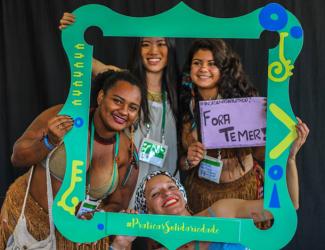
Snippet Forum Quoate Sara Abu (EN)

The Forum is a live example of what the bigger WE can do. We go to the Forum, we are seeds, we then get sowed. This we have to celebrate.
- Sara Abu Ghazal, Lebanon

Snippet - Impactmapper’s Database blurb - En

Impact Mapper's Logo


2025 Funding Database by ImpactMapper

Explore 150+ regularly updated funding opportunities in this searchable database, created in response to cuts in development aid. Filter by issue, region, funder type, and eligibility.

Subscribe to their database here

Film club - Films from Nuestramérica

Ya está disponible nuestro programa final del Club de Cine Feminista: “Films from Nuestramérica” es una serie de películas sobre realidades feministas latinoamericanas / centroamericanas curada por Alejandra Laprea (Venezuela).

MIRAR

Rosa Candida Mayorga Muñoz

Rosa Candida Mayorga Muñoz était une travailleuse sociale, leader syndicale et défenseure des droits humains du Guatemala. On la surnommait affectueusement Rosita. 

Dans les années 1980, Rosa devient la première femme à siéger au comité exécutif du syndicat de l’Institut d’électrification nationale (STINDE), syndicat qu’elle avait rejoint en premier lieu pour défendre les droits des femmes au travail. Cela signifiait, à ses yeux, de lutter pour l’égalité des chances dans une entreprise où de nombreuses femmes affrontaient un système discriminatoire et violent mis en place par la direction de l’entreprise. Rosa avait également subi du harcèlement sexuel sur son lieu de travail, tant de la part de collègues que de responsables. Elle n’entendait cependant pas rester silencieuse. 

Rosa a continué à se battre et fait partie des efforts pour façonner la lutte afin qu’elle prenne la forme du « Pacte collectif pour les conditions de travail du INDE-STINDE ». Ce pacte était le premier du genre et le premier au Guatemala à caractériser le concept de harcèlement (sexuel). Il fait désormais référence dans la loi guatémaltèque pour les questions de travail, et sert d’encouragement aux autres syndicats.

« Elle n’avait d’autres outils pour se battre que ses propres idéaux... Elle a été intimidée à plusieurs reprises, harcelée pour abandonner la lutte, mais son courage a fait naître l’espoir chez les syndicalistes de la base. Rosita a créé une image de respect non seulement au sein de son syndicat mais également face aux autorités de l’institution et au sein du mouvement des femmes. Elle a été reconnue comme une pionnière du mouvement des femmes du syndicat, dans un espace qui avait davantage été dominé par les hommes. » - Maritza Velasquez, ATRAHDOM

Rosa est décédée le 4 avril 2018, elle avait 77 ans.

Body

El Fondo Acceso para el Foro de AWID

Nos esforzamos para hacer que el Foro de AWID sea un encuentro verdaderamente global, con participación de un conjunto diverso de movimientos, regiones y generaciones. Con este fin, AWID moviliza recursos para un Fondo Acceso (FA) limitado para ayudar a algunxs participantes con los costos de asistir al Foro. 

El 14° Foro Internacional de AWID tendrá lugar entre el 11 y el 14 de enero de 2021 en Taipei, Taiwán. 


¿Cómo será asignado el Fondo Acceso?

Para este Foro de AWID no habrá proceso de postulación​. 

Las becas del Fondo Acceso serán asignadas sólo por invitación para:

  • Dos personas por actividad seleccionada para el programa del Foro (decididas por aquellas organizaciones, grupos o individuos que organizan la actividad)
  • Participantes que se identifiquen como parte de Colectivos Prioritarios del Foro (CPF) recomendadxs por las organizaciones, redes y grupos que están creando el Foro junto con AWID. Los CPF son aquellos que consideramos que fortalecerían nuestro poder colectivo como movimientos, que no estén centrados en los movimientos feministas dominantes, y cuyas realidades feministas nos gustaría honrar, celebrar y visibilizar:
    - Feministas negrxs 
    - Feministas indígenas 
    - Feministas trans, de género no convencional e intersex 
    - Feministas con discapacidades  
    - Feministas trabajadorxs sexuales y trabajadorxs informales, incluyendo trabajadorxs migrantes 
    - Feministas afectadxs por la migración  
    - Mujeres afectadas por la política de drogas 
    - Feministas de las regiones del Foro (con el foco en el Pacífico y en China continental) 

Además, AWID va a financiar a aproximadamente 100 participantes del país anfitrión del Foro. Lxs integrantes de los Comités del Foro (Contenidos y Metodología, Acceso y Anfitrionxs así como el Grupo de Trabajo de Artistas también tendrán apoyo del Fondo Acceso.

¿Qué cubre el Fondo Acceso?

Para lxs participantes seleccionadxs, el Fondo Acceso cubrirá el costo de su:

  • Vuelo 
  • Alojamiento 
  • Visa
  • Transporte local en Taipei
  • Seguro médico de viaje 

El Fondo Acceso no cubrirá su: 

  • Inscripción al Foro, una pequeña suma de $100 dólares
  • Transporte hacia y desde el aeropuerto en su ciudad de partida 
  • Otros costos eventuales

Aparte del Fondo Acceso, ¿cómo puedo financiar mi participación en el Foro?

Hemos preparado una lista con otras ideas sobre cómo puedes financiar tu participación en el Foro de AWID en la página de Ideas sobre financiamiento. 

Más Ideas sobre financiamiento

¿Qué es el Foro Internacional de AWID?

Cada tres o cuatro años, AWID celebra su principal evento internacional. Es el mayor foro mundial que concentra a los movimientos feministas y de justicia de género en toda su diversidad. Es una reunión global de activistas feministas, movimientos aliados, académicxs, donantes y formuladorxs de políticas. Los Foros alternan entre distintas regiones y países del Sur global.

Snippet2 - WCFM With smart filtering - EN

With smart filtering for Who Can Fund Me?  Database, you can search for funders based on: