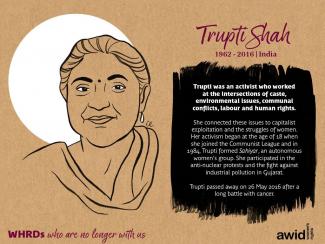
Trupti Shah
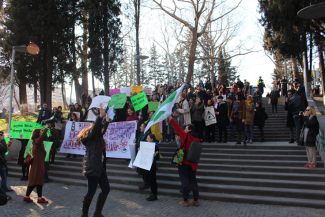
Women human rights defenders (WHRDs) worldwide defend their lands, livelihoods and communities from extractive industries and corporate power. They stand against powerful economic and political interests driving land theft, displacement of communities, loss of livelihoods, and environmental degradation.
Extractivism is an economic and political model of development that commodifies nature and prioritizes profit over human rights and the environment. Rooted in colonial history, it reinforces social and economic inequalities locally and globally. Often, Black, rural and Indigenous women are the most affected by extractivism, and are largely excluded from decision-making. Defying these patriarchal and neo-colonial forces, women rise in defense of rights, lands, people and nature.
WHRDs confronting extractive industries experience a range of risks, threats and violations, including criminalization, stigmatization, violence and intimidation. Their stories reveal a strong aspect of gendered and sexualized violence. Perpetrators include state and local authorities, corporations, police, military, paramilitary and private security forces, and at times their own communities.
AWID and the Women Human Rights Defenders International Coalition (WHRD-IC) are pleased to announce “Women Human Rights Defenders Confronting Extractivism and Corporate Power”; a cross-regional research project documenting the lived experiences of WHRDs from Asia, Africa and Latin America.
"Women Human Rights Defenders confronting extractive industries: an overview of critical risks and Human Rights obligations" is a policy report with a gender perspective. It analyses forms of violations and types of perpetrators, quotes relevant human rights obligations and includes policy recommendations to states, corporations, civil society and donors.
"Weaving resistance through action: Strategies of Women Human Rights Defenders confronting extractive industries" is a practical guide outlining creative and deliberate forms of action, successful tactics and inspiring stories of resistance.
The video “Defending people and planet: Women confronting extractive industries” puts courageous WHRDs from Africa, Asia, and Latin America in the spotlight. They share their struggles for land and life, and speak to the risks and challenges they face in their activism.
Challenging corporate power: Struggles for women’s rights, economic and gender justice is a research paper outlining the impacts of corporate power and offering insights into strategies of resistance.
AWID acknowledges with gratitude the invaluable input of every Woman Human Rights Defender who participated in this project. This project was made possible thanks to your willingness to generously and openly share your experiences and learnings. Your courage, creativity and resilience is an inspiration for us all. Thank you!
Simone has 20 years’ experience working in management support and administration in non-profit organizations, in particular post-graduate medical education and ICT training. She has qualifications in Management Support and Paralegal studies. She is based in South Africa, enjoys traveling and is an amateur Genealogist.

Pour renforcer notre voix et notre pouvoir collectifs en faveur de davantage de financement de meilleure qualité pour l’organisation des mouvements féministes, de défense des droits des femmes, des personnes LBTQI+ et des mouvements alliés dans le monde entier.
Khaoula Ksiksi es una apasionada defensora de la justicia, la equidad y la liberación. Como asesora de género, igualdad, diversidad e inclusión, trabaja en diferentes programas humanitarios y contextos de crisis para que la inclusión sea una realidad, no una mera política. Colabora con diferentes equipos para luchar contra la opresión estructural mediante herramientas audaces y transformadoras basadas en experiencias reales.
Su activismo comenzó al frente del movimiento antirracista de Túnez. Con Mnemty, contribuyó a impulsar la primera ley antidiscriminación del país, lo que forzó un examen de conciencia nacional sobre la injusticia racial. Más tarde fue cofundadora de Voices of Black Tunisian Women (Voces de las Mujeres Negras de Túnez), que tiene por objetivo ampliar el liderazgo de las mujeres negras, construir redes de solidaridad y exigir su visibilidad en una sociedad que a menudo las silencia.
Khaoula es también miembro fundadora de Falgatna, un movimiento queer-feminista radical que lucha por los derechos relativos a la orientación sexual, la identidad y la expresión de género y las características sexuales (SOGIESC, por sus siglas en inglés) y apoya a las comunidades LGBTQI+ mediante acciones directas, la resistencia digital y una militancia enfocada en las personas sobrevivientes.
Anteriormente, lideró proyectos feministas y de justicia climática regionales de la Fundación Rosa Luxemburgo en África del Norte y África occidental.
El corazón de su trabajo abriga una convicción bien arraigada: nadie es libre hasta que todes seamos libres. Su activismo es tanto una lucha como una carta de amor a su gente, a sus comunidades y al mundo que merecemos.
The global survey is a key pillar of the third iteration of our action-oriented research: “Where is the Money for Feminist Organizing?” (in short, Where is the Money or WITM). The results of the survey will be further elaborated and explored through in-depth conversations with activists and funders and cross-referenced with other existing analysis and research on the state of funding for feminists and gender equality globally.
The full “Where is the Money for Feminist Organizing” report will be published in 2026.
 To learn more how AWID has been shining a light on money for and against feminist movements check out the work of our Resourcing Feminist Movements Initiative here.
Trabajamos para alcanzar la justicia de género y los derechos humanos de las mujeres mediante el fortalecimiento de la voz colectiva, el impacto y la influencia de las/os activistas, organizaciones y movimientos por los derechos de las mujeres de todo el mundo.