None On Record

Young Feminist Activism

Organizing creatively, facing an increasing threat

Young feminist activists play a critical role in women’s rights organizations and movements worldwide by bringing up new issues that feminists face today. Their strength, creativity and adaptability are vital to the sustainability of feminist organizing.

At the same time, they face specific impediments to their activism such as limited access to funding and support, lack of capacity-building opportunities, and a significant increase of attacks on young women human rights defenders. This creates a lack of visibility that makes more difficult their inclusion and effective participation within women’s rights movements.

A multigenerational approach

AWID’s young feminist activism program was created to make sure the voices of young women are heard and reflected in feminist discourse. We want to ensure that young feminists have better access to funding, capacity-building opportunities and international processes. In addition to supporting young feminists directly, we are also working with women’s rights activists of all ages on practical models and strategies for effective multigenerational organizing.

Our Actions

We want young feminist activists to play a role in decision-making affecting their rights by:

  • Fostering community and sharing information through the Young Feminist Wire. Recognizing the importance of online media for the work of young feminists, our team launched the Young Feminist Wire in May 2010 to share information, build capacity through online webinars and e-discussions, and encourage community building.

  • Researching and building knowledge on young feminist activism, to increase the visibility and impact of young feminist activism within and across women’s rights movements and other key actors such as donors.

  • Promoting more effective multigenerational organizing, exploring better ways to work together.

  • Supporting young feminists to engage in global development processes such as those within the United Nations

  • Collaboration across all of AWID’s priority areas, including the Forum, to ensure young feminists’ key contributions, perspectives, needs and activism are reflected in debates, policies and programs affecting them.

Related Content

Lina Ben Mhenni

« Je veux dire à tou·te·s les Tunisien·ne·s : Nous devons nous rassembler pour dire “non” à la censure et aux procès d’opinion. » - Lina Ben Mhenni (entretien de 2013)

Lina Ben Mhenni était une blogueuse, activiste et chargée de cours de linguistique tunisienne. Elle s’est exprimée haut et fort contre la censure sur Internet, a défendu la liberté d’expression ainsi que les droits des femmes et les droits humains. Lina s’est également battue pour la libération des étudiant·e·s arrêté·e·s sous l’ancien président Zine el-Abidine Ben Ali. 

« Un cyberactiviste doit aller sur le terrain, sentir ce que vivent les autres. On dit que la Révolution tunisienne est celle du Net, mais si elle n’était que ça, elle n’aurait jamais abouti ! » » Lina Ben Mhenni (article dans Ouest-France)

Elle a co-organisé en 2010 une manifestation en réaction à la suppression des médias et la censure sur Internet imposées par le gouvernement. Lina était très connue pour son blog « A Tunisian Girl » et son travail pendant la révolution tunisienne en 2011 était reconnu. Elle s’est servie de son blog pour transmettre des informations sur la révolte, partager des images documentant les manifestations, et a été parmi les rares voix qui s’élevèrent pour dénoncer les assassinats et la répression des manifestant·e·s à Sidi Bouzid. Lina était une des rares blogueuses à utiliser son vrai nom sur Internet, et non un pseudonyme pour protéger son identité. 

« Notre liberté d’expression est vraiment en danger. Je crains que nous ne soyons en train de perdre les fruits magnifiques de notre révolution : la disparition de la peur et la liberté d’expression. Nous devons continuer de nous battre pour protéger et préserver ce droit. » - Lina Ben Mhenni (entretien de 2013)

Lina n’avait que 36 ans lorsqu’elle est décédée, le 27 janvier 2020, de complications d’une maladie auto-immune. 

« La liberté, une meilleure éducation et la santé - c’est tout ce que nous voulions. Lorsque nous échouions, elle nous incitait à continuer. » Hala, l’institutrice de Lina.

 

Snippet FEA Principles of work Education and Learning (FR)

Une pile de livres dans une couverture rose et un mortier de graduation noir sur le dessus.

ÉDUCATION ET APPRENTISSAGE CONSTANT

Snippet - WCFM With smart filtering - EN

With smart filtering for Who Can Fund Me?  Database, you can search for funders based on:

FRMag - Editors Note

Note éditoriale

Les Réalités féministes consistent en une invitation chaleureuse et bienveillante, une sorte d’acte de préservation et de soins massifs (versus un soin individuel), une invitation à archiver et à faire l’inventaire de tout le travail réalisé, sous peine de le voir disparaître.     (...)

Lire

Love letter to Feminist Movements #1

Dear gorgeous beings,

I know you are so close. You can feel it can't you? How things need to shift and you need to centre yourself. 

Love letter to feminist movements from Your dramatically cloaked jungle nymph.

This is a letter to tell you to do it. Choose your healing. Choose to be OK. Better than OK. Choose to be whole, to be happy. To cry tears for yourself and no one else. Choose to shut out the world and tell them that 'you will be back in 5 mins'. Or five days. Or five years. 

Or never.

Choose to not take it all on. Choose to take none of it on. Because none of it is yours. It was never yours. They told you since you were born that it was yours. Your family's problems. Your lovers' problems. Your neighbours' problems. The globe's problems. The constant whisper that these problems belong to you. They are yours. Yours to hold, yours to shoulder. Yours to fix. 

That was a lie.
A bamboozle 
            A long con.
                          A scam.

The problems of the universe are not yours.

The only problems that are yours are your own. Everyone else can take a hike. 

Allow yourself to drop everything and sprint off into the jungle. Befriend a daisy clad nymph, start a small library in the roots of a tree. Dance naked and howl at the moonlight. Converse with Oshun at the river bed. 

                          Or simply drink a cup of tea when you need to take a moment to breathe.

Give yourself permission to disappear into the mist and reappear three countries over as a mysterious chocolatier with a sketchy past and penchant for dramatic cloaks and cigars. 

                          Or stop answering work calls on weekends.

Let yourself swim to deserted island with a lover and dress only in the coconut shells from coconut rum that you make and sip at sunset. 

Or say no when you don't have the capacity to create space for someone.

The options for holding yourself are endless. 

Whatever you do, know the world will always keep spinning. That's the beauty and the pain of it. No matter who or what you choose over yourself and your soul the world will always keep spinning. 

Therefore, choose you. 

In the morning when that first light hits, choose you. When it’s lunchtime and it’s time to cry on company time, choose you.  In the evening, when you are warming up leftovers because you didn’t have time to cook again, choose you. When anxiety wakes you up and existence is silent at 3:45 am. 

Choose you.

Because the world will always keep twirling on a tilt and you deserve to have someone always trying to make it right side up for you. 

Love,
Your dramatically cloaked jungle nymph.

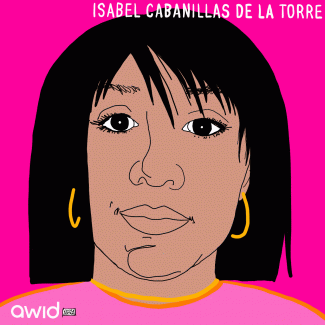
Isabel Cabanillas de la Torre

Isabel Cabanillas de la Torre was a much loved young feminist artist and activist from Ciudad Juárez, Mexico, known for her beautiful and evocative hand-painted clothing with eyes being an emblematic feature in her work. Her murals transformed the run down and vacant buildings in Ciudad Juarez’s downtown, bringing life and political commentary to their walls.

Through her art and political activism Isabel sought to draw attention to the gender based violence pervasive in her hometown. She volunteered with the women’s network Mesa de Mujeres on the Citizen Observatory on Gender to monitor the performance of judges, prosecutors and public defenders on cases of femicides and other gender based violations. She was also a member of Hijas de su Maquilera Madre, a feminist collective whose name makes reference to the daughters of mothers who are maquila workers. Some of these mothers were among the first victims of femicide in the city.

Isabel’s latest project, still in progress, was an art installation to protest a Canadian company that was looking to mine copper in the Samalayuca Desert. 

On 18 January, 2020 Isabel was shot while riding her bike back home in Downtown Juárez, in what appeared to be a targeted killing, her body found beside her bike.

Isabel’s murder, sparked a new wave of outrage against femicides in the region, hundreds marched to the US-Mexico border bridge, blocking it for hours and chanting “Ni una mas” (Not one more) as feminist collectives continue to protest the murders of women throughout Mexico. In 2019 alone, 3142 women and girls were killed in Mexico, many of whom were targeted specifically because of their gender.

She loved riding her bike.

"The bike for her was a symbol of freedom. A symbol of being free in the streets." - Marisol (a friend of Isabel’s)  

Snippet FEA We are living in a world left (EN)

We are living in a world where the destruction of Nature fuels our current global economy.

Snippet WITM survey result - EN

DATA SNAPSHOTS

Where is the money for feminist organizing?

1,174 feminist, women's rights & LGBTQI+ organizations 
from 129 countries participated in AWID's 2024 survey.

The data reveals the state of resourcing for feminist movements between 2021-2023, amid current major defunding trends in aid and philanthropy.

Our collective power knows no boundaries, but our bank accounts do.

FRMag - Roots of Love and Resilience

Kunyit Asam: The Roots of Love and Resilience

by Prinka Saraswati

The menstrual cycle usually lasts between 27 and 30 days. During this time, the period itself would only go on for five to seven days. During the period, fatigue, mood swings, and cramps are the result of inflammation. (...)

Read

< artwork: “Feminist Movement” by Karina Tungari 

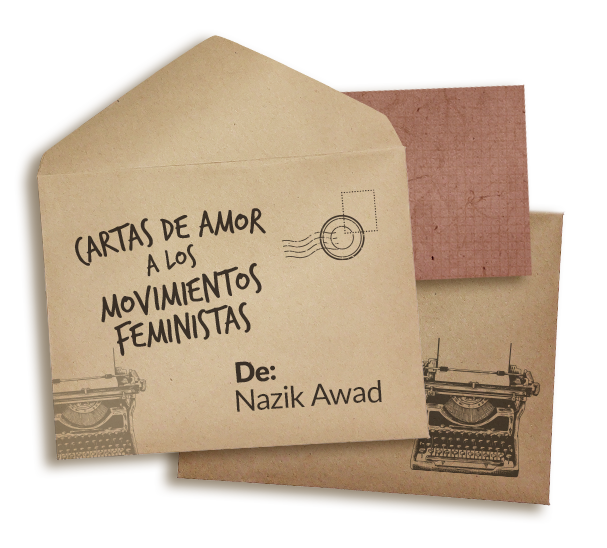
Clone of Clone of Carta de amor a los movimientos feministas #5

Feministas sudanesas: «Una revolución dentro de la revolución»

«Mientras estaba en la primera línea de la protesta, fui sometida a violencia sexual, a lesiones físicas y a otras formas de violencia. Pero no me detendré hasta que logremos pleno gobierno civil en Sudán. Debemos impedir la militarización del Estado. Nuestros cuerpos no deben seguir siendo tratados como campos de batalla»

dijo Amal,1 una manifestante de 23 años.2 

Durante los últimos cuatro años, las mujeres lideraron la revolución en Sudán. Su liderazgono fue solo callejero, sino que constituyó el poder que impulsó la resistencia constante en todos los niveles. Las mujeres y las jóvenes feministas se convirtieron en la conciencia alerta del movimiento de cambio y democratización sudanés. Desde la primera protesta del 13 de diciembre de 2018 contra el régimen anterior, en la ciudad de Aldmazein, en el área de conflicto del Nilo Azul, las jóvenes estudiantes fueron las voces que demandaron el fin de la dictadura de los militares y los Hermanos Musulmanes, que ya lleva treinta años en el poder.

Love letter to feminist movements from Your dramatically cloaked jungle nymph.

El movimiento feminista, liderado por mujeres de entre 16 y 35 años, ha entablado una revolución dentro de la revolución en Sudán durante los últimos cuatro años de lucha ininterrumpida. Las potentes voces de las jóvenes que ocupan espacios en las calles, las redes sociales, la sociedad civil y las organizaciones políticas se elevaron lo suficiente como para reconfigurar la opinión pública y desafiar las normas sociales. Por primera vez en la historia de Sudán, las discusiones sobre violencia sexual y de género y sobre los tabúes de la violencia doméstica y los procesos de toma de decisiones dominados por los hombres se convirtieron en debates generalizados. Los equipos de fútbol de mujeres designaron voceras ante los comités de resistencia, y los sindicatos profesionales liderados por mujeres son parte de la expresión de la nueva ola del movimiento feminista de Sudán. El logro más importante es que las jóvenes se identifican como feministas en forma orgullosa y pública, en un país regido por el fundamentalismo islámico durante tres décadas. Los jóvenes varones que apoyan el activismo feminista -y se identifican como feministas- son otra señal de progreso notable.

Bajo el actual régimen del golpe militar, las jóvenes que lideran estas iniciativas y los grupos de mujeres que trabajan en el territorio no pueden mencionarse aquí debido a varios problemas de seguridad. Pero su resiliencia, su fuerza y su valentía serán incluidas en los libros de historia. Las audaces jóvenes que encabezan la resistencia en las calles y detrás de las pantallas, y que trabajan en diferentes profesiones y áreas de activismo están dando forma al futuro de Sudán. Las jóvenes feministas de Sudán están creando nuevos espacios para que las narrativas y los discursos feministas reestructuren la distribución del poder a nivel político, económico y social.

A pesar de la inmensa violencia, del resurgimiento del islamismo fundamentalista, de la militarización y de la reducción de los espacios cívicos, las activistas feministas de Sudán se mantienen arraigadas en su sororidad. Siguen siendo una gran inspiración para los movimientos feministas de todo el mundo.


Nazik Awad


1 «Amal» es un seudónimo utilizado para proteger a la joven activista citada.
2 Desde 2018, Sudán vive en una revolución constante. Una nueva ola opositora arrancó a partir del golpe militar del 25 de octubre de 2021.

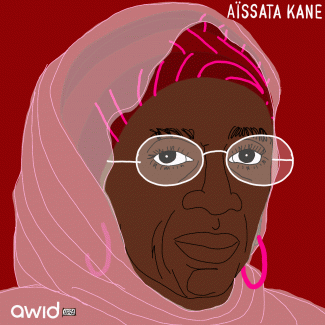
Aïssata Kane

Aïssata Kane, también conocida afectuosamente como «Yaye Kadia»” [«Madre Kadia»], fue una feminista comprometida, durante toda su vida, con la defensa de los derechos de las mujeres africanas y, en especial, mauritanas.

En 1975 fue la primera mujer en ocupar el cargo de Ministra de Protección Familiar y Asuntos Sociales, puesto desde el cual Aïssata trabajó fervientemente para mejorar el estatus de las mujeres de su país.

Este trabajo incluyó el fomento de la educación de niñas y mujeres, la lucha contra la práctica de alimentación forzada de mujeres jóvenes, la incidencia para la inclusión de una legislación sobre derechos maritales, y la promoción de la creación de un cupo de representación femenino en el Parlamento.

«[Aïssata] materializaba todas sus pasiones con humildad, valentía y determinación. No quería molestar a nadie con su lucha en todos estos frentes simultáneos.» - Ball Halimata Dem, sobrina de Aïssata

Fundó la Unión Nacional de Mujeres de Mauritania (UNFM), creando y publicando con otras activistas Marienou, una revista dedicada a la emancipación de las mujeres mauritanas. Aïssata también dirigió varias organizaciones subregionales y locales, por ejemplo, como Presidenta de la Asociación Internacional de Mujeres Francófonas (AIFF) y, como firme ecologista, fue Presidenta de la Asociación para la Protección del Medio Ambiente de Mauritania (APEM).

En 2018, recibió el Premio a la Mujer Pionera, en honor a su trabajo para la promoción del estatus de las mujeres de Mauritania y como reconocimiento de su fuerte liderazgo y su sentido de la innovación.

Aïssata falleció el 10 de agosto de 2019.

Snippet - Podcast Playlist Season 1 (ES)

WITM - Refreshed INFOGRAPHIC 2 EN

How funding falls short for feminist movements

Feminist movements need core and long-term funding - including savings and reserves - to stay focused on systemic change. Reserves aren’t extras; they're essential for sustainability.

Explore the data on the quality of funding

FRMag - Mainstreaming The Invisible

Popularizar las realidades feministas invisibles

por Dr. Pragati Singh

En 2019, fui invitada por la BBC para hablar en la 100 Women Conference en Delhi, India. El tema era «El futuro del amor, las relaciones, y las familias». El público presente en el gran salón consistía mayoritariamente en jóvenes indixs: estudiantes universitarixs, profesionales, activistas, etc. (...)

Leer

arte: «Angels go out at night too» [Los ángeles también salen de noche], Chloé Luu >

The 2023 Feminist Calendar

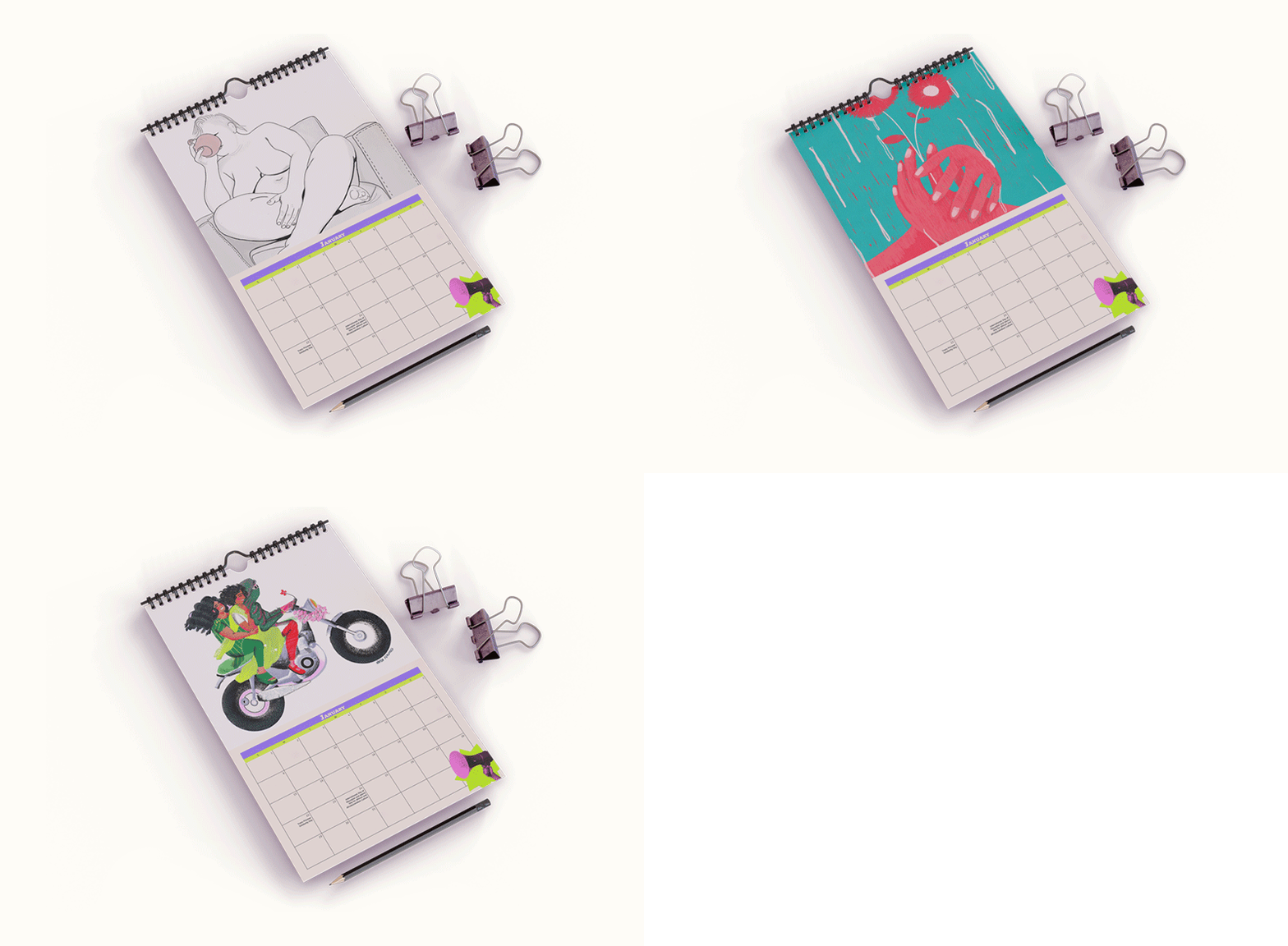
Image of a calendar on a flat surface. The images decorating each month change every second: first there is a naked person sitting enjoying a hot drink in relaxation, then we see two pink hands over a blue background and finally a couple riding a motorcycle. This looks indefinitely.

AWID is a part of an incredible ecosystem of feminist movements working to achieve gender justice and social justice worldwide. With our 40th anniversary, we are celebrating all that we’ve built over these last 40 years. As a global feminist movement support organization we know that working with fierce feminisms is our way forward, acknowledging both the multiplicity of feminisms and the value of fierce and unapologetic drive for justice. The state of the world and of feminist movements calls for brave conversations and action. We look forward to working together with our members, partners and funders in creating the worlds we believe in, celebrating the wins and speaking truth to power in service of feminist movements globally.

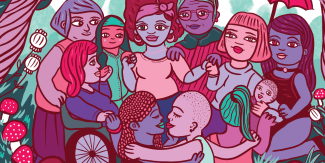
The 2023 Feminist Calendar is our gift to movements. It features the artwork of some of our amazing AWID members.

This is the cover for the 2023 Feminist Calendar. It shows a diverse group of people of all ages embracing and holding hands.

Use it. Print it. Share it. 

Get it in your preferred language!

Select image quality

English Print Quality |  Digital Version
Français Print Quality |  Digital Version
Español Print Quality |  Digital Version
Português Print Quality |  Digital Version
عربي Print Quality |  Digital Version
Русский Print Quality |  Digital Version